/pic5941333.png)








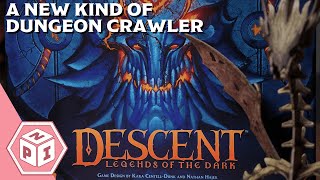




Descent: Legends of the Dark Deep Dive
What the Community Thinks About Descent: Legends of the Dark
Descent: Legends of the Dark represents a bold reimagining of the dungeon-crawl formula. Rather than being a direct sequel to previous Descent games, it establishes its own identity as an app-driven narrative experience that prioritizes storytelling alongside tactical gameplay. The community response has been remarkably positive, with reviewers consistently highlighting the game's exceptional story, innovative app implementation, and impressive component quality as standout strengths. While some express concerns about table space requirements and the learning curve for the crafting system, the overwhelming consensus is that the game delivers a unique experience that stands apart from traditional dungeon crawlers.
Core Mechanics That Define Descent: Legends of the Dark
The Card-Flipping Dual-Sided System
At the heart of Descent's gameplay lies an elegant card-flipping mechanic that gives the game tremendous depth without overwhelming complexity. Every weapon, skill, and character card features two distinct sides that can be flipped during play. This mechanic serves as both a tactical puzzle and a resource management tool. Players spend actions to flip cards, switching between ranged and melee weapons or activating entirely different abilities. The system becomes increasingly sophisticated as the campaign progresses. Additional skill cards don't just provide new abilities; they create additional spaces to place fatigue tokens, allowing players to spread exhaustion across multiple cards rather than concentrating it on a single card. This creates an elegant feedback loop where player progression directly expands tactical options and strategic depth.
Fatigue and Exhaustion as Core Resource Management
Rather than traditional health attrition, Descent employs fatigue as its primary resource management system. Characters spend fatigue to activate powerful abilities, convert dice results into successes, and power special actions. The tension comes from balancing immediate tactical needs against long-term stamina constraints. When a card reaches maximum fatigue capacity, that ability becomes unavailable until the character takes an action to flip and reset the card. This creates compelling turn-by-turn decisions about whether to burn a flipped card for fresh capacity or preserve current abilities. The elegance lies in how fatigue creates distinct gameplay phases within each campaign. Early scenarios force careful resource conservation, while later chapters with more skill cards and tactical options allow for more aggressive ability chaining and combo execution.
The Descent: Legends of the Dark Experience
A Story-Driven Campaign That Respects Player Agency
The 16-quest campaign stands as a narrative achievement in the board game space. Rather than serving as a mere wrapper around combat scenarios, the story meaningfully integrates with gameplay through character-specific choice points. Each hero possesses distinct personality traits and virtues that evolve based on decisions made throughout the campaign. These choices aren't merely cosmetic; they ripple through the narrative and can alter the tone of later scenarios. The writing deftly balances complex moral decisions with character development, creating genuine investment in party members. The game's world-building extends beyond main quest beats through random encounters, side events, and NPC interactions that initially seem inconsequential but ultimately contribute to a cohesive sense of the Terrinoth realm. This approach respects player intelligence by trusting that small details accumulate into meaningful atmosphere rather than spelling out every emotional beat.
The 3D Terrain as Narrative Architecture
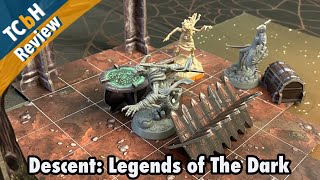
Descent's 46 pieces of punch-board 3D terrain transform from visual novelty into core narrative and tactical element. The terrain system permits scenario variety that feels almost impossible within a standard dungeon-crawl framework. Rather than rotating between generic cave rooms, each scenario presents distinct environments from town squares to laboratories to taverns. The terrain pieces directly communicate interactive possibilities through physical affordances. A bookcase isn't just flavor; it invites searching. An elevated platform suggests tactical positioning. The app guides players through terrain assembly in a way that builds narrative tension, gradually revealing what lies beyond each door. The beauty of the system is that the vertical dimension and environmental underlays aren't mere chrome; they fundamentally alter combat tactics and create scenario-specific puzzle solutions that demand careful planning and resource allocation.
What Makes Descent: Legends of the Dark Stand Out
The Integrated App as Narrative Facilitator
The companion app transcends typical app-driven game support by becoming essential to storytelling rather than merely handling bookkeeping. The app manages quest progression, character development, crafting recipes, and enemy behaviors while maintaining a curated quest log that allows players to reference prior story details without constant manual note-taking. The line-of-sight tool eliminates tedious ruler arguments by providing instant clarity. The app can adjust difficulty mid-campaign, allowing groups to tailor challenge levels to their comfort without restarting. Most importantly, the way the app reveals terrain tiles and story beats creates a dramatic pacing that would be impossible to replicate with printed components. Character abilities unlock through completed achievements, incentivizing specific tactical approaches across multiple scenarios. The app proves that digital integration can enhance rather than diminish tabletop play when designed with purpose rather than convenience.
Character Progression Through Intentional Constraint
Rather than allowing players to cherry-pick favorite heroes, the campaign's quest structure ensures every character gets mandatory spotlight moments. This enforces party composition diversity and prevents dominant strategies from ossifying across the campaign. The feat system creates personal achievement loops within the broader narrative; each hero pursues their own goals alongside party objectives. Weapon crafting with modular upgrades delivers the satisfying incremental power progression that drives modern RPG engagement. The brilliance is that all this complexity remains invisible to casual players while providing deep optimization opportunities for those inclined to tinker. A player content with straightforward builds faces no punishment; simultaneously, a player tracking optimal proc chains for each character finds rewarding complexity. This elegance of scaling sophistication means the game works equally well for narrative-focused groups and mechanics-focused optimizers.
Potential Drawbacks
Significant Table Space Requirements
The 3D terrain's tactical excellence comes at a severe logistical cost. Mid-to-late campaign scenarios sprawl across table space that defies accommodation on standard kitchen tables or even modest gaming tables. A few scenarios produced terrain configurations so expansive that they physically couldn't fit on large game toppers without removing sections. While the app maintains complete terrain state, meaning players can temporarily disassemble sections to make room, the constant setup and teardown becomes tedious. Players in smaller playing spaces must accept either reduced immersion from constant terrain management or accept significant additional setup time. This remains the single biggest environmental barrier to accessibility, particularly for players without dedicated gaming spaces.
Steep Initial Learning Curve for Crafting Systems
While the crafting interface proves elegant once understood, the initial tutorial inadequately prepares players for the depth of weapon modification and recipe management. The app interface for selecting upgrade slots and managing multiple weapon variants isn't immediately intuitive. Players spend approximately 25% of their first campaign confused about how recipes work, what they can carry forward between scenarios, or how inventory sharing functions between party members. The rules compendium exists entirely within the app and lacks printed reference materials, forcing players to navigate digital menus mid-game to verify edge cases. This creates friction during multiplayer sessions where tabletop immersion breaks as one player scrolls through menus searching for forgotten rules. A printed quick reference or more explicit early-campaign tutorial would resolve most confusion without changing the core system's elegance.
If You Enjoy Descent: Legends of the Dark
Players invested in Descent will find the most comparable experiences in story-driven dungeon crawlers like Mansions of Madness Second Edition or Journeys in Middle-earth, both of which employ app-integration for narrative pacing. The tactical combat system echoes Gloomhaven, though Descent emphasizes storytelling over mechanical depth. For those prioritizing pure mechanical engagement, Altar Quest offers superior character asymmetry despite lacking narrative scope. The terrain-driven scenarios with environmental puzzle elements share DNA with older games like Heroquest and Shadows of Brimstone, though with superior production values and deeper mechanical systems. Those seeking endless progression and procedurally-varied content may feel constrained by the linear 16-quest structure, making roguelike dungeon crawlers like Warhammer Quest the more natural fit. Ultimately, Descent represents its own category: a narrative adventure game that happens to include dungeon-crawling mechanics rather than a dungeon crawler that includes story elements.
What Reviewers Are Saying
"This is the absolute best story game I've ever played in terms of a tabletop board game experience without question."
— Drive Thru Games
"The fatigue system forces you to make constant interesting decisions about managing resources and character positioning rather than autopiloting through combat."
— No Pun Included
"I was more surprised than anyone that I did care about the characters and the narrative because I generally don't have time for young adult fiction, but this game absolutely won me over."
— The Broken Meeple