



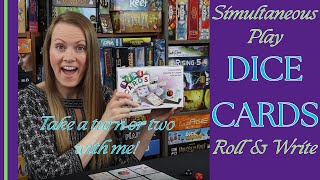
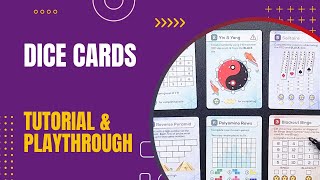

Dice Cards Deep Dive
What the Community Thinks About Dice Cards
Dice Cards lands as a delightfully surprising package. Reviewers express genuine enthusiasm for what appears at first glance to be a simple roll-and-write game but reveals itself as a gateway to fifty distinct mini-games in a single box. The consensus centers on accessibility paired with unexpected strategic depth. DaniCha and Tabletop Tolson both highlight the game's ability to serve players of any experience level while offering meaningful decisions that matter throughout the fifty-round progression. The game's modular approach (letting players choose which six cards to focus on from a larger pool) means that no two plays feel identical, yet the fundamental loop remains so clear that newcomers grasp it immediately. Reviewers appreciate that games complete in 20 to 30 minutes regardless of player count, keeping the experience snappy without sacrificing the sense of discovery that makes each turn count.
Core Mechanics That Define Dice Cards
Dice Rolling
At the heart of Dice Cards sits a shared dice roll that drives every decision. Each round, a pair of six-sided dice lands on the table and all players face the same numbers simultaneously. The elegance lies in the choice: a player can use the red die value, the black die value, or combine them for a third option. This straightforward resolution system injects immediate tension into what might otherwise feel like a passive activity. Because the dice are shared and public, luck levels the playing field between seasoned players and novices. Tabletop Tolson explains how reviewers appreciate that the game "values high and low" across its card designs, meaning that even an unlucky roll has utility somewhere on a player's selected cards. The mechanic transforms random chance into a strategic puzzle: which card needs this number more, and can you afford to use it here instead of saving it for a different goal?
Flip/Roll and Write
Dice Cards executes the roll-and-write framework with a focus on simultaneous, independent play. Every player records their choice on personal dry erase cards using markers provided in the box. This means fifty rounds flow rapidly without downtime: while one person rolls, all seven others are writing and making micro-decisions about where their number fits. Tabletop Tolson notes how the game's card design includes visual examples on the reverse side of each card, so players can immediately understand the rules without consulting a rulebook during play. The dry erase component also means zero setup between rounds and easy reset for the next game. No erasing between plays, shuffling the hundred cards, and pulling out the dice again is all that stands between finishing one session and starting fresh.
The Dice Cards Experience
Rapid, Frictionless Decision-Making
Reviewers highlight the pacing as one of Dice Cards' greatest strengths. Tabletop Tolson compares the sensation to Super Mega Lucky Box and Rolling Realms, games that build excitement through constant small choices and immediate feedback. Here, the ten to fifteen seconds each player spends deciding where their die roll belongs creates a rhythm that pulls everyone forward. There is no planning paralysis, no waiting for opponents to resolve complicated turn sequences. Instead, a lightness pervades the table as players rapidly communicate their selections and pass dice to the next roller. This speed paradoxically serves strategic play: the constraints are clear, the time pressure is gentle, and mistakes are learning opportunities rather than game-ending setbacks. Solo players experience a similar cadence when working through their fifty rounds alone.
Strategic Puzzle-Solving Under Scarcity
Underlying the brisk turns lies a deeper strategic layer rooted in resource scarcity. Players have fifty turns to complete six cards, which means every selection carries weight. DaniCha points out that "you likely won't complete all six cards by the end of the game," forcing players to choose which cards receive their attention. Some cards demand specific sequences, like Yin and Yang, which requires exactly twelve particular rolls spread across both dice colors. Others, like a simple Golf variant, need lower values to score well. Reviewers appreciate that this forces meaningful tradeoffs between pursuing a few high-scoring completions versus spreading efforts to rack up partial points across multiple cards. Tickets earned by meeting certain card conditions act as a catch-up mechanism, allowing players to adjust a die value up or down by one, which can be the difference between completing a goal or narrowly missing it.
What Makes Dice Cards Stand Out
Fifty Distinct Mini-Games in a Reusable Package
The sheer variety embedded in Dice Cards astonishes reviewers. Classic games appear alongside originals: Golf, Sudoku, Bingo, Polyomino (Tetris-like tile placement), Solitaire, and Reverse Pyramid share a box with Word Crafting, Chicken Catching, Recipe matching, and dozens more. Tabletop Tolson highlights how each card teaches through visual example, removing guesswork from rules parsing. The dual-set of 100 cards (fifty unique games repeated once) allows scalable play from one to eight or more players without altering table feel or game length. Players draft six cards to focus on before the game begins, which means players can tailor their experience and ensure no two games feel the same. Reviewers note that even within a single card concept, the visual language and thematic flavor differ enough to sustain interest across a full fifty-round play.
Crystal-Clear Rules and Accessible Design
Dice Cards succeeds at what many teach-heavy games struggle with: teaching quickly without condescension. Tabletop Tolson praises the card design itself, where each card includes worked examples and step-by-step instructions that answer rules questions before they arise. New players can learn in minutes. The dry erase component removes setup barriers and fumbling with components. Reviewers note that card quality stands out, with erase surfaces that wipe clean instantly and shuffle smoothly, meaning the game holds up to repeated play without wear. This polish extends to pen durability, with eight markers included so no player wrestles over a single pen or runs out mid-game. The result is a game that feels premium without requiring a premium price, and that plays with the ease of a party game despite offering strategic decisions comparable to much heavier titles.
Potential Drawbacks
No Integrated Scoring System
DaniCha surfaces a notable absence: Dice Cards includes no built-in score tracker on the box or cards. Players must keep tallies on separate paper or use a free app or spreadsheet. While this is a minor friction point (literally writing numbers on a sheet), it breaks immersion slightly and leaves open the possibility of arithmetic errors. Reviewers note this doesn't fundamentally harm the experience, but it does mean that Dice Cards requires a little more table administration than fully self-contained games. Solo players especially may find the manual bookkeeping less elegant than hoped.
Some Cards Present Extreme Difficulty Curves
DaniCha notes that certain card configurations, like those requiring long consecutive rolls of specific types, or a large number of very high or very low values, can be nearly impossible to complete within fifty total rolls. A Golf variant demanding all nine scores under par across nine consecutive turns is a tall ask; Yin and Yang's requirement for all twelve specific red and black combinations pushes players to dedicate a quarter of their rolls to a single card. This isn't a flaw per se, as it creates interesting tension and strategic prioritization. But for players who chase completionism, a few cards may feel less like puzzles to solve and more like brick walls to bash against, potentially creating frustration rather than delight.
If You Enjoy Dice Cards
Players captivated by Dice Cards share common tastes with fans of Super Mega Lucky Box, a game that fuses quick simultaneous actions with mini-game variety. Rolling Realms operates on a similar principle: take a beloved board game anthology and compress each entry into a lightweight, fast-playing form.
Those seeking deeper polyomino puzzles may find satisfaction in Calico or Cascadia, which dive more thoroughly into tile placement than Dice Cards' Polyomino card allows. Similarly, fans of pure roll-and-write games like Quill or Wavelength will appreciate Dice Cards' combination of writing-based resolution and simultaneous play.
For players who love the selection mechanic (choosing which six cards to use), titles like 7 Wonders or Sushi Go offer similar drafting tension. And if the party-game accessibility and speed appeal most, Wavelength, Codenames, and Just One share Dice Cards' gift for bringing a table together around simple rules and rapid turns.
What Reviewers Are Saying
"Knowing that you have to realize that 12 of your turns out of the 50 has to be on Yin and Yang if you plan on completing it by the end of the game. You likely won't complete all six cards by the end of the game."
— DaniCha
"It really reminds me of the Super Mega Lucky Box style where you are having fast turns, making selections based on the information that everybody has to respond to by writing down onto your individual dry erase board. But moreover, it reminds me of Rolling Realms."
— Tabletop Tolson
"Absolutely blew me away, surprised me with how much I liked it based on my anticipation of what the game was going to offer players. I think the quality is great, these cards erase so easily and they shuffle really well."
— Tabletop Tolson