


DICEcapades Deep Dive
What the Community Thinks About DICEcapades
The most detailed reviews of DICEcapades come from Ian and Stacy on Where There's A Wilz, There's a Play, who keep the game in regular rotation as a party title rather than a strategy game. They describe it as one of their staple New Year's Eve games, and they say they have been playing it less recently as their collection has grown. Their view is that the silliness is the point, and that the game succeeds when the group is willing to be goofy.
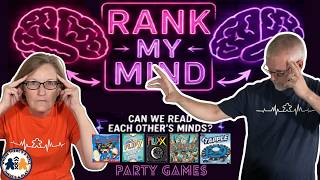
Opinion across the episodes that discuss it is positive, and the disagreements are small. In a party-game ranking video titled Rank My Mind, DICEcapades landed second on one of the lists, a result that surprised Ian. Stacy said the only reason it was not first is that the trivia cards need refreshing. The reviewers also note that the box advertises two to six players, and they play it as a two-player game. Their one shared practical complaint, raised in the episode covering games that start with the letter B on Where There's A Wilz, There's a Play, is that setup is tedious without organization.
Core Mechanics That Define DICEcapades
Trivia Gates on Movement
Movement in DICEcapades is controlled by questions as much as by dice. Players race around a board that passes through themed areas, and in the trivia area the other players ask questions tied to that section. A correct answer lets the player move on, while a wrong answer keeps them in place until they get one right. The reviewers say that this is where they usually both get stopped, which shows how much progress depends on recall. Because the questions come from the other players, each person is put on the spot in front of the group, and that pressure is a large part of how the mechanic plays.
Physical Challenges in Action Town
The second mechanic is the set of physical tasks in Action Town, where a player escapes the area by completing a challenge instead of answering a question. The reviewers list running from room to room within a time limit, doing push-ups, and stacking tiny dice before time runs out. Another challenge asks players to roll three dice showing the same number as fast as they can. The reviewers say they enjoy the room-to-room running challenge in particular, which suggests the hosts value the physical comedy as much as the quizzes.
The DICEcapades Experience
Silly, Loud Group Fun
The feel of DICEcapades is loud and goofy. Ian and Stacy call it a really fun family-friendly game, and they describe the Action Town tasks as the silliest things a player can do to get out of a space. Because the rounds involve running, stacking, and acting out ideas, the game works best when everyone is willing to look a little ridiculous. The hosts also suggest playing it earlier in the day rather than late at night, since the physical actions go better when everyone is still alert and thinking clearly.
Friendly Pressure to Guess Right
Drawing challenges introduce a different kind of tension. One host says drawing is the part they always struggle with, and the hosts say that when they play any game with drawing, they are very honest with each other about whether a drawing matches the guess. In the two-player version they play, they rely on that honesty instead of a strict scoring rule, so the tension comes from trust between players. The result feels closer to an improvised party game than a competitive race, and the awkward guesses are part of the appeal.
What Makes DICEcapades Stand Out
A Dice Collection Unlike Most Party Games
Reviewers return again and again to the dice. Ian and Stacy describe dice with numbers, letters, pictures, and other unusual symbols, along with small dice that must be stacked, a die placed inside another die, and math dice that call for a particular sum. The reviewers react to the sheer volume of dice in the box, and they agree that nearly every die has a different job. That variety gives the game much of its character, because each roll asks for a different kind of response.
Two Editions in One Box
The hosts own both the first and second editions and recently combined them into one box. The reviewers credit Amigo with the 2007 original. The second edition has no board and uses cards instead: players roll a die to choose a deck, and the first player to collect five cards of one type wins. Because either edition can be played in either style, the box gives players a board-based game and a faster card-based game. The reviewers also say the second edition has been hard to find, and they could not locate it on BoardGameGeek.
Potential Drawbacks
Setup Takes Organization
The most consistent practical complaint is setup. Ian and Stacy say the game is a pain to set up if the dice are not organized, and that the logical approach is to separate the dice by type before play. Because the box holds many dice of different shapes and kinds, the first setup can take real time. Combining the two editions into one box has made storage easier, but the sorting step remains.
Trivia and Drawing Wear Thin
The other concern is that the trivia and drawing elements can start to feel familiar. The hosts say the game needs newer trivia cards, and that is the main reason DICEcapades did not take the top spot on Stacy's list. The drawing challenge is also uneven, since the group has to rely on honesty when a drawing is hard to read. The board structure is a mixed feature as well: the hosts say they like that players pass through everything twice at times, but they also find that it slows the game down.
If You Enjoy DICEcapades
Players who enjoy the quick-thinking pressure of the trivia gates will find a similar feeling in Tapple, which Ian and Stacy describe as a thinky word game that they usually play late at night in short sessions. Players who enjoy the group energy of the physical challenges should look at 5-Sec Rule, which the hosts describe as a fast, clean party game with a loud timer that makes every category harder than it looks. For a playful party night with a different kind of pressure, Junk Art and Flip Seven both appeared beside DICEcapades in the hosts' party-game ranking, and the hosts praise Junk Art for its theme and colorful pieces.
What Reviewers Are Saying
"In Action Town, now this is one of the reasons why I love this game. In action town, you can do the silliest things to try and get out of there."
— Ian and Stacy, Where There's A Wilz, There's a Play
"There are so many dice in this game that do so many different things. Some with numbers, some with letters, some with pictures, some um with uh uh other weird little things on them."
— Ian and Stacy, Where There's A Wilz, There's a Play
"So, I do love me some dice capades. Um, my sister even played that with us and had fun."
— Ian and Stacy, Where There's A Wilz, There's a Play