





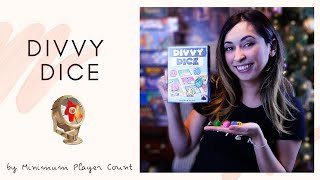
Divvy Dice Deep Dive
What the Community Thinks About Divvy Dice
Divvy Dice, published by Stronghold Games and first released as Man muss auch gönnen können, is most often discussed alongside the Clever series of roll-and-write games, namely That's Pretty Clever, Twice as Clever, and Clever Cubed. Reviewers agree on the core appeal: every player builds a personal scoring grid, and the dice one player rolls can end up in another player's hands. They part ways on whether the design earns a permanent place on the shelf. The walkthrough by Board Game Spotlight explains the rules through a two-player variant without offering a verdict. Dylan of All You Can Board removed their copy, arguing that it consistently loses out to the Clever games they prefer. Tyler and Ilya came away enthusiastic about its replayability, and John Gets Games in a live question and answer session calls it excellent while naming That's Pretty Clever as a slight personal favorite.
Core Mechanics That Define Divvy Dice
Dice Rolling With Shared Re-Rolls
The dice engine is the heart of the game. According to Board Game Spotlight, the active player rolls five dice and may roll up to three times on a turn. After a roll, the active player can set some dice aside to use on a later turn and re-roll the rest. Those re-rolled dice then become available to the other players, who may each take one and save it on their own sheet. This is what makes the game unusual among dice games: the active player's re-rolls generate resources for everyone else. John Gets Games compares the rhythm to Yahtzee, arguing that Divvy Dice handles the roll-save-roll structure better because every re-roll gives the rest of the table something to copy.
Card Drafting and the Personal 3x3 Grid
The second core system is the drafting and placement of cards. Each player receives four cards, keeps three, and arranges them into a 3x3 grid, with every card attached to a neighbor by an edge or a corner. Board Game Spotlight explains that the market board offers victory point cards and bonus cards, which are bought with sets of matching dice: the leftmost spots require four of a kind, while the others require three of a kind. Dylan notes that each card scores differently and that some scoring depends on which cards sit next to one another, creating a tableau-building puzzle inside a dice game. Bonus cards add further options by letting a player adjust a die by one, change a die's color, or buy from the market with one fewer die.
The Divvy Dice Experience
Tension Over Every Roll
Reviewers describe a steady pressure that builds with each roll. Because the active player's decision to keep rolling feeds the opponents, the table is locked in a quiet tug of war. Tyler and Ilya highlight that inactive players are never idle, since they can take dice and act while someone else is rolling. John Gets Games frames the same rule as a deliberate restraint: the incentive is to stop once the result is good enough, because continuing hands the other players more options. The result is a game where each decision carries a small cost, which keeps the table engaged even when it is not their turn.
The Satisfaction of Completing a Plan
Reviewers also describe a quieter satisfaction in building toward a combination. Board Game Spotlight calls the bonus cards essential, since they provide extra actions and help complete the harder cards. Dylan describes the pleasure of arranging cards so that their adjacencies pay off, while noting that the dice and luck element forces players to manipulate their rolls to fit the cards that will score the most. The experience is less about a single big turn and more about steadily fitting each roll into a plan that is still taking shape on the grid.
What Makes Divvy Dice Stand Out
Every Player Stays Involved
The most frequently praised feature is that the game keeps everyone engaged. Tyler and Ilya single out the fact that players can take meaningful actions during other people's turns, a design choice they find more interesting than the usual roll-and-write approach. Because opponents can use dice the active player has rerolled, the outcome of each turn affects the whole table rather than only the player rolling. Reviewers who value interaction in an otherwise solitary genre tend to see this as the feature that sets the game apart from its Clever relatives.
A Personal Grid That Rarely Plays the Same Way Twice
Replayability is the other standout. Tyler and Ilya argue that the game is both customizable and replayable, saying that no game will ever look alike. Board Game Spotlight makes a related point about strategy, advising players to spread their investments across victory point cards and bonus cards rather than committing to a single path. Reviewers who enjoy market-driven games find that the blend of drafting and dice keeps each session distinct, since every player's grid develops along a different line.
Potential Drawbacks
Stiff Competition From the Clever Series
The most persistent criticism comes from players who already own the Clever games. Dylan of All You Can Board found the game fun each time they played it, but they consistently left the table wishing they had played That's Pretty Clever or Twice as Clever instead. Dylan felt that those titles do the same kinds of things better, and that Divvy Dice always seems to miss the boat when it is compared against them. Dylan's criticism is less about the rules than about the crowded field of similar games, and Dylan suggests the game may suit players who want a different feel from a traditional roll-and-write.
The Market Cannot Be Cleared
Tyler and Ilya raise a concrete complaint about the market mechanic. Tyler states that they do not like how the market cannot be cleared, meaning the cards on offer remain in place once they are passed over. Ilya agreed that the point was fair, though Tyler still described the rest of the game as fun. Players who prize tight, flexible market rules may find this constraint frustrating, particularly in games where the market is the main source of the cards needed to complete a grid.
If You Enjoy Divvy Dice
Players who enjoy Divvy Dice's dice-driven puzzle will find the most natural companions within the Clever series. Dylan of All You Can Board recommends That's Pretty Clever and Twice as Clever as more satisfying alternatives, and Tyler and Ilya highlight the abundance of combinations in Twice as Clever and Clever Cubed. Players who enjoy the shared re-roll tension of Divvy Dice will feel at home with Yahtzee, which John Gets Games uses as the reference point for the mechanic. Tyler and Ilya also covered Railroad Ink in the same first impressions video, describing its roll-and-draw play as a good match for players who enjoy rolling and writing with dice.
What Reviewers Are Saying
"Every time I've sat down to play Divvy Dice, I've left the session going, yeah, it was fun, but I kind of just wish I would have played That's Pretty Clever or Twice as Clever or something like that."
— Dylan, All You Can Board
"The trick is every time you reroll, all of your opponents can use one of the dice that you just rerolled. So that means if you roll once and you stop, then your opponents get nothing. ... I think that's a really cool twist on the Yahtzee mechanic because it's a big incentive to not roll more."
— John Gets Games
"I really like it because it's kind of like a market type game. But also it's so customizable and so replayable because no game will ever look alike."
— Tyler and Ilya