


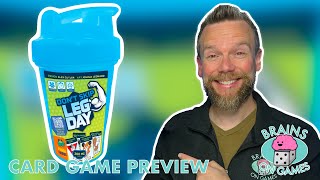

Don't Skip Leg Day Deep Dive
What the Community Thinks About Don't Skip Leg Day
Pandasaurus Games' Don't Skip Leg Day is a light card game that reviewers judge mostly by how much fun it is at the table. Brody, the host of Let's Table It, describes it as a set collection game with a funny theme, and says the players laugh while reading the rulebook. Dr. Brian McDonald of Brains On Games frames it as a game about bodybuilding in which you never actually exercise, and reports that it played so quickly that the group often asked to go again.
Both reviewers come away impressed by the same thing: the game is easy to teach and quick to finish. Brian puts a game at about fifteen minutes and says the rules take minutes to learn. Brody reports that the kids in the household have wanted to play it again and again since the first session. Neither reviewer treats the game as a deep strategy experience. Instead, they treat it as a dependable filler or party game that works well with a mixed group, with a few reservations about the physical components and the depth of scoring.
Core Mechanics That Define Don't Skip Leg Day
Pick-and-Pass Card Drafting
Every player begins with a hand of nine cards, chooses one to play, and passes the rest to the next player. Brian describes the goal as building a workout tableau in front of you that produces the sets you need for points. The first card of each week is played face up, and the next is played face down, so other players can see some of your choices but not all of them. Brian notes that the pass continues until seven cards are down in each of two weeks, and that unlike some other pick-and-pass games, you are not forced to play the last card handed to you because you still have some options at the end. Brody points out that the hands keep circulating, which means a careful player can plan which cards will return.
Elimination by Leg Day Count
Leg Day cards are worth zero points, and playing one face up costs a point. Before anyone scores, the player with the fewest Leg Day cards is eliminated and does not count their points at all. Brody calls this a push-your-luck mechanism: you want some Leg Day cards to stay safe from elimination, but you do not want so many that your other cards stop scoring. Brian describes the same tension as a balancing act, since having too few Leg Day cards means no points at the end, and playing them face up can draw other players to take them. Both reviewers agree that the elimination rule gives the game its sting, because a player who ignores leg day is out before scoring begins.
The Don't Skip Leg Day Experience
A Gym Theme That Keeps the Table Laughing
The theme carries most of the charm. Brian notes that the rulebook uses the word "bro" again and again, as if written for gym rats, and that the artwork has a vintage workout-plan look reminiscent of old fitness magazines. Brody says the game has a funny theme that gets players laughing, and adds that the art and icons were easy to read and appealing. Both reviewers seem to enjoy the joke that the game is about exercise even though nobody actually lifts anything.
Low Brain Burn and Easy Table Talk
Brian describes the game as having little brain work involved. Players do not stare at the cards for long before choosing, and the game is easy enough that people can talk while they play. Brian says it works especially well at the top of its range, with six players close to a party game. Brody similarly notes that the game plays fast enough that players ask for another round, which suits a casual evening with a loose group of people.
What Makes Don't Skip Leg Day Stand Out
A Shaker Cup Packaging
The game comes packed in a plastic protein shaker cup, and both reviewers spend time on it. Brody says the publisher did a good job with the marketing and that the kids liked seeing the game arrive in a cup. Brian calls the cup a fine travel case because the cards fit inside, the plastic holds up, and the whole set can be tossed into a car. The packaging is a central part of the identity of the game, and reviewers see it as a clever way to make a small, portable product feel thematic.
Hidden Information Through Face-Down Play
The face-down rule is what keeps the game from feeling purely mechanical. Brian explains that hidden cards create a memory element, especially with fewer players, because a hand that passes by you will return and you can remember how many Leg Day cards it held. Brody adds that with more players, the hands are less predictable, so the memory element is more about reading the table than about tracking a single hand. Brian also highlights the selfie card as the most powerful card in the game, because it adds points for each different symbol in your tableau, which can turn an otherwise worthless card into a scoring card.
Potential Drawbacks
Thin Cards in a Rough Environment
Brody is candid that the cards feel a little thinner than usual. Because the set is designed to be shaken around in the cup, Brody expects the cards to take some punishment over time. Brody still calls the game ultimately fun, so this is a durability concern rather than a dealbreaker, but it is worth knowing before the game is taken on the road.
Limited Scoring Paths and a Dominant Selfie Card
Brian sees a trade-off between how quickly the game is learned and how many different ways there are to score. The game is not a point salad, meaning that players need to focus on a few specific card combinations to collect enough sets to make the effort worthwhile. Brian also notes that the protein shake scoring rarely decided a game, while the selfie cards were the cards players most wanted. For players who enjoy many routes to a big score, this narrower design may feel thin after a few sessions.
If You Enjoy Don't Skip Leg Day
- Families and mixed-age groups should find it appealing. Brody's kids asked to play repeatedly, and Brian says kids age eight and up can figure out the rules.
- Groups of five or six players will get the most out of it. Brody notes that more players mean less certainty about each hand, and Brian describes the six-player table as almost a party game.
- Gym-themed players and anyone who likes a silly evening game will likely enjoy the humor and the bodybuilding jokes.
- Players who want a quick, low-pressure game with plenty of table conversation are the best match. Players looking for a deep engine-building experience with many scoring routes may find the game too light.
What Reviewers Are Saying
"It's a set collection type game that punishes the player who keeps on skipping leg day."
— Let's Table It
"It's a fun game to kind of play with the group, you can sort of talk at the same time as you're playing it."
— Brains On Games
"The kids have really enjoyed it. They've wanted to play it over and over again since we first played it, so that's always good."
— Let's Table It