



Doom Pilgrim Deep Dive
What the Community Thinks About Doom Pilgrim
Reviewers describe Doom Pilgrim, the solo card game designed by Waclaw Tryer and published by War Claw Games, as a dark and strange experience built around atmosphere and discovery rather than strategy. Daniel of Daniel, The Dungeon Dive returns to it often, praising the world, the art, and the writing, and calls the base game almost an idle game. Colin of Colin, Meet Me At The Table frames it as a narrative adventure with hardly any mechanics to speak of, and was drawn in by the unknown finds each card might produce.
The strongest agreement concerns the art and writing, which both channels treat as the main reason to play. Reviewers also agree that the game is a short, grim journey in which the player witnesses a doomed character's last days more than they steer a hero to victory. They part ways on how much the design asks of the player. Daniel frames the doom as the point of the design, while Colin describes the game as very random and says players need to be comfortable simply exploring and seeing what the deck delivers. Daniel also notes that English is not the designer's first language, so the translation is occasionally rough, though the roughness, in Daniel's view, suits the otherworldly tone.
Core Mechanics That Define Doom Pilgrim
Resource Management
Daniel explains that the main mechanism of the base game from War Claw Games is a form of resource management, in which the player tracks a growing set of dooms, diseases, poisons, and curses while trying to survive until the deck is exhausted. Keywords on the character sheet act as the currency of that system. Cards check for those keywords, so a trait gained early can unlock harmful effects or, occasionally, a way to postpone doom. Colin's run shows the tension clearly: Colin accepted an extra wound to earn gold, and then discovered that a useful armor deal cost more than the three gold on hand. Daniel's later video takes a different view, calling Doom Pilgrim a stat-tracking game that is not really resource management, which shows how the label depends on how a player reads the afflictions and keywords.
The Reject, Postpone, and Take Card Loop
The second mechanic is the drafting loop that structures every turn. The player draws three cards and looks at the art before deciding which one to resolve. Colin describes rejecting one card outright, placing another at the bottom of the deck, and flipping the third to resolve. Daniel adds that the art is the only guide before the story is revealed, so players must interpret it literally, figuratively, or metaphorically. Because postponed cards return to the deck later, each choice shapes the order of the dangers and rewards the pilgrim will meet. Daniel notes that once the right keywords appear on the character sheet, many outcomes trigger automatically, which is why Daniel links the game to idle clicker titles.
The Doom Pilgrim Experience
Dark Fantasy Dread
Both channels describe a bleak, unsettling tone that feels deliberate. Daniel calls the setting a twisted dark fantasy, fairy tale world, and says that opening the box feels like entering something weird and wild. Colin's playthrough moved from a freezing mountain cave to a vampire tower, a tollgate fight with thugs, a werewolf, and a dream castle. Colin admits to rejecting one of the darkest cards without wanting to see it. The dread comes less from any single shocking event than from the steady accumulation of wounds, diseases, and dismay that the pilgrim carries forward.
Art-Led Interpretation
The second feeling is a curiosity driven by the illustrations. Colin says the favorite part is looking at the art and trying to decide which card to encounter. Daniel describes Waclaw Tryer's paintings as evocative enough to make Daniel want to dive into the world, and compares the style to Francis Bacon in some respects. Choosing a card becomes a visual reading exercise, and the story on the reverse is revealed only after the decision. That gives the experience a hopeful undertone even when outcomes are grim, because players hope for the best while building a story as they go.
What Makes Doom Pilgrim Stand Out
Waclaw Tryer's Art and Writing
The most consistent praise goes to the art and writing. Daniel calls Tryer one of the most interesting artists working in tabletop gaming and says Daniel has purchased the digital rights to one of Tryer's pieces. The cards pair large painted illustrations with short story paragraphs on the reverse, so the game works as a fighting fantasy gamebook built in cards. Colin calls the writing cool, even while noting that its condensed layout makes it hard to tell where sections begin and end.
A Modular, Expanding Line
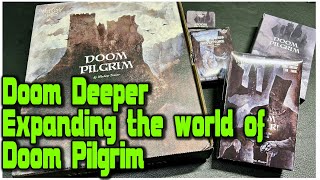
Reviewers also value the way the game grows. Daniel's first video covers the Black Bag expansion, which adds double-sided event cards drawn from a bag between major encounters, a d20 system for avoiding bad outcomes, and optional character lots and talents. Daniel says the lot containers are built so future expansions can add keywords easily, which makes the system feel future-proof. Daniel's second video covers Doom Deeper, which adds subdecks for easier, harder, or thematic play, along with Doom Pilgrim Micro, a short coffee-break version, the Freak Cult Dungeon mini-game, and Grimlands Adventure, a blank-backed art deck for solo world building. Both channels note the forthcoming standalone expansion Flails and Citadels, and Daniel hopes the line could eventually grow into an adventure board game. Daniel also praises the storage box, comparing it to the boxed starter sets of classic TSR role-playing games.
Potential Drawbacks
Condensed and Sometimes Rough Text
Colin notes that the writing is very condensed on the cards, which makes it hard to tell where one section ends and the next begins. Daniel points out that the translation can be hard to decipher at times, especially on newer releases, although Daniel reports that the translations and proofreading are improving. This matters most because each card contains conditional instructions that must be read exactly to be resolved correctly.
Limited Agency and Randomness
Daniel acknowledges that the base game offers little choice, describing it as a game to play out a doomed character's last days rather than a choice-based experience. Colin reaches a similar conclusion from a different angle, calling the game very random. A run can end abruptly, as Colin's did in a fight with a vampire with no way to avoid a fourth wound. Daniel suggests that the optional dice rules in the Black Bag expansion add choice, since players decide when to roll against a bad outcome, but cautions that escaping every encounter would break the theme.
If You Enjoy Doom Pilgrim
Readers who enjoy Doom Pilgrim are most likely to appreciate other solo narrative card games that use a single deck to generate a story, especially those built around dark fantasy and grim survival. The design sits between a gamebook and a card game: the player reads a card, follows its text, and lets accumulated keywords shape what comes next. Fans of dark fantasy gamebooks, of the automatic triggers found in idle clicker games, or of open-ended solo role-playing tools will find familiar pleasures here. Players who want strategic control and dense decision trees may find the reliance on luck less satisfying.
What Reviewers Are Saying
"The game hardly has any mechanics to speak of. We're just going to be drawing three cards from the top of the stack, looking at the art on the back, choosing one to get rid of completely."
— Colin, Meet Me At The Table
"It's almost an idol game. It's almost a game that kind of plays itself."
— Daniel, The Dungeon Dive
"Basically what this is is a kind of fighting fantasy game book done in cards. There are even fewer mechanisms involved in this game because you don't really roll dice or anything."
— Daniel, The Dungeon Dive