


Dragon Farkle Deep Dive
What the Community Thinks About Dragon Farkle
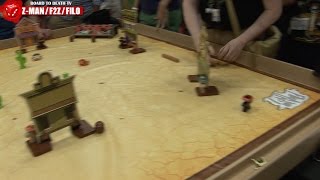
Dragon Farkle is remembered as a compact, approachable dice game with a sharp push your luck core and a theme that players notice right away. The clearest picture of first impressions comes from the Board to Death TV coverage filmed at the Z-Man Games booth during Gen Con 2015. The Z-Man representative introduces it as a push your luck dice game in which each player takes on a character with a magical item, builds an army, and then attempts to defeat a dragon. The artwork receives direct praise in that conversation, and the look of the game is described as amazing, which signals that the presentation is a large part of its pull.
The Stonemaier Games perspective is more reflective and comes from a Positively Board Gaming episode featuring Jamey Stegmaier and Mitchell Whitfield. Stegmaier explains that the designer contacted Stegmaier on BoardGameGeek after seeing Stegmaier's video about Stegmaier's favorite mechanism in the game. The designer is looking for a new publisher because the game has been out of print, and Stegmaier says Stegmaier adores playing it. Stegmaier is candid that a publisher like Stonemaier Games is not a natural fit for the title, but Stegmaier sees real potential in bringing it back to shelves with a fresh presentation that does not need to change the design.
A later Stonemaier Games live cast by Jamey Stegmaier shows the game working at a social gathering. Stegmaier recalls playing Dragon Farkle at a get-together of around fifteen people alongside The Gang, Just One, and Caution Signs, and describes these titles as games that can be played in about twenty minutes without outstaying their welcome. The same broadcast shares a listener anecdote about a player who won in three turns, which Stegmaier calls remarkable for the game. Taken together, the commentary paints Dragon Farkle as a title that is admired by enthusiasts, quick enough for casual tables, and still rewarding for players who want a bit of strategy.
Core Mechanics That Define Dragon Farkle
Dice Rolling
Dice rolling sits at the center of Dragon Farkle, and reviewers tie it directly to the lineage of the Farkle family of games. In the Positively Board Gaming episode, Stegmaier and Whitfield describe the game as based on the Farkle system, a design that they compare to Yahtzee for its simplicity. The result is dice rolling with a twist and a theme, a combination that Stegmaier believes makes the game ripe for a fresh presentation from a publisher. Z-Man Games released the game in 2015, and its rolls are the engine that produces soldiers, the points that matter at the end of the game.
The dragon die is the mechanical twist that distinguishes the game from its ancestors. In the live cast, a player rolled six dice, achieved a straight, and then rolled the face on the dragon die, which doubles the benefit of that straight. That single outcome turned an ordinary roll into a decisive turn, and it illustrates how the dice interact with one another rather than functioning as isolated results.
Push Your Luck
Push your luck is the tension that gives each turn its drama. Board to Death TV summarizes the game as a push your luck experience, and the mechanics explained at the booth make the risk concrete. The soldiers a player accumulates form the army that must eventually be brought to the dragon. Before that confrontation, a player must eliminate the rival armies, because those rivals can attack and reduce the number of soldiers a player controls. The choice to keep building or to commit to the dragon is where the push your luck tension lives.
The Dragon Farkle Experience
A Quick, Social Table Game
Dragon Farkle delivers a feeling of brisk, friendly competition. Stegmaier's account of playing it alongside other short titles emphasizes that the game fits a relaxed evening without demanding a long commitment. The sense of a lively table comes through in the description of a gathering with many players, where the short games kept the mood light.
Tension Built Around a Single Turn
The most memorable moments in the commentary revolve around the dragon fight, which creates tension that builds across the whole game. The Z-Man representative explains that the dragon must be beaten within one turn, because if it is not defeated the dragon regains its life and the attack must be repeated again and again. This requirement makes the final turn feel like a high-stakes gamble, and the anecdote about a player who won in three turns shows how quickly a well-timed set of rolls can turn a race into a finish.
What Makes Dragon Farkle Stand Out
The Dragon Die Twist
Reviewers consistently point to the dragon die as the feature that gives the game its character. Stegmaier says Stegmaier loves the twist of the dragon die and the couple of different layers that the design adds on top of the familiar Farkle structure. The die rewards rolls that would otherwise be ordinary, and it introduces a moment of excitement into the familiar Farkle rhythm.
Layers That Can Be Peeled Back
Dragon Farkle offers characters, magical items, and special abilities, but its design also works when those layers are reduced. Stegmaier describes the version Stegmaier will most often play as the most distilled form of the game, without the items and special abilities, while still appreciating the fuller design that the designer created. This flexibility means that the game can serve both players who want more customization and players who prefer a lean, dice-focused experience, which broadens its appeal across different table preferences.
Potential Drawbacks
Limited Availability
The most consistent concern in the commentary is that the game is hard to find. The conversation notes that the game has been out of print, which is why it was so hard for Stegmaier to get. The designer's search for a new publisher underscores the issue. Although the title is admired, this scarcity means that many people will encounter it only through videos or secondhand recommendations until it returns to print.
An Unforgiving Finale
The single-turn requirement for defeating the dragon is presented as part of the game's appeal, yet it also means that a poor run of rolls late in the game can undo substantial progress. Because the dragon regains its life when the attack fails, players who have built a strong army must commit their entire turn to the finale with no guarantee of success. Players who value steady, predictable progress may find this demand frustrating, even if others will see it as the source of the game's excitement.
If You Enjoy Dragon Farkle
Dragon Farkle belongs to the classic lineage of Farkle and press-your-luck dice games, a family in which players repeatedly decide whether to bank their gains or risk them on another roll. Stegmaier's comparison to Yahtzee highlights the simplicity that makes such games accessible, while the dragon die and the army-building structure distinguish Dragon Farkle from its relatives. Players who enjoy this style of play should also look at the later Stonemaier Games live cast mention of Cats Versus Cucumbers, a new Kickstarter delivery described as a push your luck game along the lines of Dragon Farkle with a bit more set collection. Dragon Farkle remains a strong starting point for anyone who wants a short, theme-rich dice game with real tension at the end of each turn.
What Reviewers Are Saying
"Well, in Dragon Farkle, it's a dice game. It's a push your luck game, in which you have different character. Each player will have a character and magical item also that will help them. And then you will try to buy, well, an army, a good army of 5,000 army guy, and then you can go beat that dragon. And you must beat him in one turn because if you don't, he will regain his life and you will have to do it again and again."
— Board to Death TV
"I love what you've done with the game, but probably the way that I will play it most often is the most distilled version of the game, without maybe the items, without the special abilities. I love the twist of the dragon die and a couple different layers there."
— Stonemaier Games
"Susanna had the perfect roll, like literally the best roll in the game, where she rolled six dice, rolled a straight with those dice, one, two, three, four, five, six, and rolled the face on the dragon die. That doubles your benefit for getting that straight. So Susanna, that was Susanna's second turn of the game. So on Susanna's third turn of the game, she won the game. She took all — in Dragon Farkle you get all these points that are represented by soldiers in the game, and then to win the game you have to take all those soldiers and go fight the dragon to win the game — and Susanna pulled it off in three turns, which is remarkable for this game."
— Stonemaier Games