


Dragonflame Deep Dive
What the Community Thinks About Dragonflame
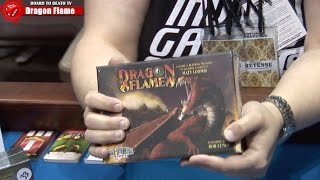
Dragonflame, the card drafting game from Minion Games, comes across in reviews as a light, fast, and good-humored game with a memorable theme. Board to Death TV covered it from the Indie Game Alliance booth at Gen Con, where the overview presented the game as fast to play, with most of the effort going into scoring. Getting Games has covered it twice, first as one of the titles it was most looking forward to at Board Game GeekCon and later after a full session. Reviewers respond most to the premise: you are a dragon, and the goal is to pillage villages and hoard treasure.
The reception is not uniformly enthusiastic. In the later Getting Games video, the group played Dragonflame after a long, tiring game and did not enjoy it as much as they might have. That reviewer still called it a solid game with no obvious problems, saying it "didn't jump out and smack me in the face with awesomeness." They said they would play it again but were unsure whether they would buy it. Their experience is best read as a reminder that the session's energy level affects how the game lands, not as a verdict on the rules.
Core Mechanics That Define Dragonflame
Hand Management
Each round, every player receives three cards, and the real decision is how to spend them. Getting Games described the round as beginning with three cards in hand, which players place into columns face up or face down. Board to Death TV explained that a player's castle sets both their place in the turn order and how many of their cards may be played face up. A player who goes last can play one card face up and two face down, which means the timing of each card matters as much as the card itself. Reviewers describe this as a loop built on sequencing and bluffing rather than on what you happen to draw.
Hidden Placement and Turn-Order Claiming
The second mechanic is the way cards are claimed. Once every player has placed their cards, players claim castles in turn order, and the cards resolve one at a time. Treasures go into the player's hoard, knights and other penalty cards go into the hoard as well, and relics stay in front of the player to provide ongoing effects. Getting Games noted that earlier players have more face up cards and later players have more face down, so a player who acts late can slide a strong card into a spot that nobody suspects. The result is a push and pull where players hope the early players take the bad cards and leave the good ones for themselves.
The Dragonflame Experience
Playful Dragon Mischief
The theme carries the game. Board to Death TV opened its overview by pointing out that the player is a dragon from the start, and that dragons care about treasure and about destroying villages. Victory points are called glory points, and the flaming itself is the centerpiece, to the point that the overview joked that "Dragon Flame, it's the name of the game." Getting Games pointed to the village tokens, which carry punny names such as Scorchville and Ashton, as a sign of the game's humor. Reviewers enjoy the sense of wickedness that comes from setting a village alight for points.
Light, Quick Tension
Beneath the playful surface, the game produces a steady tension. Players do not know what their opponents have hidden, and a bad card placed face down may or may not be taken by an earlier player. Board to Death TV noted that the play itself is quick and that the scoring is where the extra thought goes, and the flaming decisions made there are where a player can accidentally hand points to someone else. Despite that tension, the games are short enough that reviewers describe the feeling as light rather than heavy, with each round moving briskly toward the next flame.
What Makes Dragonflame Stand Out
Playing as a Dragon
Reviewers consistently highlight the fantasy of being a dragon. Board to Death TV called it the coolest thing about the game, and the flaming mechanic gives that fantasy concrete form: a basic flame does one point of damage, while a larger flame does three, and flames resolve one at a time across the village. The artwork earned strong praise, with the overview calling it very beautiful and crediting Rob Lundy. The fire tokens also drew comment for their look, with the host calling them really cute and noting that they resemble little fire markers laid on the board.
Quick to Learn and Quick to Play
Accessibility is the second standout. The game supports two to five players, and reviewers estimate a session at around 30 to 45 minutes. Board to Death TV described it as quick and very easy to pick up, and showed off the cheat sheets that come with the game. The overview also pointed out that the actual play is fast, with most of the extra time going to scoring. For groups looking for a short game that does not require a long teach, Dragonflame fits the description reviewers give.
Potential Drawbacks
Flaming Can Hand Points to Opponents
The most pointed criticism is that a player can accidentally give away victory points. Board to Death TV walked through a scenario in which a player flamed a village and, in doing so, gave away 12 glory points that would otherwise have scored nothing. Because a flame that lands on an already destroyed village dies out, and because a tie goes to whoever flamed first, careless timing can cost a player dearly. Reviewers treat the flaming decision as the game's sharpest edge.
Scoring Only Pays When a Village Burns Completely
Area scoring is the other concern. A village must be fully destroyed before anyone scores, so a village that still has villagers left in it earns nothing, as the Board to Death TV overview demonstrated. Getting Games observed that some villages burn quickly while others need a great deal of flame to die, which creates a real choice about where to commit. Because a village that is not fully burned scores nothing, the scoring rewards players who commit to finishing what they start.
If You Enjoy Dragonflame
Reviewers repeatedly compare Dragonflame to Colorado. Getting Games framed the game as looking like Colorado meets Burning Villages, and noted that both use a push-your-luck idea in which a player decides whether to cash out or keep taking cards while opponents may take what is on offer. The key difference, according to that reviewer, is theme and card variety: Dragonflame uses dragons and flame rather than simply collecting colored sets. That makes it seem like a more thematically interesting take on the same kind of decision.
The comparison also comes with a caveat. The same reviewer who ranked Colorado highly described its design as simple, elegant, and brilliant, and judged Dragonflame as simple and good but not exactly elegant or brilliant. Players who value the crisp decision space of Colorado may find Dragonflame more ordinary, while players who want the same sort of tension wrapped in a dragon fantasy are likely to find it a good fit.
What Reviewers Are Saying
"So, the play is super fast. It's mostly the scoring that's that needs a little bit. So, play is super easy."
— Board to Death TV
"I think it is a solid game. I didn't really see any particular problems with it. It didn't jump out and smack me in the face with awesomeness. I would definitely play this one again."
— Getting Games
"It's not just set collecting colors like in Colorado. So, it looks like it might be a more thematically interesting version of Colorado. I love Colorado, so I want to give it a shot."
— Getting Games