






Dragonheart Deep Dive
What the Community Thinks About Dragonheart
Reviewers see Dragonheart as a quick two-player card game that rewards careful timing and a willingness to gamble. Designed by Rüdiger Dorn, it pits a great dragon‘s disciples against the minions of an evil wizard, although several reviewers note that the story rarely comes into play. Chris Yee, The Dice Tower, ranked it sixth on their list of favorite Board Game Arena games and admitted that in some ways they feel they should not enjoy it, since so many plays hand the opponent an opening. Chris Yee later returned to the game on a most-played list, calling it one they recommend highly. Chris Yee also points out that the title has been out of print in the United States for a long time, so Board Game Arena is where many players first encounter it.
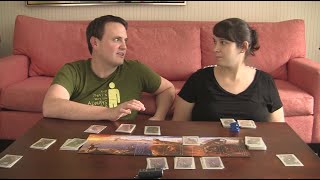
Matt and Jennifer of Board Game Replay recorded a full session on a vacation and describe it as a light, fast game they play often. Tabletop Tokki, Tabletop Tokki, singles it out as a design unlike most others they have played, with a learning curve that is steep at first but a play time of only a couple of minutes once the rules click.
Core Mechanics That Define Dragonheart
Hand Management Drives Every Turn
Each turn breaks into three steps: play cards, collect, and draw back up to your hand size. Matt, Board Game Replay, explains that it is usually advantageous to play as many cards as you can, because the refill is what gives you options next turn. Cards go onto the board space that carries matching artwork. Single-outline spaces accept any number of matching cards, while multi-outline spaces need a threshold of plays before their collection triggers. Holding back matters just as much as playing out. Chris Yee, The Dice Tower, says they would not place three dwarves at once, because an opponent holding a single dwarf could then take the whole pile, so they prefer to add one or two at a time.
Push Your Luck Through Refilling
Matt says the game "has push-your-luck elements," and the clearest example is dumping cards from your hand to dig for something better. Players deliberately spend treasure, dwarves, or archers so they can draw up and hope for a sorceress, a dragon that raises the hand limit to six, or a high-value dragon pile. Jennifer, Board Game Replay, adds that the planning is undercut by the draw, since you cannot control what comes back. The result is a repeated gamble that the next refill will fix the position.
The Dragonheart Experience
Light, Fast, and Tactically Tense
Reviewers describe a light game that still demands attention. Matt calls it light fare and a fast game, but one packed with small decisions: whether to end the game while ahead, whether to take a pile that opens a bigger one for an opponent, and how to time the third ship play that signals the finish. Tabletop Tokki calls it a very quick game that is easy to fit into a short break, and the feeling is less about heavy calculation than about making a clean, sharp move on each turn.
Mind Games Between Opponents
The strongest feeling is that you are playing your opponent as much as the board. Chris Yee, The Dice Tower, compares the back-and-forth to rock, paper, scissors, lizard, Spock, since anything you put down might be grabbed by a counter-card, while you hope to snatch what they have placed. Chris Yee describes players getting into each other‘s head space, and in a later video says players lay traps for one another. Matt adds that you need to watch what the opponent is scoring, because a stack of low-value dwarves is often not worth the risk of setting up a bigger reward for the other side.
What Makes Dragonheart Stand Out
Arrows That Turn Every Card Into a Threat
Many cards carry arrows that point to a board space, and when those spaces are triggered, the arrows gather everything in their path. A sorceress wipes out the dragons on the table, a troll captures a sorceress, and a pair of knights either destroys an ogre or captures the sorceress, as Matt demonstrates. Tabletop Tokki describes the core appeal as placing cards out in order to capture other cards, and reviewers agree that a card left on the board is never safe for long. Every play is both an investment and a potential gift to the other side.
Many Routes to Points Keep Games Open
Chris Yee says the game offers a lot of ways of scoring, and reviewers value that variety. Dwarves carry small values while dragons can be a jackpot, and Matt and Jennifer end their session with a stack of dragons that would have decided the match. Cards left in hand at the end do not count, and the game ends when the third ship trigger resolves, giving the other player one final turn. Tabletop Tokki adds that the special dragon statue raises the hand limit to six cards, and that animals score points at the end of the game.
Potential Drawbacks
Luck Can Overrule Planning
The most consistent concern is the random draw. Jennifer, Board Game Replay, says it is hard to be tactical because you cannot control the cards you draw, and Matt agrees that some luck is built in. A player can set up an excellent turn and then refill into a poor hand. Some reviewers accept this as part of the push-your-luck appeal, but it can frustrate players who want more control over the outcome.
The Theme Takes a Back Seat
Matt says up front that the theme of the dragon and its disciples and minions does not really come into the game much, so players who want a story will find the setting more like a label than a driving narrative. Chris Yee‘s concern is a different kind of friction: the most natural plays can set up an opponent for a big score, which Yee admits feels uncomfortable even while continuing to make those plays. Players who dislike games where helping the opponent is unavoidable may find that tension hard to accept.
If You Enjoy Dragonheart
Reviewers did not name direct comparison titles for Dragonheart, but several games they praised share its core pleasures.
- Games built on push-your-luck gambles: Chris Yee, The Dice Tower, calls Sid Sackson‘s Can‘t Stop "the quintessential push-your-luck game," a good next step if the repeated refill gamble is what appeals to you.
- Games about denying the opponent: Chris Yee also recommends Tucano for the moments when you take one card fewer on purpose so the other player cannot collect a big column, a choice that mirrors Dragonheart‘s trap-setting.
- Games where each move sets up the next player: Chris Yee praises the Rio Grande game Butterfly, where a shared hedgehog move forces the next player into a choice they may not want, a tense take on the same give-and-take.
What Reviewers Are Saying
"It‘s this kind of like rock, paper, scissors, lizard, Spock thing where everything that you play, the other player might have a way to play something out there that grabs it."
— Chris Yee, The Dice Tower
"This is a really unique game where you‘re going to be placing cards out in order to capture other cards."
— Tabletop Tokki
"You try to be tactical in this game, but it‘s so difficult because you don‘t have control over the cards that you‘re drawing. There‘s some luck there."
— Jennifer, Board Game Replay