




Duelosaur Island Deep Dive
What the Community Thinks About Duelosaur Island
Reviewers generally treat Duelosaur Island as a confident, well-crafted two-player game, although the enthusiasm is not uniform. The shared view is that this spin-off takes the sprawling Dinosaur Island formula and compresses it into a tighter package built around cards, a smaller board presence and shorter games. The Cardboard Herald was the most enthusiastic voice, ranking the game fourth on a personal list of favorite two-player titles and calling it a beautiful distillation of the original. The Brothers Murf shared that enthusiasm in a list of two-player spin-offs that improve on their parents, praising how the card layout and specialists make the experience feel fresh rather than diluted.
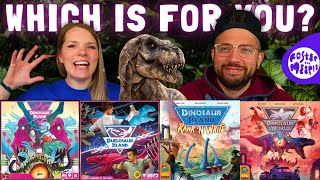
Foster the Meeple offered the most measured response. Their comparison of the Dinosaur Island family placed Duelosaur Island at the bottom of the group for their household, mainly because the two-player version drops the dinosaur meeples and the personal player board that give the original its character, while still asking for a surprising amount of setup. Their verdict was that the game is fun but not essential when the full original can simply be played at two players.
Meeple University presents the game through a teaching lens, with a one-round playthrough, a full rules walkthrough featuring designer Ian Moss, and a what-to-expect overview. Their tone is neutral and instructive, and they describe the game as light in complexity with tactical drafting decisions and limited direct take-that. That framing suggests the community sees the game as an accessible way into the wider Dinosaur Island family rather than a heavy strategic experience.
Core Mechanics That Define Duelosaur Island
Dice Drafting With a Split Choice
Dice drafting is the system reviewers return to most often. One player draws and rolls the five DNA dice, places them against the plot twist tiles, and draws three specialist cards before keeping two. The other player then chooses first from the resulting options, so the drafter has to build choices that look appealing without handing over the best combination. Meeple University's rules video explains that the first player has an incentive not to leave particularly strong options available, which turns setup into a small guessing game. Plot twists add another layer, since a multiplier can let a single die deliver its bonus several times over. The Cardboard Herald describes the draft as the cornerstone of the entire game, pointing to the split between the dice and their bonuses as the source of much of the suspense.
Multi-Use Cards
The Brothers Murf put card design at the center of their praise. Almost every card can be used in more than one way, because the top half is a dinosaur that costs DNA to create and the bottom half is an attraction that costs coins to build. That means each card in hand carries a real decision about what it should become. Meeple University's walkthrough confirms that building an attraction slides the card under the player board, while creating a dinosaur uses the top half, so the same card can change the direction of a whole turn. Reviewers treat that single choice as the reason a small hand still feels deep.
The Duelosaur Island Experience
Tense Threat Management
Reviewers describe the game as tense, and much of that comes from the threat track. Each round, the card or die that nobody drafted adds to the threat level, and players who have not kept their security up can watch visitors get eaten. The Cardboard Herald says the draft creates a level of suspense that is hard to match, and the Meeple University overview makes the same point, warning that underprepared parks can lose many visitors in a single round. Spending coins to raise security competes directly with building attractions, so each round tends to feel like a balancing act rather than a race.
A Satisfying Engine
The Cardboard Herald says the draft feels so good, and that satisfaction comes from watching the park grow. Food stalls produce extra coins at the start of each income phase, merchandise stalls produce extra park cards, and the excitement generated by dinosaurs determines how many visitors arrive. Meeple University's playthrough shows that loop in action, as income and park cards build up round by round. Set collection adds to the payoff, because completing a food, merchandise and ride set scores bonus visitors at the end, which rewards players who plan their park with a clear shape in mind.
What Makes Duelosaur Island Stand Out
A Compact Take on Dinosaur Island
The most consistent praise is that the design keeps the core of Dinosaur Island while removing much of its bulk. The Brothers Murf describe the two-player version as much easier to set up and play, and they note that the DNA system from the original carries over into a card-based form that splits neatly down the middle. Meeple University's teaching video supports the point, showing the dinosaurs, the security track and the attractions all coming together on a single player board. Reviewers describe it as a faithful, smaller version that keeps the feel of the original.
Specialists and Scoring Depth
Specialists are another point of praise. The Brothers Murf say the specialists are central to the two-player game and carry rules that can change a game dramatically. Meeple University's rules video explains that each player can keep up to three specialists in front of them, each with an ongoing benefit in a specific phase, and that discarding a specialist straight from the draft triggers a one-time bonus. Scoring also rewards planning, since the designer notes that attraction sets are worth four points at the end of the game and that finishing them late can be a strong move.
Potential Drawbacks
Missing Dinosaur Meeples and a Lighter Feel
The most specific criticism comes from Foster the Meeple, who singled out the absence of dinosaur meeples as the biggest difference from the original and the one they liked least. The hosts argued that the original's personal player board and meeples gave it a tactile identity that the card-based version does not fully recapture. Their view is that the two-player game is enjoyable but thinner, which is why they would rather teach the full original at two players. Fans who value the card-driven design may find that trade-off easy to accept.
Setup and Length
Setup is still a talking point. Foster the Meeple says the game is lighter than the original but still asks for more setup than many board games, with DNA boards, specialist boards and a full card supply to lay out before play begins. They argue that committing a couple of extra minutes to the full Dinosaur Island is a reasonable trade for the bigger experience, and they note that the game still takes up a meaningful share of the table. On length, The Brothers Murf find the game so easy to play that it can feel almost too short, even on the longest setting, although they still recommend the long version for the best ramp.
If You Enjoy Duelosaur Island
- Dinosaur Island: the original game with a personal player board and a larger setup, which Duelosaur Island condenses into cards for two players.
- Dinosaur Island: Rawr & Write: the roll-and-write version that keeps the chunky dice and park building on a sheet, and that reviewers recommend for players short on table space.
- Dinosaur World: the sprawling sequel with hex tiles and jeep tours, which Foster the Meeple describes as the pinnacle dinosaur experience for fans of Jurassic Park who have room for a big table.
- Dominant Species: an area control game with an Ice Age setting rather than dinosaurs, suited to players who enjoy the head-to-head tension but want a different theme.
What Reviewers Are Saying
every card is dual use because you can either keep it for the dinosaur and then try to make that dinosaur again with your DNA or you can put attractions for a lot of the attractions like various set collection stuff going on down there.
— The Brothers Murf
and it implements an eye split you choose system with the dice drafting that is so ingenious and feels so good and is the cornerstone of the entire game
— The Cardboard Herald
you want to know what the biggest difference is and probably the worst one no dino meeples
— Foster the Meeple