

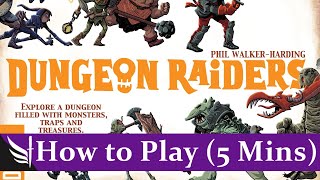



Dungeon Raiders Deep Dive
What the Community Thinks About Dungeon Raiders
Reviewers describe Dungeon Raiders as a small, approachable dungeon game that sits between friendly cooperation and quiet backstabbing. The Dice Tower's nostalgia countdown, hosted by a staff member who calls it a "great game," treats it as a keeper for family and friend groups even after the table time has faded. Tom Vasel, in The Dice Tower's "pile of mid games" series, is more measured. Tom Vasel describes the Devir edition, designed by Phil Walker-Harding, as close to working but held back by its presentation, and says the original Dungeon Raiders that the newer game re-implements is preferred. JestaThaRogue treats the game as an explainer subject, laying out its setup, turn phases, and scoring in roughly half an hour, which makes the overall impression of a tightly structured, quick game.
The areas of agreement are clear. Reviewers like the light footprint, the short playing time, and the sense that every player is working toward the same dungeon while also racing each other for the treasure. Where they diverge is on polish. Enthusiasm for the core design is tempered by comments about artwork and production, and the existence of more than one version creates some confusion about which edition a reviewer actually played.
Core Mechanics That Define Dungeon Raiders
Push Your Luck
Tom Vasel frames Dungeon Raiders as "a little bit of push your luck," and the mechanic comes from the way the dungeon is revealed. Players have a hand of cards numbered one through five and face-down room cards that flip one at a time, so no one knows exactly what the next room will demand. Each round, the group must decide whether to commit a strong card early to secure a room or hold it back and risk losing the opportunity. Reviewers describe the tension as a choice between locking in gains and continuing deeper into the dungeon, where a single monster fight can change who ends up with the most treasure.
Hidden Card Bidding
The second mechanic that reviewers explain is simultaneous hidden card play. Each player places a card face down, and all cards are revealed together. The highest card wins treasure rooms, the lowest card gains rooms in monster fights, and the rest of the table learns what everyone else committed only after the reveal. In the nostalgia countdown, the host explains that spending a bidding card means it is gone for the round, so players try to hedge their bets by getting their strongest card in first or saving it for later. JestaThaRogue summarizes the same structure, noting that the player who plays the highest card wins the room and that the monster result depends on the lowest card played.
The Dungeon Raiders Experience
Light, Tense Family Play
Reviewers describe the feel of Dungeon Raiders as light but tense. The game is short and easy to teach, which makes it a regular on family tables. The host of The Dice Tower's nostalgia countdown says the game was a favorite for playing with children, and that it worked even with a family member who does not normally enjoy games like it. Despite the simple rules, the uncertainty of the flipped room cards keeps each round feeling different, and the group reactions to a surprise monster or a lucky treasure are what make the game memorable.
Shared Danger Mixed With Suspicion
The second feeling reviewers mention is the uneasy alliance of the dungeon. JestaThaRogue describes the basic formula of dungeon crawlers and then points to the twist in this one: "some of those monsters are dangerous and although you work together you don't have to risk getting hurt." Players are nominally on the same side against the monsters and traps, but they still compete for the most treasure. That gap between cooperation and competition produces a mild sense of suspicion, because the player who helped you survive a monster fight may be the one who takes the gold at the end.
What Makes Dungeon Raiders Stand Out
A Compact, Affordable Box
Reviewers repeatedly point to the physical size and price of the game as a strength. The host of The Dice Tower's nostalgia countdown says the box is small and that the game is worth every penny. That affordability makes Dungeon Raiders easy to bring along and easy to recommend to people who are new to tabletop games. Because the game is compact, it can also serve as a quick filler between heavier titles.
A Quick Game With a Clear Structure
JestaThaRogue highlights that the game is built for three to five players and plays in about 30 minutes. The turn structure follows a clear sequence: enter the room, play cards, resolve the room, and discard. Reviewers who explain the rules tend to praise how little overhead the game requires once the setup is complete. That clarity is part of why the game works as a teaching title, even for groups who are not familiar with dungeon crawlers.
Potential Drawbacks
Production and Artwork
The most direct criticism comes from Tom Vasel, who says that production was probably the factor that kept Tom Vasel from loving the game. Tom Vasel also comments that the artwork in the Devir edition is not especially strong. For a game built around the excitement of revealing new rooms and monsters, reviewers feel that the visual presentation could better support the sense of adventure. This is a fair critique of a game that otherwise earns praise for its design.
Uncertainty Between Editions
Tom Vasel also points out that the newer Devir edition is a re-implementation of an older Dungeon Raiders, admitting uncertainty about which version was played before. Tom Vasel says the original game is liked and was rated highly, while the newer edition is less familiar. Readers who want the classic experience should check which edition they are buying, because reviewers do not always treat the two as identical.
If You Enjoy Dungeon Raiders
Players who enjoy Dungeon Raiders's light hand management and quick rounds will find similar satisfaction in Quirkle. The host of The Dice Tower's nostalgia countdown says that the game remains a fixture for their family and describes playing it with children. Quirkle shares Dungeon Raiders's appeal as a compact game that can be learned quickly and played again without a long commitment, and it suits the same kind of relaxed table where a short, lighthearted match is the goal.
What Reviewers Are Saying
"So, you're trying to hedge your bets, get your big one in first so you can get what you need or try to save it till later. You get to a monster, everybody kind of has to participate in fighting the monster. If you fail, whoever puts the least amount of points into it gets damaged."
— The Dice Tower
"It's almost there. There's some things I like about it."
— Watch Review
"some of those monsters are dangerous and although you work together you don't have to risk getting hurt."
— JestaThaRogue