

Dungeons & Dragons: Trials of Tempus Deep Dive
What the Community Thinks About Dungeons & Dragons: Trials of Tempus
Reviewers agree that Dungeons & Dragons: Trials of Tempus is a team game with a strong Dungeons & Dragons flavor, and that it rewards groups who stick with it past the first session. The most detailed walkthrough comes from Rolling Dice & Taking Names, whose hosts describe a WizKids release that plays 2v2, 3v3 or 4v4 on a very large modular board. Quests award victory points, and a boss monster eventually enters the fight once a threshold is reached. They praise the character creation and the card play, and they point to the painted miniatures in the premium edition as a major part of the table appeal.
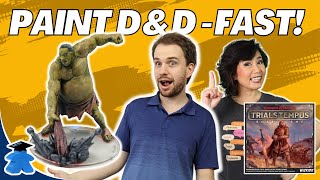
The painting channel Stella, Meeple University approached the game from the table side. Stella and Henry said they had played it as a team and narrowly lost to two friends, and they painted the Hill giant, which they note is recommended as the enemy in a first game. Their enthusiasm centers on how the boss fight keeps both teams involved. The Discriminating Gamer placed the game as an honorable mention in a top ten list, remembering a fun team game full of tokens and monsters, although they no longer keep it in their collection. The shared view is that the game is fun and thematic, while the main debates concern how easy it is to learn and how long it takes to play.
Core Mechanics That Define Dungeons & Dragons: Trials of Tempus
Drafted Character Decks
Rolling Dice & Taking Names explains that character creation is the first and most distinctive system. In the recommended starter, players build a deck by merging class cards, subclass cards and a named character card. Once combined, the deck produces primary actions such as attack and movement that stay on the table for the whole game, while the remaining cards form a draw deck that supplies additional actions during a turn. Some cards carry chain icons, so a movement or attack can be extended by linking a second card to it. The hosts also describe a draft that replaces the starter in later sessions, where players take turns picking classes, subclasses and characters from the table. Their main complaint is that sorting and returning these cards between games takes real effort.
Quest Points and the Boss Trigger
Victory points come from quests, which might ask a team to defeat particular monsters, destroy altars or loot chests. Looted cards also count toward the score, which makes a player carrying loot a visible target. When one team reaches the point threshold, a big bad spawns in the middle of the board. Defeating it ends the game, and the team with the most points wins. The Rolling Dice hosts note that players cannot be eliminated and instead respawn, but they drop their loot when knocked out. Meeple University frames the boss as the key decision point: the team that kills it while still leading wins, but the trailing team can use the fight to catch up, or leave the boss to its opponents and chase quests elsewhere.
The Dungeons & Dragons: Trials of Tempus Experience
A Race Around the Boss
The most vivid experience in these reviews is the tension between the two teams while the boss is alive. Stella and Henry describe a swinging match in which one side fights the monster while the other side sabotages it, collects points, and waits for an opening. Rolling Dice adds that camps of monsters across the board will attack anyone who wanders close, so the environment is always a threat alongside the rival team. The result, as reviewers describe it, is a Tavern brawl in which both sides talk trash, chase objectives, and react to whatever the other team does next.
Constant Engagement With Your Team
Rolling Dice & Taking Names argues that the game does not let players drift off. Players are expected to track what everyone else is planning from turn to turn. The hosts compare the feel to a tabletop RPG party in which someone who stops paying attention falls behind. The same review notes that the game is not a role playing game in the traditional sense, but a dungeon crawler that borrows its dice rolls, classes and initiative from Dungeons & Dragons. For players who want the D&D flavor without a full campaign, the combination of drafted characters and team tension is the appeal.
What Makes Dungeons & Dragons: Trials of Tempus Stand Out
Table Presence and Painted Miniatures
Reviewers consistently notice the size and look of the game. Rolling Dice & Taking Names calls the board a table hog built from tiles that combine into one large playing surface, and says the premium edition with painted miniatures looks especially impressive when someone walks past. Meeple University's painting session reinforces the point, since the Hill giant they painted is one of the largest figures in the box and gives a sense of the scale players will be fighting over.
Replayable Character Building
The second standout is the way characters evolve between sessions. Rolling Dice & Taking Names describes setting aside higher tier cards at the start, then adding selected discards to the draw deck as the game progresses, and flipping primary attacks to their stronger side. The hosts say that once players know the cards, they can dig for specific combinations ahead of a big fight. They also say that the game is one players will keep returning to because each group builds its own character and tactics over multiple plays.
Potential Drawbacks
A Confusing First Session
The most consistent criticism is the learning curve. Rolling Dice & Taking Names says the first play is hard to follow because players must read their cards, understand line of sight, and learn the effects of the chain and draft systems at the same time. The hosts also report that the designer acknowledged that sorting the cards at setup is confusing. Their advice is to judge the game after several plays, when the rules and the draft are familiar.
Length and Table Footprint
The second concern is play time and space. Rolling Dice & Taking Names describes a solid two-hour game once players settle in, and says the group modified its rules to shorten play. They triggered the boss at seven victory points instead of ten and halved the monster's hit points, a change they say was suggested by the designer on BoardGameGeek as a way to shorten the game while learning it. The board also takes up a lot of space, so groups will need a dedicated table to set it up.
If You Enjoy Dungeons & Dragons: Trials of Tempus
Players who enjoy the team tension and the quest-driven scoring of Dungeons & Dragons: Trials of Tempus will find a similar kind of competition in Onslaught, another WizKids game set in the Dungeons & Dragons universe. Rolling Dice & Taking Names draws the comparison directly and explains the difference: Onslaught is built as a competitive one-versus-one skirmish that suits tournament play, while Trials of Tempus is a team game where a team can choose to ignore the other side if a quest allows it. Players who value the card-driven character decks and the Dungeons & Dragons dice rolls will find those same elements in Onslaught, although its head-to-head design leaves less room for side objectives. The Discriminating Gamer also placed Onslaught ninth on their top ten Dungeons & Dragons board games list, praising its initiative system and the feeling of questing in a one-on-one duel.
What Reviewers Are Saying
"you've got a whole bunch of things that you can be doing whilst they're trying to take down the big boss monster ways to sabotage them"
— Stella, Meeple University
"this is a solid two-hour game once you get into it we did modify our rules to where we triggered the monster to come out with somebody got seven victory points instead of the 10 victory points we cut the monsters HP in half"
— Rolling Dice & Taking Names
"There were a ton of tokens and you had these really cool monsters and you're kind of fighting against each other, but you're also fighting on these monsters. It was a lot of fun."
— The Discriminating Gamer