




Dungeons of Infinity Deep Dive
What the Community Thinks About Dungeons of Infinity
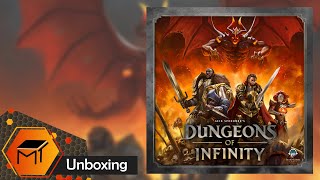
Dungeons of Infinity divides the board gaming community, with opinion leaning critical rather than enthusiastic. Board Games UnLocked, which has reviewed the game multiple times across one-shot and campaign modes, consistently describes it as tedious and uninspired, rating the one-shot experience at 4 out of 10. The channel's hosts find the core gameplay loop repetitive despite appreciating the deluxe components and campaign potential. Meet Me at the Table, by contrast, took a more optimistic stance during an unboxing of the 2.0 deluxe edition, emphasizing the quality production and the variety offered by different character designs. The overarching consensus is that Dungeons of Infinity works best as a campaign experience rather than standalone one-shot scenarios, where narrative structure and special rules bypass the game's most problematic mechanics.
Core Mechanics That Define Dungeons of Infinity
D20 Hit-Chance Combat System
Dungeons of Infinity uses a straightforward but restrictive combat model centered on D20 rolls within fixed hit windows. Each hero has a specific hit chance value, such as rolling 15 or lower to strike an enemy; this inverted target, where lower rolls succeed, differs from most dungeon crawlers. Reviewers note that the hit-chance band is typically generous enough to land most attacks, yet the system feels mechanically flat. Combat unfolds in 3x3 grids of enemies standing above the player's character board, with encounters often devolving into swarms of low-threat minions fought repeatedly across dungeons. The simplicity leaves little room for tactical nuance or mitigation, making combat feel as though it is following a scripted pattern rather than creating meaningful tactical decisions.
Threat Meter Escalation and Dungeon Lord Events
The threat meter stands as the single most criticized component of Dungeons of Infinity. This escalating track climbs with nearly every player action: exploring new tiles, engaging in combat, or simply advancing turns all push the threat level higher. As the meter fills, it triggers Dungeon Lord event cards that spawn hostile encounters designed to punish exploration. In one-shot scenarios, reviewers found the threat meter rises so aggressively that the Dungeon Lord appears well before players have adequately explored, armed with stats (12 defense, 13 attack) that render heroes with base-level equipment nearly powerless to combat. The campaign mode, by contrast, largely sidesteps this mechanic with special rules that disable threat tracking in most dungeons, reserving the mechanic for dramatic moments. This mechanical difference alone accounts for reviewers describing the campaign as potentially 7 or 8 out of 10 while one-shots languish at 4 out of 10.
The Dungeons of Infinity Experience
Tedium and Repetition
The most damning criticism across reviews is that Dungeons of Infinity feels tedious rather than grind-heavy. Reviewers did not object to grinding per se, but to the uniformity of the grind. Combat repeats the same sequence: roll the D20, determine if a hit lands, resolve damage. Minion swarms appear predictably; rewards materialize at painfully slow rates. One reviewer noted that new ability cards feel fresh at first but quickly settle into bog-standard attack variations (ice damage, fire damage, poison damage, repeated across every ability). The chest deck, meant to supply valuable loot, often contains only gold coins, which convert to starter-level items that fail to excite. Even character progression lacks momentum, with heroes requiring 36 experience points to reach level 4, earning only 1 XP per hit. This arithmetic creates a perception that advancement is distant and achievement hollow.
Frustration with Consequence Stacking
Reviewers expressed frustration at the way multiple systems compound to limit player agency. The merchant system, while novel in concept (sending out errand runners to fetch items), costs precious action points and time to execute. Crafting systems introduced in expansions remain inaccessible in early play due to the XP ceiling. The threat meter, by design, penalizes the player's desire to explore, the core loop of any dungeon crawler. One reviewer contrasted this favorably against Shadows of Brimstone, which gates threat progression behind a die roll; by using an automatic escalation triggered by exploration itself, Dungeons of Infinity creates a perverse incentive structure where the act of playing the game accelerates failure conditions. Over the course of multiple one-shot scenarios, this accumulation of minor frustrations became the emotional throughline rather than satisfaction or excitement.
What Makes Dungeons of Infinity Stand Out
Deluxe Component Quality and Production Design
The 2.0 deluxe edition, published by Sky Kingdom Games, is mechanically sound in its presentation. Heavy metal coins replace cardboard tokens, reducing table noise and adding tactile weight. Player boards recessed and slotted to hold trackers prevent fumbling during intense moments. Over 400 individual cards fill the card decks (bodies, debris, chests, mist, loot, abilities), and while reviewers criticize the variety's execution, the sheer volume of distinct cards ensures that no two dungeons feel identical on paper, if not in play. Punch boards are cleanly produced, miniatures come pre-washed, and the campaign book spans 175 pages with hero backstories. The production effort is evident and appreciated, even if the underlying system does not justify the investment.
Campaign Structure with Character Focus
The campaign mode, which divides the experience into 10 chapters with 3 dungeons per chapter and a new character protagonist for each chapter, offers structural novelty that one-shots lack. Reviewers appreciated the idea that players can keep their experience and leveled heroes across the three dungeons of a chapter before resetting to a new character for the next chapter. This pacing allows for incremental progression and attachment to individual heroes without committing to a 30-mission marathon. Moreover, each chapter features special rules that contextually disable or modify the threat meter, transforming the game's feel dungeon by dungeon. Reviewers noted that the campaign itself appears to be where the designers invested narrative weight and mechanical innovation, positioning it as the intended way to experience the game.
Potential Drawbacks
Threat Meter as a Fundamental Design Flaw
The threat meter emerges as the core design problem that limits Dungeons of Infinity's appeal. In one-shot play, its aggressive escalation leaves no room for extended exploration, the primary verb of a dungeon crawler. The meter climbs to its cap (24) within a handful of turns, at which point the Dungeon Lord's superior stats ensure combat becomes a desperate rearguard action or wipe condition. Even cooperative play, where any hero's defeat ends the mission, fails to soften this punishment. Reviewers universally identified the threat meter as the reason they would not replay one-shots and cited its absence from campaign dungeons (via special rules) as the sole reason the campaign might be worth experiencing. This suggests the threat meter is less a dynamic tension system and more an obstacle that should have been left on the design table.
Combat and Progression Fail to Deliver Excitement
Reviewers repeatedly contrasted Dungeons of Infinity unfavorably against Gloomhaven, Frosthaven, Massive Darkness 2, and Arcadia Quest, each of which offers a stronger sense of escalation or immediate reward. In Gloomhaven and Frosthaven, leveling up feels momentous because heroes gain new ability cards and refreshed resources with each threshold. In Massive Darkness 2, loot drops continuously and equipment swaps feel impactful. Dungeons of Infinity offers neither. Items arrive slowly, are bound to level requirements heroes have not yet reached, and once equipped offer modest numeric bonuses. Abilities, though numerous, lack synergy or build variety. No loadout feels materially different from any other. The game was designed 15 years ago, reviewers noted, at a time when simple dungeon crawlers could succeed on novelty alone. Modern competitors have raised the standard for pacing, progression, and reward feedback, and Dungeons of Infinity has not kept pace.
If You Enjoy Dungeons of Infinity
If Dungeons of Infinity resonates with you, particularly its campaign mode, you may want to explore Gloomhaven and Frosthaven for similar character-driven progression and large card decks that define heroes' abilities. Massive Darkness 2 emphasizes the loot-drop gratification and constant equipment swaps that Dungeons of Infinity promises but underdelivers. Arcadia Quest offers a lighter dungeon-crawl experience with more immediate action and reward pacing. Oaths serves a narrative-campaign niche without the dungeon-crawler formula, focusing instead on open-world exploration and branching story. The Stonebound Saga, mentioned in the Kingdom Cost expansion materials, appears positioned as a spiritual successor to the narrative-campaign trend. Marvel Zombies leans harder into the escalating power fantasy, with visible tier progression and asymmetric gameplay that Dungeons of Infinity attempts but struggles to execute.
What Reviewers Are Saying
"It's not even a grind, it's just tedious to play. The story is not great."
— Board Games UnLocked
"That threat meter is the worst. It kills anything about this game because every time you're trying to explore or move it just ramps up and by turn five it's already at the top."
— Board Games UnLocked
"Leveling up is amazing in this game because not only do you get to have a new ability, all your ability cards can become more powerful, and you get to heal all the way back to your new starting value."
— Meet Me at the Table