




Emerge Deep Dive
What the Community Thinks About Emerge
Emerge generates notably polarized reactions among board game reviewers. Board Game Sanctuary highlights the thoughtful design of its dice-manipulation system and the satisfaction of watching islands grow in three dimensions. By contrast, Board Games UnLocked finds the experience forgettable and deterministic, criticizing both the 3D island component as a visual gimmick and the overall lack of mechanical depth. Getting Games offers a more measured enthusiasm, appreciating the customizable board and dice-mitigation mechanics as solid foundations for a light euro experience. The split reflects a genuine divide in how reviewers value component novelty versus strategic engagement.
Core Mechanics That Define Emerge
Dice Rolling
Each round, players roll dice to generate the numbers that drive their actions. The core innovation is that players do not simply succeed or fail based on random pips; instead, they match rolled numbers against a customizable personal board. Early in a game of Emerge, rolling a two might be your only way to place a crab on an island. But by acquiring Discovery tiles throughout play, you can expand which die values unlock which actions. This mechanic injects meaningful decision-making into what could otherwise be pure luck: do you spend resources now to modify your board for future flexibility, or press ahead with your current options. The dice rolls themselves inject variance, but the power to reshape which rolls matter gives players genuine agency.
Modular Board
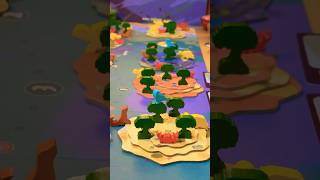
The play area centers on a long central board with hexagonal tiles representing different islands. As players explore and develop these islands over eight rounds, the board transforms from a barren landscape into a populated ecosystem. Each player has their own player board with number-indexed spaces for placing modifier tiles, and these personal boards become increasingly customized as the game progresses. The archipelago grows not just aesthetically, with 3D stacking pieces representing island elevation, but strategically: the accessible research opportunities and scoring pathways shift as the board develops. This design choice keeps the experience feeling fresh across playthroughs, though reviewers noted that the long board layout creates spatial problems in two-player games, where one player's starting area fills up quickly, leaving the far end of the board unused for much of the game.
The Emerge Experience
Island Discovery and Biodiversity Building
For those engaged by it, Emerge delivers a satisfying progression loop. You commit dice results to place animals and plants on your islands, building up their biodiversity. Research cards unlock new species and grant one-time bonuses. Over eight rounds, each turn feels purposeful as your custom board shapes which actions you can take. The production design supports this; the meeples representing crabs, turtles, and seals are vivid and thematic, and watching your islands stack higher and develop distinct ecosystems creates a tangible sense of progress. Reviewers who enjoyed the game praised this ascending arc and the payoff of a growing, populated island chain.
Deterministic Constraints and Limited Interaction
Others experience Emerge as restrictive and isolating. The placement rules are rigid: you must place crabs before turtles, turtles before seals, and large animals only on islands that have progressed through three growth stages. Combined with the deterministic dice mitigation, players often have only one or two viable moves each turn, reducing the sense of strategy. More critically, player interaction remains minimal. Since the board offers ample space and resources do not directly compete, players largely build in isolation. At two players, this remoteness becomes acute; reviewers reported spending several final turns unable to act meaningfully because they had built out their initial area and the distant portions of the board held no appeal. The result, for skeptics, is a game that feels more like solo puzzle-solving than competition.
What Makes Emerge Stand Out
Thoughtful Dice Mitigation
Emerge's most praised mechanical feature is its approach to randomness. Rather than leaving players at the mercy of dice rolls, the game equips them with Discovery tiles that can be placed over dice numbers on their player board, expanding which die values trigger which actions. This is not a single mitigation tool but a strategic layer: the specific tiles you acquire determine your flexibility, forcing decisions about which actions matter most to your emerging strategy. The design acknowledges that dice-driven games need player agency to remain engaging, and Emerge delivers this through board customization rather than re-rolls or ignores.
Visual Island Growth and Component Production
The three-dimensional island stacking system is Emerge's signature visual element. As players place larger animal meeples on islands, the physical board transforms, growing upward and outward. The artwork on both the central board and player components is polished and thematic, with naturalistic illustrations of ecosystems, flora, and fauna. Pandasaurus Games invested heavily in component production here, and reviewers consistently noted that the visual presentation is the game's greatest strength. Even critics who dismissed the overall design acknowledged that the aesthetic alone might draw casual or thematic-minded players.
Potential Drawbacks
Forgettable Gameplay and Limited Replayability
Emerge's most damaging criticism is its perceived blandness. Critics observe that the Research cards available each game are drawn from a small pool, and the discoveries players pursue follow similar arcs regardless of player count or table composition. The lack of scoring variety and minimal player interaction mean that repeated plays feel nearly identical. One reviewer compared it to Dice Settlers, a game that, when it came out, was similarly "immediately forgotten," mechanically sound but emotionally hollow. The eight-round structure compounds this: at only 75 minutes, the game is too short to justify the setup overhead, yet too long to feel zippy or decisive.
Deterministic Placement and Player Isolation at Low Counts
The strict placement hierarchy (crabs before turtles before seals) combined with abundant board space and the long-linear island track creates a game where optimal moves are often obvious and interaction between players rare. At two players, this becomes acute. The central board's unusual length means that each player begins in their own region and has little incentive to venture toward the other side. Reviewers reported games where the final turns offered no meaningful decisions because the active player's developed area was exhausted and the unexplored island regions held no immediate appeal. The game lacks the dynamic conflict or negotiation that would make these isolated decision points feel like strategy rather than autopilot.
If You Enjoy Emerge
Consider Dinosaur Island and After Us, both from Pandasaurus Games, which offer thematic euro experiences with richer decision-making and board development. Fox Experiment, also from Pandasaurus, provides a more streamlined take on discovery and exploration. If you appreciate the dice-mitigation mechanics, Dice Settlers and Quacks of Quedlinburg offer bag-building and push-your-luck systems that feel more engaging. For a game that nails the "growing ecosystem" fantasy with more interaction, Forever Home delivers lighter play without sacrificing narrative satisfaction, though at a lower price point than Emerge. Skate Summer, another Pandasaurus release, appeals to players who value novel themes and solid component production over mechanical innovation.
What Reviewers Are Saying
"This game kind of like wants to be more complicated but also not at the same time, cuz you're literally your entire game is rolling dice, hoping that you can get sets of numbers to place meeples on it."
— Board Games UnLocked
"I like the idea of customizing my own board and dealing with the randomness of dice. You emerge islands out of the water and you try to increase their biodiversity to get a bunch of points. All these things just sound lovely. This sounds like a game I'd really like to try."
— Getting Games
"This is a competitive strategy game where you are going to be taking on the role of scientists as you'd recently discovered a chain of new islands. You'll use your dice each round to collect research and make new discoveries. You watch the islands on your board grow in three dimensions as you learn about them and add colorful plants and rich wildlife to each of the islands' ecosystems."
— Board Game Sanctuary