/pic7090909.jpg)






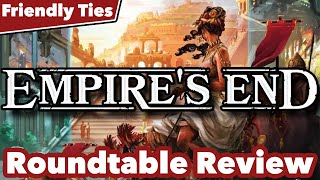






















Empire's End Deep Dive
What the Community Thinks About Empire's End
Empire's End occupies a unique space in modern board gaming. Reviewers consistently praise its elegant thematic design: instead of building up a glorious civilization, players watch their empires crumble around them and compete to be the least destroyed. The game has found an enthusiastic audience among those who enjoy tight decision-making and tense bidding mechanics, though it divides players based on their preference for planning versus adaptation.
Core Mechanics That Define Empire's End
The Reverse-Bidding Disaster System
Empire's End takes inspiration from the classic trick-avoidance mechanics of No Thanks, adapting them into a fuller board game experience. When a disaster card flips, players bid resources to avoid having that location destroyed. The tension comes from a fundamental push-pull: taking a disaster is bad because it destroys a tile and costs victory points, but it's also good because you gain all the resources that other players bid to avoid it. This resources then fuel future actions and help you take better disasters with powerful innovations attached. Reviewers describe this as creating delightfully hard choices where every turn presents meaningful sacrifice.
Engine Building Through Destruction
Rather than building a thriving economy, players construct engines by strategically letting locations burn. Disaster cards include innovations that attach underneath healthy locations, providing ongoing benefits. The more disasters you take early, the more innovations you can acquire. The challenge is deciding which locations are worth protecting and which can be sacrificed for the innovations that will strengthen the rest of your empire. This creates a satisfying tension where the optimal game state is not preservation, but strategic collapse and adaptation.
The Empire's End Experience
Sustained Tension and Tense Decision-Making
Players consistently describe Empire's End as tense throughout its entire runtime. The game never feels like a break in the action, even during economy phases where you're simply gaining resources. The visual reminder of your burning locations and the knowledge that more disasters are coming creates a foreboding atmosphere that matches the theme perfectly. Many reviewers note that you'll experience the five stages of grief during play, moving through denial, bargaining, and eventual acceptance that your empire will fall. Despite this relentless pressure, the shared misery creates a sense of communal sympathy: everyone is suffering equally, which prevents the game from feeling like anyone is being personally attacked.
Variable Setup and Divergent Gameplay
Everyone begins with identical empires represented by 11 location tiles, but from the very first disaster, paths diverge dramatically. Which locations get destroyed, which innovations each player draws, and how they rearrange their tiles through conflict phases all contribute to radically different board states. While the rules are accessible and can be learned as you play, the actual strategic variety comes from adapting to the hand you're dealt. Reviewers appreciate that you can plan several turns ahead using the visible turn track, but you must remain flexible as disasters emerge from the deck unpredictably.
What Makes Empire's End Stand Out
Beautiful Artwork Grounded in Meaningful Mechanics
The artwork by Quanchai Maria is consistently praised as gorgeous and thematic, featuring a shiny embossed effect on the destroyed side of location tiles that makes them appear to glow with fire. More importantly, the theme bleeds into every mechanical decision. Flipping a tile to show destruction is genuinely sad despite being optional, and the recovery of repairing a location feels earned and satisfying. Unlike many thematic games that feel disconnected from their mechanics, Empire's End makes disaster management and recovery feel natural and thematic.
Approachable Rules, Deep Gameplay
Empire's End presents straightforward rules that don't require extensive upfront explanation. Iconography is minimal and color-coded by phase, making it easy to process what various innovations do. The game speeds up after the first play as players become familiar with patterns. Despite this accessibility, the actual decision-making is remarkably deep. Limited resources, hidden information about what other players have, and the tension between protecting high-value locations versus letting them burn to fuel your engine create substantial strategic depth. The innovation cards provide multiple paths to victory without overwhelming new players.
Potential Drawbacks
Random Variance and Player Scaling Issues
The biggest criticism from reviewers concerns the game's reliance on luck. Which disasters come out of the deck is entirely random, and some players may find their high-value locations repeatedly targeted while others are spared. Unlike many games with luck mitigation, Empire's End offers few ways to control the chaos. Additionally, the game doesn't scale cleanly across player counts. Two players can feel tight on resources, four players can feel punishing with extra disasters, and the game length balloons, reviewers consistently report 75-90 minutes despite the box claiming 45-60 minutes. Three players appears to be the optimal count, but scaling adjustments aren't built into the system.
Limited Player Interaction and Memory Challenges
Because resources are hidden behind privacy screens, players can't effectively deduce whether opponents can continue bidding. This makes hidden information feel like a source of randomness rather than a tool for skilled play. Additionally, the game involves some memory challenges when trying to track what resources other players might have spent, which some find tedious. The multiple paths to victory are interesting in theory but can lead to analysis paralysis during the industry phase when players consider which cards to buy, sell, or reserve for future rounds.
If You Enjoy Empire's End
Players who love No Thanks and want a fuller game experience should absolutely try Empire's End. It appeals strongly to those who enjoy the chaos-agent playstyle over careful planning, and to anyone looking for a game where bluffing and uncertainty create memorable moments. The game works best with players who can appreciate catastrophe with humor and don't mind watching their carefully laid plans burn. If you enjoy clever auction mechanics, engine building, or games where theme deeply influences mechanical decisions, Empire's End delivers on all counts. It's a conversation starter and a game that generates stories about how your empire fell apart and what you managed to salvage from the wreckage.
What Reviewers Are Saying
"A game of give and take where the Highlight is that every game starts the same for every person, but because of your decision making and the sacrifices, maybe mine was a little bit more prosperous than Tyler's."
— kovray
"Empire's End is a game about delaying the inevitable. It's literally the 'this is fine' meme as a board game. Your Empire is going to crumble at some point and you have to adjust your strategy on the fly if you're the type of person that really likes to see the fruits of your labor, this one might be a little tough for you."
— Might I Suggest A Game
"The core mechanic is definitely the highlight of the game, the idea that you look at the Innovation below and think maybe it wouldn't be too bad if I took it, but which location is it going to blow up? That's a really angsty decision every time a disaster flips up."
— The Broken Meeple