/pic3710565.png)
In the fantasy card-drafting game Enchanters, you create an artifact and upgrade it each turn. Every card you take retains some of its power. As you grow stronger, you can take on more powerful monsters and, if you plan well, even defeat a dragon.
To set up the game, each player takes five crystals, then you shuffle together as many kingdom decks as the number of players, then lay out six cards (either items of enchantments) on the journey track. In the game, players take turns to embark on quests, collecting cards from the journey track by paying with crystals. Acquired cards are placed into adjacent stacks, with something like "Long Sword" going into the item stack and cards like "of Fire" going into the enchantment stack; combined, these cards create the "Long Sword of Fire", and cards grant both temporary bonuses (upper icons and skills) and permanent ones (bottom icons).
Players may attack approaching monsters and defeat them in a simple combat encounter to score points. In combat, you compare your defense against the monster's strength to determine whether you receive damage. Then, you need to accumulate as much attack as the monster's health to defeat it. You keep defeated cards as trophies.
From time to time, you rest in the village to gain crystals or heal wounds. If you do, discard the first card from the journey track. At the end of each turn, replenish the journey track to six cards.
The game ends when the last card is taken or discarded.

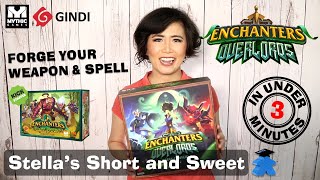
- Basic rule set is simple and approachable.
- High replayability through kingdoms and variants.
- Supports 2-4 players.
- Abundance of kingdom options and variant rules can be overwhelming.
Mechanics (from transcript analysis)
- Card Drafting — Taking cards from a common area one at a time to form your deck (artifacts/enchantments).
- Engine Building — Building an enchantment pile that provides benefits as cards are uncovered and stacked.
- Kingdom deck customization — Using a kingdom deck of cards to form the common deck.
- Resource Management — Managing strength and money to defend monsters and take boons.
- scoring and penalties — Gaining glory points by defeating monsters and handling negative points (SH).
Video topics + discussion points
Quotes (from this video)
- the basic rule of the game is simple which is nice
- defeating monsters and trying to afford one SH, one worth a negative point
- I like the thought of almost endless possibilities in a game like this one where they keep bringing new kingdoms and other
- adding even more replayability and variants to the game
- Now in chanters East Quest is coming to Kickstarter
References (from this video)
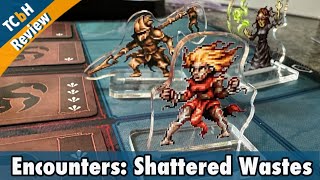
- Honors the JRPG genre's tone, aesthetic, and substance beyond a simple aesthetic cash-in.
- Tactical nuance in spacing and order of operations.
- Addictive if slightly janky gameplay that works in its favor.
- Diverse hero abilities and stats lead to enjoyable combinations.
- Climactic, desperate, and theatrical arcs due to boss leveling and hero shattering.
- Stylish with nuance and substance.
- Campaign mode feels like a half-measure, wishing for more development, hooks, locks, larger scale decisions, story progression, character progression, leveling up, skill development, and more strategic growth.
- Can be challenging to get into a good groove with threat card rhythm, requiring frequent rulebook consultation initially.
- Potential for quarterbacking in cooperative play.
- JRPG era
Mechanics (from transcript analysis)
- Boss Battler — Each session pits two to four heroes in a turn-based battle against an automated boss with its own unique stats, powers, and behavior deck.
- campaign mode — An alternative way of playing through a light campaign mode that has persistent damage, a roster of heroes that dies out, and accompanying unique locations and equipment cards.
- Dice Rolling — Dice are rolled for hero attacks and threat actions, with rolls influencing success, critical hits, and rest actions.
- Hero shattering — Heroes can shatter into a more powerful but doomed side of their character with stronger passive powers, rolling more attack dice, and landing easier critical hits, fueled by corruption.
- Threat cards — Threat cards are drawn from the boss's stamina deck or fatigue stack and placed in lanes. They represent the boss's health and timed attacks.
- threat management — Players need to manage threat cards, hero threat levels, and boss rage cards to avoid damage and destruction.
Video topics + discussion points
Quotes (from this video)
- Encounters shattered waste the self-published Boss battler by Ryan farmer is one of the few to go beyond simple aesthetic cash in and reach for something that tries to honor the overall UA the the tone the aesthetic and the substance of the genre.
- The game does a fantastic job of telegraphing possibility and leaving in your hands to work around so exploits and Jank become worthy allies.
- Encounters is such a specific type tile relying on both a love of really hard tactical Cooperative games and the 80s and 90s jrpgs that it evokes making it very much fitting into the not for everyone camp but it's got the goods I mean yeah it has style but there's a lot of nuance and substance too aware that inspiration and homage goes far beyond than just nailing A vibe.