



Escape from Colditz Deep Dive
What the Community Thinks About Escape from Colditz
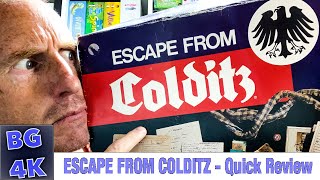
Reviewers approach Escape from Colditz with a mix of affection and disappointment. Board Games 4K describe it as a classic they have owned for decades and played as children during long summer holidays, but they also say that the game has not aged well and that it is now mostly a source of nostalgia. The Discriminating Gamer, who discusses a later reprint from Osprey Games, found the premise appealing on paper and then felt let down once the game was on the table. The shared view is that Escape from Colditz captures a strong World War II atmosphere and offers an engaging idea, with prisoners plotting escapes against a German guard player, but that its luck-driven mechanics often overwhelm the choices players are supposed to make. Even the more sympathetic voices tend to recommend it for the memories it brings back rather than as a game they would reach for today.
Core Mechanics That Define Escape from Colditz
Roll, Move, and Collect
The central engine is a roll-and-move system. On their turn, an escape officer rolls two dice and divides the total movement among their prisoners, so one prisoner might move a single space while another moves two. Doubles grant another roll, and a roll of 3, 7, or 11 lets the player draw an opportunity card. Those cards supply the tools of escape: a move fast card to reach a room quickly, parts of an escape kit, keys, and rope cards for climbing walls. The board reinforces this with obstacles that require specific items. A 30 foot wall needs one rope card and a 60 foot wall needs two, while passing through a gate or key space requires a key or pass. Equipment is found by placing prisoners in rooms that hold it, and the German player responds with its own roll-and-move turns and security cards such as the appel roll call, which forces every prisoner into the central courtyard, and arrest cards that send prisoners to solitary confinement. Board Games 4K describe this structure as the backbone of the game, and they note that the German guards cannot make arrests in the rooms around the courtyard, which shapes where prisoners feel safe.
Do or Die and Bluffing Over Equipment
Escape attempts are the climax of each session. Late in the game, escape officers may draw a do or die card, which sets a maximum number of dice rolls available to make a break for freedom. Board Games 4K point out that the values run from three to seven, so a generous draw gives a real chance to get out while a poor one is almost certainly fatal. Failure ends the game for everybody, which the reviewers see as a deliberate way to stop the game from dragging on. Around this core, the rulebook allows players to auction, sell, or gift equipment cards to one another. Board Games 4K single this out as the element that adds bluffing and bargaining to the experience, since a player can signal an intended route while secretly preparing another.
The Escape from Colditz Experience
Wartime Tension and Thematic Immersion
The most consistent praise concerns how strongly the game feels like a prison break. Board Games 4K say the theme is saturated, and they compare the mood to the film Where Eagles Dare because the characters are inside a castle while trying to get out. The board is divided into the inner courtyard, the rooms around it, the outer courtyard, and the territory beyond the walls, and that layout gives the sense of a fortress with distinct zones to cross. Even the Discriminating Gamer, who found the mechanics wanting, acknowledges that the 1960s-style artwork and pawns evoke the period and that the appeal of that look will be strong for some players. For many reviewers, the theme is the thing that keeps the game feeling special even when the rules are frustrating.
Cat-and-Mouse Plotting Against a Rival
Board Games 4K describe the most exciting part of the game as plotting an escape against one other player while the rest of the table works on their own routes. Their account highlights the value of feints, where a prisoner appears to head for the wire but actually goes over the wall, and of baiting the German player into sending guards the wrong way. Because the escape officers are competing to be the first to get two prisoners out, every move carries a suspicion that someone else is planning something similar. Board Games 4K also note that the game was one of the early examples of a one versus all design, which gives it historical interest for collectors and older players.
What Makes Escape from Colditz Stand Out
Scales Across Two to Six Players
Reviewers consistently point to the way the game adjusts to different table sizes. Board Games 4K explain that a two-player game gives each side more prisoners and fewer guards, while six players means fewer prisoners and more guards, so the balance shifts with the group. They say they have played it at most counts, though not at five, and they feel the design works across the range. For groups that want a game that accommodates a small table or a larger one, this flexibility is presented as a genuine strength, and it is one of the reasons the channel recommends not being put off by the age of the design.
Historical Depth in the Rulebook
Board Games 4K single out the rulebook as more than a set of instructions. They describe a substantial backstory about the real castle and the escapes that took place there, along with original photographs of the building. In their view, the research behind the game shows, and the extra material helps players understand how difficult imprisonment at Colditz was. This historical context reinforces the theme and turns the game into a way of learning about the period, which many reviewers value even when they are less enthusiastic about how the dice and cards play out.
Potential Drawbacks
Luck That Can Erase Progress
The harshest criticism is that Escape from Colditz is dominated by chance. Board Games 4K argue that the number of opportunity and security cards a player receives depends on rolling a 3, 7, or 11, and that a player who rolls none of them may be left without the rope or keys needed to progress. They describe that situation as arbitrary and frustrating, and they say the game can leave players wandering the board with nothing useful to do. The Discriminating Gamer makes a related point about a particularly painful loss. After gathering the items for an escape, a single guard can wander into a prisoner‘s path, and the whole collection is lost. That reviewer argues that in any game with a goal, players need to feel they are making progress, and that losing hard-won progress without a way to mitigate it is not fun. They also observe that a good game should give players choices that matter more than the dice, and they felt this design offered too little to counter the randomness.
A Thin German Role and Unclear Victory
The second major complaint concerns the German player. Board Games 4K say that aside from waiting for a useful security card, there is often little for the guard player to do, and they describe moving pieces simply because the dice demand it, even when every guard is already in position. They also criticize the lack of a clear win condition for the Germans. The rulebook, as they read it, suggests a time limit of about two and a half hours for new players and asks the group to agree a success formula before starting, which they consider an unsatisfying way to define victory. Their frustration with the hidden information also comes through in their account of an escape being foiled by a card played at the perfect moment. Because players cannot easily learn what others are holding, they say the best escape route is a matter of guesswork rather than skill, and each failure forces a restart. Board Games 4K ultimately rate the game as a chore to play today, even while acknowledging that it is still enjoyable for nostalgia.
If You Enjoy Escape from Colditz
- Stronghold: Board Games 4K note that the castle maps of Escape from Colditz look remarkably similar to those in Stronghold, and they suggest the Stronghold designer may have drawn inspiration from the older game when creating a castle layout.
Beyond Stronghold, the reviewers do not name other board games as close comparisons, so this list is short. The film Where Eagles Dare is the other reference point they offer, and it is a movie rather than a game, but it captures the same sense of being inside a fortress while trying to get out.
What Reviewers Are Saying
"At the end of the day, the theme almost successfully masks the fact that this is a random luck fest. I mean, it almost pulls it off."
— Board Games 4K
"in any game where there‘s a goal, you want to feel like you‘re making progress toward that goal. And if you spend like a long time making progress and then it‘s all gone like that, that‘s not fun to me."
— The Discriminating Gamer
"I remember playing this back in the 70s and 80s and um it was good back then, but things have moved on and we played it again recently and it‘s not that good."
— Board Games 4K