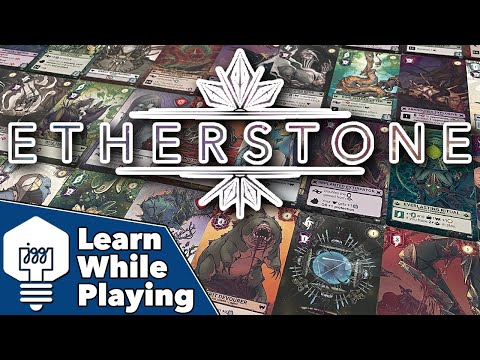












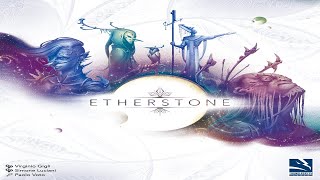








Etherstone box art

Etherstone

Game ID: GID0117522
Game Info
Year
2024
Players
4
Age
14+
Collection
Rating
Mechanic profile
Not enough video data yet
Vibe profile
Not enough video data yet
Description

Nobura is a forgotten planet shrouded in mystery. The story told that a cosmic being sacrificed its divine essence to breathe life into its desolate lands. Etherstones shaped the planet's biomes and interconnected all living beings with nature.
Yet, the lurking threat of the Vacuous, a parasitic force born from the depths of Nobura, poses a challenge to life on the surface, weaving a tale of divine sacrifice. Nobura has always been part of a paradoxical loop of life and death, where the forces of creation and destruction dance in an eternal cosmic struggle.

In Etherstone, players embody faction leaders uniting forces to avert the impending extinction, striving to gain the most victory points through various means, such as summoning cards, overcoming threats, and utilizing their abilities as effectively as possible.

The first stage of the game will be drafting your hand of 7 cards and your leader card, alternatively for the first few matches, players can take a pre-made hand of cards with the matching Leader.

Leaders have a set number of life points, a strength value, and a persistent asymmetric ability.

The game is played in turns starting with the first player and going clockwise.

There are three types of cards in the game:

Followers: That can help you during the attack when facing a threat.
Rituals: Powerful spells
Technology: Artifacts that can modify your game strategy

Cards might also have abilities that activate during dice drafts based on the drafted color or number.

During your turn, you can take only one action among the following:

1) Dice Draft: Etherstones contain concentrated Ether, and they can be spent by players to summon cards and activate powerful effects. Five different dice representing each of the Etherstones are rolled in the center of the table.
Players can draft one die from the ones available on display to immediately get 2 etherstone tokens of that color and eventually activate any summoned card effects by taking into account the drafted color and face value of the dice.

2) Summon: Players summon one card from their hand by paying the relative Etherstone cost in tokens.

3) Attack: With this attack action, the player overcomes one Threat card from the center of the table. They begin the attack action with an attack value of 0. They must decide if they, as the Leader, want to personally join the attack. If so, they add the strength value of their Leader card to their attack value, but they will also be vulnerable to taking damage from the Threat. Leader cards are never exhausted, so their card is kept upright even when used.

After this, they may exhaust any number of their Ready Followers to add the Follower’s strength to their attack value. Exhausted Followers are turned to the side to show they may not be used in attack actions until rested.

4) Rest: Ready all your cards and skip the turn.

5) Void Pact: In case the Leader is defeated, players will skip the turn to revive their leader at full health and gain a void pact token that will be worth negative victory points at the end of the game.

There is no winning strategy or play style.

Players will win by gaining victory points while doing several different actions and the game will end if any of the following three end-game conditions are met:

The active player has cards left in their hand.
There are no cards left in the Threat deck.
The victory point pool has no more tokens in it.

—description from the publisher

Description

Nobura is a forgotten planet shrouded in mystery. The story told that a cosmic being sacrificed its divine essence to breathe life into its desolate lands. Etherstones shaped the planet's biomes and interconnected all living beings with nature.
Yet, the lurking threat of the Vacuous, a parasitic force born from the depths of Nobura, poses a challenge to life on the surface, weaving a tale of divine sacrifice. Nobura has always been part of a paradoxical loop of life and death, where the forces of creation and destruction dance in an eternal cosmic struggle.

In Etherstone, players embody faction leaders uniting forces to avert the impending extinction, striving to gain the most victory points through various means, such as summoning cards, overcoming threats, and utilizing their abilities as effectively as possible.

The first stage of the game will be drafting your hand of 7 cards and your leader card, alternatively for the first few matches, players can take a pre-made hand of cards with the matching Leader.

Leaders have a set number of life points, a strength value, and a persistent asymmetric ability.

The game is played in turns starting with the first player and going clockwise.

There are three types of cards in the game:

Followers: That can help you during the attack when facing a threat.
Rituals: Powerful spells
Technology: Artifacts that can modify your game strategy

Cards might also have abilities that activate during dice drafts based on the drafted color or number.

During your turn, you can take only one action among the following:

1) Dice Draft: Etherstones contain concentrated Ether, and they can be spent by players to summon cards and activate powerful effects. Five different dice representing each of the Etherstones are rolled in the center of the table.
Players can draft one die from the ones available on display to immediately get 2 etherstone tokens of that color and eventually activate any summoned card effects by taking into account the drafted color and face value of the dice.

2) Summon: Players summon one card from their hand by paying the relative Etherstone cost in tokens.

3) Attack: With this attack action, the player overcomes one Threat card from the center of the table. They begin the attack action with an attack value of 0. They must decide if they, as the Leader, want to personally join the attack. If so, they add the strength value of their Leader card to their attack value, but they will also be vulnerable to taking damage from the Threat. Leader cards are never exhausted, so their card is kept upright even when used.

After this, they may exhaust any number of their Ready Followers to add the Follower’s strength to their attack value. Exhausted Followers are turned to the side to show they may not be used in attack actions until rested.

4) Rest: Ready all your cards and skip the turn.

5) Void Pact: In case the Leader is defeated, players will skip the turn to revive their leader at full health and gain a void pact token that will be worth negative victory points at the end of the game.

There is no winning strategy or play style.

Players will win by gaining victory points while doing several different actions and the game will end if any of the following three end-game conditions are met:

The active player has cards left in their hand.
There are no cards left in the Threat deck.
The victory point pool has no more tokens in it.

—description from the publisher

Ask a Rules Question
All mentions
Browse transcript mentions, sentiments, pros/cons, mechanics, topics, quotes, and references.
Total mentions: 7
This page: 7
Sentiment: pos 6 · mix 1 · neu 0 · neg 0
Mentions per page
Showing 1–7 of 7
Video 8wtsVtkyefU Review at 0:16 sentiment: positive
video_pk 67186 · mention_pk 163163
Etherstone video thumbnail
Click to watch at 0:16 · YouTube ↗
Overall sentiment (raw)
positive
Pros
  • Sheer amount of unique cards
  • High replayability due to drafting
  • Players have a lot of agency in their card selection
  • Multi-use cards add depth
  • Threats give players something to do
  • Stunning artwork
  • Cool dice system with multi-use dice
  • Satisfying combos and engine-heavy gameplay
  • More player interaction than Res Arcana
  • Quick to play and set up
  • Differentiates itself enough from Res Arcana
Cons
  • End game trigger (playing all cards) can feel abrupt
  • Some cards can become useless if not drafted well
  • Wording on cards and icons can be unclear
  • Rulebook doesn't answer all questions
  • Player interaction can be 'mean' if not prepared
Thematic elements
Comparison games
  • Res Arcana
  • Magic the Gathering
  • Arboreia
Mechanics (from transcript analysis)
  • card drafting — Players draft their starting hand of seven cards, influenced by their chosen leader, adding agency to setup.
  • Dice rolling — Dice are used to gain resources (gems) and trigger card abilities, adding variability and combo potential.
  • engine building — The core of the game involves creating synergies between cards to build an effective engine.
  • hand management — Players draft a hand of seven cards and utilize them to build an engine.
  • player interaction — Interaction occurs through cards that affect opponents' health or by drafting dice that opponents might need.
  • Resource management — Managing gems and other resources to play cards and activate abilities.
  • set collection — Collecting resources or fulfilling conditions on cards to gain points or activate abilities.
  • threat management — Players can engage with 'threat' cards that provide points or abilities when defeated.
Video topics + discussion points
No key topics recorded for this video.
Quotes (from this video)
  • This art is is absolutely amazing. Like it it's pretty much the focal point.
  • I do actually really like the dice system in this game a lot more. It just adds more of like variability, if that's even a word, to the uniqueness of the cards here.
  • I really really like this one. It's It's quick as well to play, quick to set up. Like, this is a a very awesome compact game that differentiates itself enough from kind of what is clearly the inspiration of Res Arcana, that you don't feel like you're just playing Res Arcana, you know, which is awesome.
References (from this video)
No references stored for this video.
Video ZrI5PfAZNRY Review at 0:05 sentiment: positive
video_pk 67142 · mention_pk 163121
Etherstone video thumbnail
Click to watch at 0:05 · YouTube ↗
Overall sentiment (raw)
positive
Pros
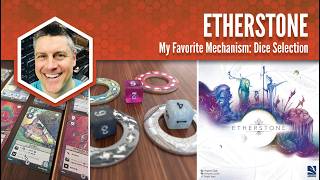
  • Really enjoyed the dice selection.
  • Turns are quick and snappy.
  • The dice are nicely color coded with rings for colorblind accessibility.
  • Gaining two resources based on die color is straightforward.
  • Numbers on dice have an impact on triggering ongoing abilities.
  • Many combos are driven by getting specific dice.
  • Adds tension because players choose when to draft dice.
  • Player interaction through monitoring opponent's needed dice.
  • Choice of focusing on specific numbers or a wide range of numbers for card triggers.
  • Cards can trigger off of colors of dice.
  • Works well due to combo mechanism and tension from other players potentially taking dice.
  • Being reduced to zero life doesn't mean losing, but a victory point penalty.
  • Three different end game conditions create tension.
  • Abilities are explained in text with icons, making replay easier than Res Arcana.
  • It scratched a nice combo itch.
Cons
  • Victory point tracking on cards is initially confusing.
  • Might have said the wrong thing about victory points initially.
  • A small penalty accompanies choosing purple dice.
  • The number on the die might seem irrelevant for resource count initially.
  • Opponents might draft dice before you can get to them.
  • Not quite as punishing as Agricola when life is reduced to zero.
Thematic elements
Comparison games
  • Machi Koro
  • Catan
  • Space Base
  • Agricola
  • Duel for Middle-earth
  • Res Arcana
Mechanics (from transcript analysis)
  • Card Play — Players play cards that have ongoing abilities, costs, victory points, and subtypes, forming the core engine of the game.
  • dice selection — Players select dice from the middle of the table, gaining resources based on the die's color and potentially triggering card abilities based on its number.
  • End game trigger — There are three distinct conditions that can end the game, creating strategic tension.
  • Push Your Luck — Players can be reduced to zero life, taking a victory point penalty but remaining in the game, which is described as a possibility that can happen.
  • Resource management — Players gain resources of specific colors when selecting dice, which are then used to play cards or activate abilities.
  • set collection — Players can focus on collecting cards that trigger off the same numbers or off all types of numbers, and also cards that trigger off of colors of dice.
Video topics + discussion points
No key topics recorded for this video.
Quotes (from this video)
  • I really, really enjoyed my first play of it.
  • I really enjoyed the dice selection.
  • Turns are quick and snappy in this game.
  • It has a little bit of that feel of a game like Machi Koro or or even Catan or Space Base, one of my favorites, in that you are hoping to see certain dice rolled, but you aren't at entirely at the whim of the dice that are rolled because you're choosing when exactly you were going to draft the dice.
  • It really scratched a nice combo itch for me.
  • Man, I love this game.
References (from this video)
No references stored for this video.
Video alkEwgn7fAk Let's Table It News at 6:06 sentiment: mixed
video_pk 61952 · mention_pk 154561
Let's Table It - Etherstone video thumbnail
Click to watch at 6:06 · YouTube ↗
Overall sentiment (raw)
mixed
Pros
  • Gorgeous art
  • Deluxe components appealing
Cons
  • First-time publisher risk
  • Table hog due to large components
Thematic elements
  • Reputation-building and area control
  • Not specified; Euro-style theme around area control and reputation mechanics
  • Euro-style engine with narrative flavor
Comparison games
none
Mechanics (from transcript analysis)
  • action_selection — Players select and chain actions to achieve goals.
  • multi-turn planning — Players plan sequences of actions to optimize reputation/territory.
Video topics + discussion points
No key topics recorded for this video.
Quotes (from this video)
  • it's hugely popular everybody really seems to love it
  • I don't know if we really need anything bigger
  • Ace of Aces and this whole Ace Series has been around a long time
  • for what you're getting I think it's a decent price
  • the art is gorgeous
  • minis look amazing
References (from this video)
No references stored for this video.
Video Vco2x1pg3dw DaniCha Rules Teach at 0:00 sentiment: positive
video_pk 60878 · mention_pk 153307
DaniCha - Etherstone video thumbnail
Click to watch at 0:00 · YouTube ↗
Overall sentiment (raw)
positive
Pros
  • Dynamic location deck that refreshes and changes during play
  • Multiple action columns offering varied strategic options
  • Clear solo mode with defined endgame conditions
Cons
  • Setup and rule complexity can be intimidating for new players
  • Requires careful tracking of relics, workshop placements, and influence tokens
Thematic elements
  • exploration, relic collection, and reputation progression
  • a modular board with locations and resource tracks, managed through actions and relics
  • procedural, instructional overview of gameplay mechanics
Comparison games
none
Mechanics (from transcript analysis)
  • Barter and Ignis market — move to Ignis to buy relics and claim rewards; market cards refill as you acquire relics; Ignis provides rewards and potential influence choices
  • end game bonuses — solo mode features global achievements that influence movement on reputation tracks; endgame triggers when certain conditions on the track are met
  • Endgame and global achievements — solo mode features global achievements that influence movement on reputation tracks; endgame triggers when certain conditions on the track are met
  • exploration — move to a chosen location using Caravan and gain the location bonus; if another player has influence there, costs may be incurred and bonuses allocated accordingly; location cards refresh as you explore
  • Harvest (dice-driven resource generation) — roll three dice and compare results to a market discovery; dice can be manipulated with resources to meet a desired combination, moving influence tracks or gaining resources
  • Relic management and repair — you pay costs to sell or keep relics, which can move you on influence or reputation tracks and grant resources; relics can be relocated or revalued via repair actions
  • Workshop and relic actions — relics can be kept, sold, or used to trigger relic actions; uncovered relics enable actions in the workshop; placement restrictions apply if relics are in a workshop
Video topics + discussion points
No key topics recorded for this video.
Quotes (from this video)
  • regain one of each of those resources
  • before I end this video I do want to talk about how the solo opponent would play
  • I hope this was helpful to you
References (from this video)
No references stored for this video.
Video yRp7wctnQQs Stonemary Games Discussion at 17:12 sentiment: positive
video_pk 29653 · mention_pk 87099
Stonemary Games - Etherstone video thumbnail
Click to watch at 17:12 · YouTube ↗
Overall sentiment (raw)
positive
Pros
  • Beautiful art and color use; thoughtful accessibility details
Cons
  • Partial dice selection; depends on group preferences
Thematic elements
  • dice-driven, colorful artistry
  • fantasy dungeon-dwelling with mystical stones
  • immersive, thematic
Comparison games
none
Mechanics (from transcript analysis)
  • color-coding and accessibility features — Pattern-based rings for color-blind players to distinguish dice.
  • dice drafting — Use dice of distinct colors to execute actions.
  • dice drafting / selection — Use dice of distinct colors to execute actions.
Video topics + discussion points
No key topics recorded for this video.
Quotes (from this video)
  • Color is a big part of it.
  • I'm a sucker for translucent dice.
  • Just take my money. I don't have to see the game. Just take it.
  • I love dice.
  • colorblind friendliness is something too.
  • Rolling Realms is those lovely chunky dice, lovely big old dice.
References (from this video)
No references stored for this video.
Video uqy-T1bQ65I Getting Games Review at 0:30 sentiment: positive
video_pk 8276 · mention_pk 24256
Getting Games - Etherstone video thumbnail
Click to watch at 0:30 · YouTube ↗
Overall sentiment (raw)
positive
Pros
  • Engaging draft-and-play loop with meaningful decisions
  • High interactivity and table pacing that creates tense moments
  • Flavorful art and memorable card names like Chin Chin Chewy
  • Flexible synergy with leaders and void cards enabling varied strategies
  • Strong teachability and fast initial rule explanation
Cons
  • Early game can be slower due to expensive cards and deck building
  • Heavy interactivity may not suit all playgroups
  • Card costs can be high, delaying early board development
  • Starter decks may include potentially broken combos to exercise caution
Thematic elements
  • hand management and real-time table-wide interactions via card play
  • Fantasy world with ether-energy and monster combat
  • epic fantasy with modular card synergies
Comparison games
none
Mechanics (from transcript analysis)
  • Area/board combat with table-wide effects — Attacks affect all opponents; there is no targeted attack—board state is shaped by simultaneous effects.
  • card drafting — You draft a seven-card hand by passing cards around and selecting options from a shared deck; you then use those cards to play into the table.
  • Corruption/penalty track — If a player's health reaches zero, corruption tokens are scored and may cause skip-turn situations or severe penalties at endgame.
  • Drafting cards and dice — You draft a seven-card hand by passing cards around and selecting options from a shared deck; you then use those cards to play into the table.
  • Exhaust/ready cycle — Units can be exhausted to attack; there is a ready mechanic that refreshes units to act again.
  • hand management — A seven-card hand is the entire decision space; players plan and stage their plays around these cards.
  • Leadership drafting — Players draw two leaders from which they pick one, shaping drafting strategy and deck-building direction.
  • Resource management — Ether stones are gained by taking dice and are spent to fulfill card costs; some cards generate or consume ether stones for effects.
  • Resource system (ether stones) — Ether stones are gained by taking dice and are spent to fulfill card costs; some cards generate or consume ether stones for effects.
  • Voids and tech card synergy — Void and technology cards interact with costs and global effects, enabling strategic synergies and disruptive plays.
Video topics + discussion points
No key topics recorded for this video.
Quotes (from this video)
  • This is a brand new game.
  • It came out from Thundergri Games.
  • It was fulfilled recently.
  • I actually backed this game so I paid for it.
  • Although I am super biased about this game.
  • I wrote the rule book for this game and I did a bunch of proofing passes on this game.
  • This is a game where you start off with drafting and then you play cards from your hand.
  • When you put these cards down, they do stuff.
  • There is no targeted attacks in this game. If you ever do an attack, it hits everyone around the table.
  • I really enjoyed the drafting and I enjoyed the card play.
  • I enjoyed the drafting.
References (from this video)
No references stored for this video.
Video JZK_zPsacRM BoardGameGeek Top List at 1:36:15 sentiment: positive
video_pk 621 · mention_pk 1818
BoardGameGeek - Etherstone video thumbnail
Click to watch at 1:36:15 · YouTube ↗
Overall sentiment (raw)
positive
Pros
  • Rich asymmetry and tactile components
  • Deep strategic depth with multiple paths to victory
Cons
  • Rule complexity and potential for analysis paralysis
Thematic elements
  • Exploration and conquest on a hex map
  • Post-apocalyptic, post-mend spectrum with tribal factions
  • Asymmetric factions with tech-tree progression
Comparison games
none
Mechanics (from transcript analysis)
  • Area control and faction-driven objectives — Control and expand on a hex-based map with objective variety
  • Deck drafting and dice drafting — Faction-driven decks with dice selection influencing actions
Video topics + discussion points
No key topics recorded for this video.
Quotes (from this video)
  • Three years. That's just crazy to me.
  • It's always a challenge looking through the preview list to pick out games for this.
  • You can definitely feel the excitement for Spiel Essen 2025.
References (from this video)
No references stored for this video.
Transcript Navigation
Top
Showing 1–7 of 7
Game Deep Dive
View on BoardGameGeek