Etherstone: My Favorite Mechanism
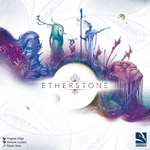
Games in This Video
1 game is featured in this video — it unlocks as you watch.
Transcript
Hey, I'm Jamey from Stonemaier Games and today I'm going to talk about my favorite mechanism in the relatively new game Either Stone, which I enjoyed so much and my friend Henry enjoyed it so much that Henry is now borrowing Either Stone even though I hope to play it more in the future. I really, really enjoyed my first play of it. Here are just a few of the components in the game. There are a lot of cards in the game and they're really nice card size. It's kind of a longer, taller card size to fit the art and some crucial information including things like the cost to play the card, the victory points it's worth at the end of the game, um card subtypes, card names, and card abilities down here at the bottom of the card. Actually, did I just say the wrong thing for the victory points? I may have. One of these is the victory points. I'm blanking on it right now which one it is. However, what's important here is the dice. I chose the dice intentionally to show you in this in this uh image because I really enjoyed the dice selection. It's close to dice drafting but not quite dice dice dice drafting because it's just one of different things that you could do on your turn.
Turns are quick and snappy in this game. You are doing one of a couple different things including maybe playing a card. You could um uh you can you can do a rest turn to replenish some of your your cards. You could do an attack turn where you attack some central cards, not the other players. And then there is the dice selection option. You can select a die. Uh these five dice are in the middle of the table and they actually they're nicely color coded in the middle of the table. So it's not just the die that you're looking at that's color coded but it also has a little cardboard ring around it. So if you are uh if you have color blindness of any sort, you can tell from the pattern on the ring which color die it is. No matter what the number on the die is, you gain two resources of that color. Or if you choose purple, you gain any two you choose one resource and gain two resources of that color and there's a small penalty to go along with it. Um Oh, that's what it is. Victory points and strength combat strength is down here at the bottom right.
Um So yeah, you draft that die, you gain two resources, no matter what the number is on it. And that might seem like why don't I look at the number to determine the resource count? It's because the number has another impact in the game and that is that many of the ongoing abilities in the game, including on this card right now, if I have this card in play and I draft a one or a two value die, then I get to trigger this ability. Um this has me gaining one life for every specific card type that I that I have in play. I also gain a victory point, which is a token that I'd be gaining if I have eight or more life at that time. So many of the combos in this game are driven by getting specific dice. It has a little bit of that feel of a game like Machi Koro or or even Catan or Space Base, one of my favorites, in that you are hoping to see certain dice rolled, but you aren't at entirely at the whim of the dice that are rolled because you're choosing when exactly you were going to draft the dice. It adds a lot of tension to the game, too, because I might have a few cards like this that want me to draft ones and twos, but you might also have a few cards like that.
And so I'm kind of choosing, okay, how much do you value these numbers versus me? And typically, at least in the first game that I found, we were paying attention to the other to the opponent's numbers um based on numbers that could hurt us because there are certain cards that could hurt opponents. And so, for example, I had a card that was a little damaging to my opponent if I selected a five or six die, and so my opponent was kind of keeping an eye on those fives and sixes and maybe drafting them before I could get to them at certain times, if possible. I keep using the term drafting. It's not dice drafting because it's just an action that you can choose to do on your turn, or the action that you can choose to do on your turn, is selecting a die. Again, you're getting two resources and then you can trigger a bunch of cards. It also gives you the wonderful choice of do I focus on cards that have the same numbers? So do I I get really good at at drafting ones and twos and trigger a bunch of abilities when I draft ones and twos? Or do I go wide and have cards that trigger off every type of number?
Um that's neat, too. And also, not shown here, let's see if there's one elsewhere that I can show you. There are cards that trigger off of colors of dice. So, that's why the color the dice need to have these color blind rings because there are a number of cards, believe this is one down here, that triggers when you draft this kind of light blue die. So, it looks at the colors and the numbers. It is really cool, and I think it works so well not just because of the combo mechanism, but also because of the tension that other players might select that die before you have the chance to get to it. Two other things I really liked about this game, among many things, it really it really scratched a nice combo itch for me, is uh you can be reduced to zero life in this game, but you don't lose. You aren't out if you do that. Rather, you get to replenish your life, but you take a victory point penalty. It's kind of akin to akin to not feeding your workers in a game like Agricola. Not quite as punishing as Agricola cuz it doesn't happen that often, but there is a possibility that can happen, and you're still in the game, you just get some negative victory points. And the other thing I really liked is that there are three different end game conditions.
There's a little bit of that tension that I love in games like um Duel for Middle-earth, where is the game going to end because uh we can't draw any more um any more enemies, any common enemies? Is the game going to end because a player has played all seven of their cards? Is the game going to end because all of the victory point tokens that are seated at the beginning of the game, all those are selected by players? So, three different ways to end the game, a little bit of tension there, something to keep in in track of between other players. This is an early contender, either stone, of one of my favorite games of 2026, even though I think it was a 20 In fact, I'm pretty sure it was a 2025 release. I really enjoyed the game. I have heard it compared to Res Arcana, which I have played a few times, haven't gone all that deep into it, but I I do enjoy it. But, one of the things I really like about Etherstone is that the abilities are explained in text with icons in the text, but the text really helps. So, it will be much easier for me to replay Etherstone than it is for me to replay Res Arcana after not playing for a while. Man, I love this game. I I Even just talking about it now, I'm like, I kind of want to get that copy of back copy back so I can play it again.
Um I hope you're having fun with it if you played it. If any of these things remind you of another game or maybe you have dice selection or dice draft and that adds nice tension, triggers cards as well, let me know about that in the comments below. Um or if you have a favorite mechanism in Etherstone, I will I would love to hear about that as well. Thanks.