/pic7672387.jpg)

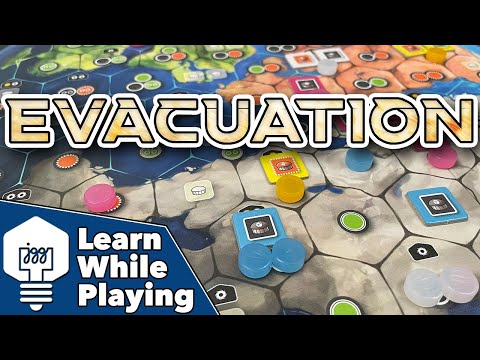



































Evacuation Deep Dive
What the Community Thinks About Evacuation
Evacuation has caught the attention of strategic board game enthusiasts worldwide, with reviewers praising its mechanical elegance and thematic coherence. The game, designed by Vladimir Sushi and published by Delicious Games, stands out in a crowded hobby as a title that successfully merges compelling theme with sophisticated gameplay. Multiple reviewers highlight this seamless integration as a defining strength, noting that the theme actively enhances understanding of the rules rather than obscuring them. This is particularly notable given Sushi's reputation for sometimes over-complicating his designs. Evacuation represents a refinement in his design philosophy, delivering what many describe as a mechanically brilliant experience grounded in genuine thematic resonance.
Core Mechanics That Define Evacuation
Dual-World Resource Management
At the heart of Evacuation lies an ingenious asymmetry that defines every decision. Players manage completely separate inventories across two planets, the old world and the new world, with strict rules preventing cross-world mixing except through spaceship transport. This dual-inventory system forces players into constant strategic tension. Early game turns involve abundant old-world resources and limited new-world supplies, creating a natural production economy. As rounds progress, the evacuation becomes more critical. Reviewers note that players must carefully dismantle their old-world economy while simultaneously bootstrapping a new one from scratch. One reviewer described it as a "perfect blend between theme and mechanics" where the game's progression directly mirrors the in-game narrative, making economy management feel thematically justified rather than arbitrary.
Progress Tracking and Biome Unlocking
The progress track serves as both mechanical and thematic centerpiece, representing satellite positioning that unlocks access to more productive regions of the new world. Players advance markers along this track by accumulating action power, with transition points triggering production penalties on the old world while granting settlement permissions for richer biomes. Reviewers praise this mechanism for creating dynamic tension, forcing players to balance between exhausting their old-world resources and gaining access to superior new-world production. The biome system itself (tundra, desert, forest, and sea) adds spatial strategy to the settlement phase, where placement affects both production values and settlement requirements, creating layers of long-term planning.
The Evacuation Experience
Four-Round Race Against Time
Evacuation plays across exactly four rounds, with two win conditions creating genuine tension. Either the game ends when one player reaches eight production in all three resources and builds three stadiums on the new world, triggering a final round for others to take equal actions, or the full four rounds conclude and scores are tallied. Reviewers emphasize that this dual-condition structure prevents the game from devolving into pure optimization. The threat of early-game victory keeps opponents engaged and prevents players from ignoring threats in favor of personal engine-building. The four-round structure itself creates a natural arc, with early emphasis on old-world execution giving way to desperate new-world settlement and production scramble by round four. One reviewer noted that the game generates moments of genuine regret, where early decisions haunt later progress, encouraging multiple plays to refine strategy.
Escalating Decision Complexity
The action selection system creates deepening complexity as the game progresses. Early actions are free, but subsequent actions cost increasing energy, forcing careful sequencing. The energy cost source shifts based on progress track position, requiring constant awareness of marker locations and energy availability. Reviewers describe the strategic depth as profound but accessible, noting that new players understand the basic loop quickly but find themselves discovering sophisticated lines of play through multiple plays. The tech tree system adds another layer, where researcher actions unlock powerful ongoing effects and abilities that cascade through subsequent turns. This creates the sensation of a "efficiency machine" that skilled players can optimize, which appeals strongly to reviewers who enjoy puzzle-like gameplay.
What Makes Evacuation Stand Out
Thematic Integration Without Sacrifice
Evacuation demonstrates exceptional alignment between thematic narrative and mechanical demand. The game literally forces players to evacuate their old-world infrastructure because the mechanics require it, not because flavor text suggests it would be nice. Every resource, every transition point, every stadium requirement reinforces the core concept: you must abandon a functioning economy and build a new one before your people and production capacity become worthless. Reviewers contrast this favorably with many Euro games where theme sits atop mechanics like icing on a cake. Here, the theme IS the mechanics. As one designer-enthusiast noted, Evacuation represents the "sweet spot between theme and mechanics" that Vladimir Sushi perfected better in this design than in prior works like Praga Caput Reni or Shipyard, both of which feature excellent strategy but sometimes feel mechanically dense or thematically thin by comparison.
Long-Term Planning and Skill Differentiation
The game rewards foresight and punishes short-term thinking mercilessly. Decisions made in round one ripple through rounds two, three, and four. Reviewers describe games where they felt regret over choices made early that created compounding problems later, and they appreciated this outcome. The high skill ceiling means that multiple plays reveal new strategic approaches, and player skill heavily influences outcomes over luck. The only significant luck factor involves which market cards appear for spaceship and stadium purchases, but reviewers note that strong players can adapt to whatever markets they face. This focus on pure strategy and planning creates an engaging experience for players who enjoy "optimization puzzle" games where efficiency matters. One reviewer spent considerable time analyzing the game's decision points and found themselves wanting to play again specifically to test better strategies.
Potential Drawbacks
Significant Complexity in Rules and Teaching
While reviewers praise the mechanical elegance of individual systems, they note that the overall ruleset is substantial. Teaching the game requires careful explanation of the dual-world inventory system, action sequencing with escalating costs, progress track mechanics, settlement restrictions, and tech tree advancement. One reviewer characterized the game as "relatively complex" and suggested that while the rules are not extremely difficult to teach in under 30 minutes for experienced gamers, new players may feel overwhelmed by the sheer number of moving parts. The game compensates somewhat through clear symbology and consistent rule logic, but it is not a game for casual players seeking a quick or simple experience.
Economic Tightness and Decision Paralysis
The economy in Evacuation is extremely tight and efficient. Reviewers note that players cannot afford to waste resources on blockage or spite moves because every resource has critical value. While this creates engaging decisions, it also means that some players may experience decision paralysis, especially on early turns when the full scope of consequence feels unclear. The game rewards forward-thinking planning, and players who prefer more reactive or flexible gameplay might find the tight economy constraining. One reviewer acknowledged this, noting that the only real risk is playing with someone who gets frustrated by the planning-heavy nature and the reality that early game mistakes are difficult to recover from.
If You Enjoy Evacuation
Players who love Evacuation typically gravitate toward other Vladimir Sushi designs, particularly Shipyard and Praga Caput Reni. These share similar production management and spatial planning elements. Outside Sushi's catalog, Evacuation appeals to fans of games like Agricola, Food Chain Magnate, and Kanban that require careful economic planning and multi-turn optimization. The game also resonates with players who enjoyed Machi Koro or Puerto Rico but want denser gameplay with higher skill differentiation. Reviewers mention that the game's focus on transition and transformation mechanics finds similar expression in games like Evolution or Pandemic Legacy, though Evacuation's scope is narrower and more economically focused. The four-round structure and dual-world management create an experience that stands largely on its own, making it a valuable addition to collections seeking sophisticated economic strategy games with thematic grounding.
What Reviewers Are Saying
"The mechanics of this game so perfectly are suited to what the game is about. I love this progress track and how the progress track shifts from efficiency on the old world versus increased efficiency on the new world. Having two inventories is thoroughly brilliant and gives you so much to think about and plan for."
— Board Game Dad
"The thing is I really really admire the art of designing a game that is a perfect blend between mechanics and theme. This one just lands for me and that's what I admire most about the game. It is thematically interesting and mechanically brilliant. The theme supports the rules, it makes sense. I think it's just a genius game."
— Board Game Dad
"I really want to cover this. I hope you agree with me soon because I really like the idea of that game. There's excellent thematic elements throughout this game. You still need the old planet to pay for your endeavor."
— Board Game Dad