





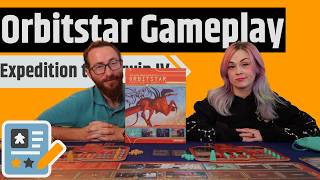
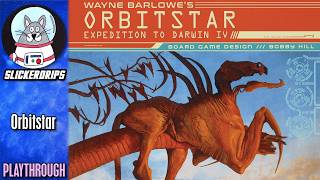
Orbitstar: Expedition to Darwin IV Deep Dive
What the Community Thinks About Orbitstar: Expedition to Darwin IV
Orbitstar: Expedition to Darwin IV has struck a chord with the board gaming community as a refreshingly science-first adventure that celebrates exploration and discovery rather than dominance or violence. Reviewers across multiple channels consistently praise the game's commitment to a decolonized approach, where players operate as scientists rather than conquerors, studying alien life forms while leaving the ecosystem undisturbed. The thematic foundation is exceptionally strong, built on Wayne Barlowe's iconic art book about an alien world, creating a sense of wonder and legitimate scientific engagement that feels rare in modern board games.
The game has earned recognition as one of the most thoughtfully designed bag-building experiences available today. BoardGameCo describes it as a "good game of combining basically bag building, building up your tableau, and then area control," with particular praise for how well the designer, Bobby Hill, executed the core systems. Rahdo's perspective is especially telling: the game lands at number 10 of the month as something Rahdo would "happily play anytime, anywhere," a marker of genuine enthusiasm distinct from mere competence.
3 Minute Board Games calls it a "gold medal game," and the praise isn't generic. Reviewers recognize this as a sharp, mechanically sophisticated design that delivers on its ambitions. However, the consensus also acknowledges meaningful caveats about player count and experience scope, particularly for two-player sessions and solo exploration.
Core Mechanics That Define Orbitstar: Expedition to Darwin IV
Bag Building
At its heart, Orbitstar is a bag-building game that departs meaningfully from the Dominion template most players know. Instead of a discard pile that automatically reshuffles when empty, players must strategically return to the Orbit Star to reset their bag of colored wedge discs. Each turn begins by drawing a handful of wedges (typically five to seven, depending on upgrades), then spending those in color combinations to perform actions. The system creates constant decision tension: do you have the colors you need right now, or should you accelerate your return trip to the Orbit Star to refresh your inventory?
This mechanic fundamentally shifts the game's rhythm. Reviewers note that the bag-building creates a puzzle similar to Concordia in how it shapes planning. You cannot simply grind forward indefinitely with your current pool; deliberate cycles of depletion and resupply structure your strategy.
Area Exploration and Movement
Players pilot hover cones from the Orbit Star down to Darwin IV's biomes, moving between zones to discover and study alien species. Each location has distinct color-cost requirements for movement, and the game forces constant relocation through a punishing event system. If you linger in a biome for two turns, you must draw a devastating planetary event that inflicts damage, removes research progress, or worse. This design choice ensures momentum, preventing players from camping and forcing exploration across the planet's diverse regions.
The area-control layer emerges from how players study the same creatures. Each alien card displays traits (fast, small, concealed, etc.), and players must match those traits with their disc colors to mark progress. When a creature is fully studied, whoever placed the most discs claims the card and both available upgrade bonuses; other contributors get one bonus each. This creates organic moments of collaboration disguised as competition.
The Orbitstar: Expedition to Darwin IV Experience
A Sense of Scientific Wonder and Exploration
The game achieves something boards games rarely attempt: it puts science on a pedestal. There is no combat, conquest, or resource extraction framed as triumph. Instead, players are here to observe, learn, and document. The Wayne Barlowe art is central to this atmosphere. Reviewers emphasize that the theme isn't window dressing but rather the entire point. The decolonized framing, where you leave only footprints (and even those not really, since you're in a hover cone), signals a genuine commitment to ethical exploration. This resonates deeply with players seeking games that celebrate knowledge-gathering over dominance.
Momentum and Urgency
The game maintains relentless forward momentum through its event system and mandatory movement. Events escalate stakes on the board (alien hunters appear, storms form, fuel pods are placed), and players cannot afford to ignore them. The planetary events that trigger from lingering in a zone are specifically designed to be punishing, making the decision to stay focused and deliberate. 3 Minute Board Games captures this perfectly: "The game forces you not to camp and to keep moving about. That combined with the claiming goals gives the game a real sense of momentum and urgency, which I like." This creates an engine-building experience that never feels stalled; there's always a reason to act, always a reason to plan your next move toward the Orbit Star.
What Makes Orbitstar: Expedition to Darwin IV Stand Out
A Creative Mix of Cooperative and Competitive Elements
Orbitstar achieves a rare balance: it never feels antagonistic, yet competition is unmistakable. Players can piggyback on each other's research, claiming smaller bonuses from creatures others are studying. They can rescue stranded hover cones for points and upgrades. They work on overlapping objectives. Yet everyone is racing against each other to control key animals and lock in high-value objectives at the Orbit Star. 3 Minute Board Games describes this dynamic as "a funny mix of poaching points and helpfulness among the players." This tone allows for table play that doesn't devolve into aggressive screwball tactics while maintaining genuine strategic tension.
An Innovative Return Mechanic and Thematic Resonance
The Orbit Star return system is where Orbitstar distinguishes itself most clearly from other bag-builders. Rather than an invisible shuffling, returning to the Orbit Star is a deliberate, costly action that ends your turn immediately, regardless of how many actions remain. But it's also where you refresh your bag, repair damage, and most importantly, claim objectives from a grid that only the player returning can access. This creates a heartbeat to the game's pacing: expedition down, study and explore, gather data, return home to resupply and consolidate gains. Rahdo identifies this as what separates Orbitstar from traditional deck builders, making it feel instead like "what Concordia would be if Concordia were a bag building game about studying alien species on an exoplanet." This parallel is illuminating because Concordia has that same ebb and flow of action and consolidation, that same sense of cycling through phases. Orbitstar adapts this elegant framework to a wildly different theme without losing coherence.
Potential Drawbacks
Solo Mode and Player Count Imbalance
3 Minute Board Games explicitly notes that the solo mode doesn't deliver the full experience. "The best thing about this game is its creative mix of competitive and cooperative elements," the reviewer explains, noting that "as a result, I didn't enjoy the solo mode remotely as much as playing with people." The core magic hinges on that dynamic of poaching and helpfulness; remove the other players, and something essential vanishes.
Two-Player Scalability Concerns
Rahdo identifies a structural limitation: "If you're playing this as a two-player game, it's maybe sometimes a little too big. Because remember, a lot of this is, oh, I need to get over and piggyback off what you're doing. Players are constantly creating opportunities for each other. And if you were to play this as a four-player game where there are three other expeditions zipping around on the planet, there are going to be opportunities popping up left, right, and center." At two players, the board feels sparse; piggybacking opportunities don't materialize as frequently, and the game loses some of its organic flow. Rahdo suspects it would be genuinely great at three or four players but finds the two-player experience competent rather than compelling.
If You Enjoy Orbitstar: Expedition to Darwin IV
If Orbitstar resonates with you, Concordia should be on your radar if it isn't already. Both games share that distinctive pacing of action-and-consolidation, that feeling of cycling through expansion and resupply phases. Both reward planning ahead while maintaining surprise and tactical flexibility. Reviewers also mention Hadrian's Wall and Anarchy, designer Bobby Hill's previous works, for players interested in Bobby Hill's design philosophy: clever systems where seeming adversity creates interesting decisions.
For the specific combination of bag-building and strategic exploration, few games match Orbitstar's polish. Players who love Dominion and its descendants but are hungry for something with a different cadence will find the Orbit Star return mechanic revelatory. And for anyone seeking games that celebrate science and knowledge over conquest, this is essential.
What Reviewers Are Saying
"The best thing about this game is its creative mix of competitive and cooperative elements. It never feels extremely adversarial, but you're very aware of what others are doing. The strong suit of Orbit Star is its player interaction and how you can poach discoveries off other players, working together on projects, and rescue each other."
— 3 Minute Board Games
"The game forces you not to camp and to keep moving about. That combined with the claiming goals gives the game a real sense of momentum and urgency. I love fiction that's presented as non-fiction, and this game is based on a book survey of an alien world, and I think that's an amazing premise for a game."
— 3 Minute Board Games
"This is kind of like what Concordia would be if Concordia were a bag building game about studying alien species on a far away exoplanet. I play some cards, I play some cards, I play some cards, I do some stuff on the map, and eventually I've got that turn where I've got to spend my turn bringing all my stuff back so I can get ready to go out again."
— Rahdo, Rahdo Runs Through