


Field Commander: Napoleon Deep Dive
What the Community Thinks About Field Commander: Napoleon
Reviewers see Field Commander: Napoleon as a strong solitaire wargame that asks a real commitment from its audience. Zeb, Board to Death TV calls the game extremely fun and praises how well organized its manual and components are, while cautioning that its solitaire design and long playing time will not appeal to everyone. The Discriminating Gamer places the game on a list of epic solitaire experiences, valuing the way its scenarios string together into a campaign that mirrors the arc of Napoleon's career. Mike, One Stop Co-op Shop ranks it tenth on a list of twenty solo-only games and calls it the best entry in the Field Commander series Mike has played, while noting that the graphics are not always the best and that the game involves a lot of rolling.
The points of agreement are clear. All three reviewers highlight the historical flavor, the variety of scenarios, and the satisfaction of learning a system well enough to command with confidence. The disagreements concern tolerance for setup effort and randomness. Zeb is the most direct about the time commitment, while Mike accepts the dice-heavy resolution as part of the appeal. Zeb also notes that the audience is narrower than the wider board game market because the game is designed for one player.
Core Mechanics That Define Field Commander: Napoleon
Scripted and Random Enemy Battle Plans
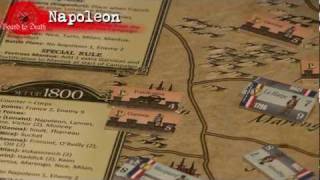
The most discussed system is how the opposing armies behave. Zeb explains that the board drives the enemy, with Italian, Austrian, British, and Russian forces following a mix of random and scripted moves. Enemy battle plans are drawn from a cup, and each battle gives the opposition a set number of them, such as Square, Column Advance Attack, or Rush. Each plan carries its own bonuses or penalties, and the plans are assigned to the strongest units on the field. Units without a plan follow scripted behavior: enemies adjacent to French troops attack, nearby enemies fire or advance, and distant enemies move according to a d10 roll. Zeb describes the result as a "somewhat predictable but still unscripted" opponent. Mike adds that "the random draw of tactics for the enemies and the random Caprices of fate and rolling are really interesting and engaging." Mike ties the series to the designer Dan Verson, and The Discriminating Gamer credits DVG Games with the release.
Campaign Objectives, Supply, and Score
Each campaign is organized around objectives with deadlines. Zeb describes Napoleon needing to hold specific cities by stated dates, with earlier completion producing a higher score. Defeat comes immediately if Napoleon is vanquished in battle, or if the French are driven out of their cities or annihilated. Between battles, Supply points accumulate according to how many cities the player controls, and they can buy back lost units or recruit weaker replacements. Zeb says the scores can reach roughly 5,000 points, and the game includes a log sheet for recording each campaign against earlier results. In Zeb's framing, the goal is to finish each scenario earlier than Napoleon did, which turns the campaign into a race against history.
The Field Commander: Napoleon Experience
Immersive Napoleonic Command
Reviewers consistently describe the sensation of directing an army through a specific historical moment. The Discriminating Gamer says that playing through several scenarios left a "strong epic feel," and stresses how campaigns link together into an ongoing sense of what Napoleon's campaigns were like. Zeb, a self-described history enthusiast, enjoys the attention to formations, lines, and columns, which determine how units approach and engage the enemy. The experience rewards players who care about the texture of the era, not only the final result.
Tension Against an Unpredictable Opponent
The second prominent quality is tension. Because the enemy follows scripts shaped by random draws and dice, each battle carries uncertainty. Zeb says the game is "nice and random," so players cannot simply memorize how the Austrians will respond and win by rote. Zeb argues that mastering battle plans and Insights builds an understanding of maneuverability that makes the player feel like Napoleon. Mike describes campaigns that range from scenarios Napoleon can win easily to ones that are nearly impossible, which keeps the stakes high whatever the difficulty.
What Makes Field Commander: Napoleon Stand Out
Scenario Variety Across Napoleon's Career
Mike praises the "huge Variety in scenarios" that cover Napoleon's whole military career. Zeb notes that the campaigns span from the 1796 Italian campaign to the 100 Days campaign of 1815, and that the 1805 and 1809 German maps are reusable across different scenarios. Zeb also reports that the rulebook signals plans for further scenarios and battles. Because each campaign can be played, scored, and repeated, players can measure their results against the historical pace again and again.
Organized Production and Tactical Battles
Zeb calls the production values "nice and high," and singles out the way every token is labeled with its year, unit, and army. That labeling keeps a large box of markers manageable, and the rulebook is slimmer than many wargames, supported by cheat sheets for the fog of war check and battle plans. The Discriminating Gamer describes the structure of play in which the player moves across a strategic map and then fights each battle on a separate battle board. That split gives the overworld and the tactical layers distinct roles, so that campaign decisions and battlefield choices both carry weight.
Potential Drawbacks
Setup Effort and Time Commitment
Zeb is direct that the game is intensive to set up, with many small tokens even for a single campaign. Zeb's first pass through the Italian campaign took about three and a half hours, and Zeb admits to misapplying several rules along the way. Zeb says the game is "not something you would sit down to just casually," and that players have to commit to a couple of hours at minimum. Zeb notes that the game becomes unplayable quickly if tokens are mixed up, so careful organization is essential from the start.
Dice Dependence and Uneven Presentation
Mike is candid that the game carries drawbacks in both presentation and resolution. Mike says "it does have all the drawbacks I already mentioned about the graphic not always being the best and about a lot of rolling." Zeb adds that the appeal is limited because the game is solitaire, and players who prefer group play may not enjoy it as much. Both reviewers still recommend the game to its intended audience, with Zeb suggesting a score of eight or nine out of ten for players who enjoy solo historical wargames.
If You Enjoy Field Commander: Napoleon
None of the reviewers directly compared Field Commander: Napoleon to the titles below. These are games reviewers named in their own solo or Napoleonic recommendations, and they share some of the qualities that make Field Commander: Napoleon appealing. Players who enjoy its historical command atmosphere will find similar satisfaction in I, Napoleon from GMT Games, which The Discriminating Gamer calls a "Napoleon simulator." That game places cards on the board and asks players to shape Napoleon's policies, family, and career beyond the battlefield. Players who value its tense, campaign-driven defense will find a related experience in Castle Itter, a David Thompson design from DVG that The Discriminating Gamer describes as "a great true story" set near the end of World War II. Mike's list also places the Valiant Defender series among the solo wargames Mike admires most. For players who want a larger administrative take on leadership, The Discriminating Gamer names Mr. President from GMT Games as an immersive solo experience.
What Reviewers Are Saying
"If I had to put a number score on it I would probably give it an eight or a nine. I say that only because the appeal is a little limited. People who like gaming with other people necessarily probably won't enjoy this as much, but for its intended audience I think this is an extraordinarily well-made game."
— Zeb, Board to Death TV
"You can string them along in a campaign so that you really get this kind of ongoing sense of what Napoleon's campaigns were like."
— The Discriminating Gamer
"It does have all the drawbacks I already mentioned about the graphic not always being the best and about a lot of rolling, but this one is really cool. It has these great tactical battles, and huge variety in scenarios to kind of cover Napoleon's whole military career, ones that he can win easily, ones that are nearly impossible, so you can really kind of tailor your experience that way."
— Mike, One Stop Co-op Shop