




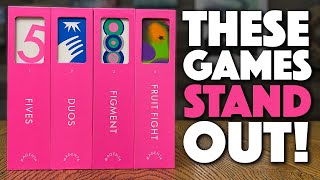

Figment Deep Dive
What the Community Thinks About Figment
Figment, CMYK's 2025 reimagining of the visual perception classic Illusion, polarizes reviewers in a way that feels intentional. The consensus among community voices is that this is a clever, well-designed game that works exceptionally well for the right audience, but absolutely will not land for everyone. Kovray and Board Game Animal lean positive, appreciating the aesthetic design and the way it challenges perception. The Dice Tower's Tom Vasel acknowledges the design quality while expressing a preference for the original competitive version, rating it a solid 7.5. Man vs Meeple approaches with more reservation, finding the color estimation mentally draining and questioning its long-term replay value. The divisiveness itself is honest: reviewers don't hesitate to say that if the visual challenge and cooperative flow appeal to you based on watching the demo, you'll love it; if not, this game isn't for you.
Core Mechanics That Define Figment
Cooperative Color Ordering
Figment, designed by Wolfgang Warsch and published by CMYK, places players in a collaborative role where everyone works toward a shared win or loss. Each round, players reveal a target color and then carefully arrange cards in ascending order based on how much of that color each card contains. One player drives the final placement while teammates discuss and collaborate, building a five-card sequence. At the round's end, players reveal the percentage values on the card backs to see how accurately they estimated. This turns the core challenge into a shared puzzle where everyone's visual perception contributes to the collective outcome, distinct from the competitive head-to-head version offered by Illusion. The cooperative structure means nobody is trying to outsmart opponents; instead, the game itself, through its visual ambiguity, becomes the common adversary.
Confidence Token Betting System
The confidence token mechanic transforms Figment from a simple estimation game into one requiring strategic judgment about your own perception. Before revealing card percentages, players place a token indicating how confident they are in their placement. Score 5 points plus the confidence bet if the sequence is correct; if wrong, score only up to the point of error. This simple but effective system rewards conviction without punishing uncertainty, creating moments where a player feels absolutely certain only to discover everyone, collectively, got it wrong. Reviewers highlight how this mechanic adds depth by forcing players to evaluate their own eyes and intuition. The system makes the game mechanically tighter while maintaining the cooperative spirit; it is not about proving others wrong, but about calibrating your trust in your own visual judgment against the group's consensus.
The Figment Experience
Mental Tension and Visual Challenge
Reviewers consistently describe Figment as mentally demanding in a unique way. The challenge is not strategic puzzle-solving or resource optimization; it is the cognitive strain of parsing abstract color percentages on visually complex cards. Kovray notes that the colors are deliberately "auspicious" (challenging to the eye), creating moments where players must "crunch your brain" and trust their rods and cones. Man vs Meeple's reviewer describes the experience more bluntly: at a certain point, "my eyes cross and my brain just goes away." This is not frustration with rules or pacing, but rather the perceptual overload of trying to compare subtle color gradations across multiple cards. Players report that Figment demands full attention and creates a distinct kind of table tension, one rooted in visual uncertainty rather than competitive pressure.
Divisiveness in Execution
Board Game Animal frames Figment as "the most non-gamelike game" in CMYK's Magenta line, a distinction that captures its unusual position. While some groups find it engaging and fun, reviewers note it does not universally appeal. The divisiveness stems partly from visual perception differences; not everyone's eyes work the same way with color, and the game offers no mechanical handicap or adaptation. Man vs Meeple suggests Figment is a one-play-wonder for many groups, fun in the moment but lacking the "let's play it again" momentum of other experiences. The game works exceptionally well as a solo puzzle, where one person can take time and work through the color sequences at their own pace without debate or group dynamics. This flexibility, while appreciated, also signals that Figment's group experience is not universally motivating.
What Makes Figment Stand Out
Clever Color-Perception Theme
Reviewers consistently praise the deceptive elegance of Figment's central conceit. Each card features four colors in varying shapes and sizes, creating visual illusions where the eye struggles to rank them by percentage. Board Game Animal calls the design "especially clever," and Kovray notes that "eyes can be very deceiving, especially when you're looking at illusions like this." The theme is not pasted on; it is the entire game. There is no narrative, no resource economy, no turn structure beyond the cooperative flow of estimation. The cards themselves do the work, presenting visual puzzles that feel fresh and immediate. This directness is part of what makes Figment compelling to those who embrace it; the game trusts that its visual challenge is sufficient, and reviewers appreciate the minimalist, confidence-focused design.
Flexible Play Modes
Figment ships with multiple ways to engage. The cooperative mode emphasizes discussion and shared decision-making, with one player placing each card while others weigh in. The game also includes a solo mode, which Board Game Animal's reviewer discovered becomes organically engaging; their son immediately began playing solo with no prompting, working through the puzzle at their own pace. A competitive version exists as the original Illusion, offering players choice in how they approach the game. This flexibility is unusual and valuable, especially for a game in CMYK's accessibility-focused Magenta line. It signals that Figment is not prescriptive about how you enjoy it; the core mechanic is robust enough to work across multiple social contexts.
Potential Drawbacks
Visual Fatigue and Not for Everyone
The primary drawback is also Figment's defining feature: it requires sustained visual perception work, and not everyone's brain works the same way with color. Man vs Meeple's reviewer describes the experience bluntly: playing Figment causes eye strain and mental fatigue to the point where "my eyes cross and my brain just goes away." This is not a player skill issue or a design flaw; it is the game doing exactly what it set out to do, asking players to calibrate their color perception against the game's abstract cards. However, reviewers note that this challenge is not for everyone, and Board Game Animal emphasizes that Figment could be "the most divisive" of the Magenta games. A player who does not enjoy visual estimation games should know upfront that Figment will not change their mind; it amplifies that core mechanic rather than offering alternatives.
Limited Replay Value and Pacing Concerns
Man vs Meeple raises a critical question about Figment's longevity: it does not seem like a game people will play repeatedly across a session. The reviewer notes, "Figment is one of those games where you'll play it once and you're like that was fun. I don't know that Figment is the kind of game that people will keep playing all night." The game lacks the momentum-building quality of other card games; after completing the five-round campaign, there is no compelling reason to immediately reset and play again. Additionally, Dice Tower's Tom Vasel points out that the cooperative version is "not as fun, I think, as the competitive version," suggesting that some players may find the co-op pacing awkward, with turns moving quickly when cards are obviously high or low, and bogging down when estimation is truly difficult. The experience works best for specific contexts: solo puzzle play, a single group session as an experiment, or competitive play where the head-to-head tension is higher.
If You Enjoy Figment
Players who love Figment likely enjoy perception-based games and do not mind visual challenge as the primary mechanic. Illusion, the competitive predecessor, is the natural next step; Dice Tower's Tom Vasel suggests it may actually be the superior version for those who prefer direct competition over cooperation. For those seeking similar abstract, non-traditional gaming experiences, Imagination (another Wolfgang Warsch design, sometimes referenced interchangeably with Illusion by reviewers) offers a related color-estimation concept, though reviewers note that Illusion/Figment itself is already on the demanding end of the visual-puzzle spectrum. Beyond direct comparisons, Figment pairs well with groups that appreciate games as experiences or puzzles rather than traditional competitive entertainment, and it excels as a solo activity or teaching tool for introducing new players to unconventional game mechanics.
What Reviewers Are Saying
"I like that it's cooperative as well because there's so many moments in this game where I feel so confident. I'm like all of you are wrong, I just know it, but it's three against one, so I'm going to sit back and then we flip the card and everybody's wrong."
— Kovray
"This is the first time I've ever been playing a game with my son, and he automatically took it and organically just started playing it solo, and he loved it. And while I 100% see how this works as a cooperative game and I enjoy the experience and have every time I've played it, at the end of the day for me it almost feels more like an activity or experience than a traditional game."
— Board Game Animal
"Figment is one of those games where you'll play it once and you're like that was fun. I don't know that Figment is the kind of game that people will keep playing all night. It doesn't have that same feel where you get to the end and you're like, again."
— Man vs Meeple