


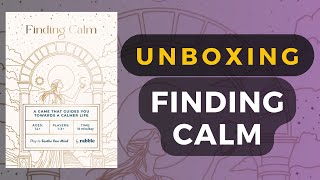


Finding Calm Deep Dive
What the Community Thinks About Finding Calm
Reviewers treat Finding Calm, the 2024 card game from Rabble, less as a contest and more as a daily ritual. The shared view is that it is a short, reflective solo experience: a few minutes of card placement that ends with a single card serving as a reading for the day. DaniCha frames it as an oracle game that guides players toward a calmer life, and points to its mental health focus and the 15 minute daily play time as its main appeal. The Board Game Garden describes it in similar terms, calling it absolutely beautiful and suggesting it fits best as a morning game to play alongside coffee or tea.
The reviewers agree on tone and on the reading at the end, but they are not fully aligned on how the game is played. The box lists one to four players, and DaniCha reads that out during the unboxing. The Board Game Garden, however, describes Finding Calm as a solo only game. Their description was given from memory, since they had not played the game recently, so the player count question is best settled by the rulebook.
Core Mechanics That Define Finding Calm
Adjacent Grid Placement and Sun Icon Flipping
Each game of Finding Calm, published by Rabble, centers on a 3x3 grid of cards. On a turn, a player has one of two choices: look at the top card of the deck and place it into an open space adjacent to an existing card, or discard the top card to move a face-up card already on the board into an adjacent open space. DaniCha noted that cards can also be placed on top of a face-down card, which is a way to flip a card that is already in play.
The card symbols drive the puzzle. In DaniCha's solo playthrough, a sun icon on a newly placed card flips the cards on its left or right side, while a moon icon does nothing. Reviewers describe the placement as a small, readable puzzle rather than a calculation, which is why it suits a short session. Each card is simple to read, and the consequences of a placement are visible on the board right away.
Face-Up Count Scoring and the Daily Intention
The game ends when the deck runs out or no legal moves remain. Any empty spaces at that point count as face-up cards, and the score is the number of face-up cards, with lower being better. DaniCha explained that the ideal result leaves one card face up, since the game is built around identifying that single card. Their playthrough finished with a score of three.
The final card selects the day's intention. If only one card is face up, the game chooses it for the player; if several are face up, the player picks the card they feel most drawn to. DaniCha chose Breeze because it was a windy day, then turned to the accompanying book to read the entry. That reading is the payoff of the session, and it is what separates Finding Calm from a purely abstract placement game.
The Finding Calm Experience
A Quiet Morning Ritual
The Board Game Garden describes Finding Calm as very much a morning game, one that is calm and relaxing to set out while a cup of coffee or tea cools. Because a full game takes about 15 minutes, reviewers see it as something to fold into a routine rather than a session to schedule. DaniCha made the same point from the box, noting that the 15 minute length makes it something a player could return to every day.
Reflection Through the Book
The experience is shaped as much by the accompanying book as by the cards. DaniCha found that locating the entry for their card took a few moments of searching, and they suggested a bookmark for faster access in future sessions. Once they found the entry for Breeze, they read a breathing exercise that asks the reader to picture their thoughts as leaves drifting down a stream and to name the emotions as they pass. The effect, as they describe it, is a pause before the day begins, with the card serving as a prompt for a short reflective exercise.
What Makes Finding Calm Stand Out
Oracle Card Art and Tactile Quality
Both channels single out the artwork. DaniCha described the cover as minimalistic and praised the card texture, noting a subtle shine on the leaves and borders. The Board Game Garden called the game absolutely beautiful and compared it to tarot style cards, which reinforces the oracle framing. Reviewers treat the visual presentation as part of the calming effect, not a decorative extra.
A Framework Built for Reflection
DaniCha highlighted that the game was developed in collaboration with Dr. Selby Guerra and draws on evidence-based therapy strategies for managing stress and reducing anxiety, as stated on the box. They also noted the book's waypoints and guides explaining what each card means, which lets a player read the reflections as they go. The Board Game Garden placed Finding Calm within Rabble's broader catalog, which leans toward large group party and conversational titles, and described Finding Calm as a solo game, which stands apart from that party-oriented focus.
Potential Drawbacks
The Reading Lookup Takes Patience
The ritual that gives the game its meaning also slows it down. DaniCha spent time looking for the Breeze entry, first scanning the book and then searching for a table of contents, and they paused several times to confirm which cards flipped after each placement. At one point they called a placement tricky before settling on a spot. Players who want a quick flow may find the book lookup breaks the rhythm, while those who enjoy a slower, more deliberate pace may welcome it.
A Thin Puzzle Once the Novelty Wears Off
Strip away the reading at the end, and the placement puzzle itself is slight: a 3x3 grid, a sun or moon icon, and a choice between placing or discarding. Neither reviewer found much tactical depth to discuss beyond that single flip-and-fill decision, which means the game leans almost entirely on its ritual framing to stay interesting once a player has seen the mechanic a handful of times.
Conflicting Player Count
The box lists one to four players, and DaniCha reads that out during the unboxing, but The Board Game Garden describes Finding Calm as a solo-only game. Neither reviewer resolves the discrepancy, which leaves a buyer unsure whether to expect a group activity or a private one before the box is even opened.
If You Enjoy Finding Calm
The Board Game Garden recommends Gentle Rain as the closest comparison, placing Finding Calm in the same realm of gentle, low pressure games. Players who enjoy that style of quiet, reflective play are likely to find the same calm pacing here. DaniCha suggests that players who enjoy tarot or oracle cards will find Finding Calm a natural fit, and encourages exploring other titles from publisher Rabble for those interested in the mental health and more spiritual side of the catalog.
What Reviewers Are Saying
"At the end of each game, your final spread leads you to an intention meant to help you manage stress, reduce anxiety, and live a calmer, more mindful life."
— DaniCha
"It's very much so like a morning kind of game to play with your coffee or your tea, where you're just placing down cards. It's very calm, relaxing, and it'll eventually give you a reading for the day, which I think is really cool."
— The Board Game Garden
"I love that it says 15 minutes a day because this is something that you could play daily just to get you into that mental space of being more calm about life."
— DaniCha