







Firefly: The Game Deep Dive
What the Community Thinks About Firefly: The Game
Reviewers approach Firefly: The Game as fans of the television series first. Gale Force Nine released the 2013 game, and the designers credited by one reviewer are Aaron Dill, John Kovaleski, and Sean Sweigart. The praise is specific. Board Game Critique argued that the game does something licensed games rarely manage: it captures the feel of its source material instead of just borrowing its names and images. The Dice Tower made a similar point, saying the game perfectly captures the feel of the show through its crew building and risky jobs.
The criticism centers on time. Board Game Critique gave a playtime of two to three hours, and a Kickstarter round-up reviewer described sessions of three plus hours that lean heavily on luck. Board Games UnLocked put it most bluntly. The host said that, as much as the theme and the mechanics are loved, the game still drags, and that a five-player session took about three hours and felt like the longest day of the week.
Core Mechanics That Define Firefly: The Game
Pick-up-and-deliver jobs and the crew that takes them
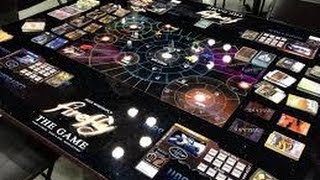
Jobs are the backbone of the game. Five contacts on the board, Badger, Niska, Patience, Amnon Duel, and Harkin, each offer work, and a story card set at the start of the game gives each session an overarching objective. Board Game Critique pointed out that the same starting position can play out very differently depending on the captain. A captain who hires fighters and arms them plays nothing like one who builds a negotiation-heavy crew optimized for legal deliveries, and both can win depending on the story card. That crew assembly is the sandbox heart of the game.
The crew system has a limit that The Dice Tower noted. The show's characters are few within large decks, so a player who wants to play as Mal has to get lucky enough to draw that card. The fantasy of building the crew from the show is strong, but the draw makes it less certain than the box implies.
The random navigation deck and full burn travel
Travel is where the game's texture comes through. The map divides into Alliance space and Border space, and each region has its own navigation deck that drives random encounters. A mosey moves the ship one sector, while a full burn moves further but requires drawing more navigation cards, any of which can trigger an Alliance encounter or a Reaver attack. Board Game Critique argued that this randomness is a feature, not a flaw, because space feels dangerous and uncontrolled. Board Games UnLocked added that landing on certain planets opens that planet's own deck of goods, crew, and jobs, so the map is a set of destinations as well as a route.
The Firefly: The Game Experience
Plans that collapse and turn into better stories
The sessions reviewers remember most are the ones where plans fall apart. In one account from Board Game Critique, a captain built a legitimate cargo running operation, then a warrant was issued midway through, and a cascade of Alliance contacts made the original route impossible. The captain was forced into a misbehaving job at the last minute, the opposite of what they had built for, and still won with two turns to spare. The reviewer said that going wrong in interesting ways is the highest compliment the game can receive.
Immersion that turns each game into a smuggling adventure
The Dice Tower described the game as relaxing and immersive, and said that every game becomes a memorable smuggling adventure. The same host recalled seeing people play it on the floor at Gen Con and feeling intense fear of missing out. For reviewers, the experience is less about optimizing a board and more about the stories a table produces along the way.
What Makes Firefly: The Game Stand Out
Thematic fidelity to the TV show
This is the most repeated praise. Board Game Critique argued that playing Firefly feels like running an episode of the show, and that this tonal authenticity is the foundation everything else is built on. The Dice Tower agreed that the crew building and risky jobs recreate the show's feel. Board Games UnLocked said that the game is still worth playing if you have never seen the show, but that fans get much more out of it. For these reviewers, the theme is not decoration on top of the rules. It is the reason the rules feel right.
Open world freedom with a defined frame
Reviewers praise the freedom to shape a captain's own path. The Dice Tower highlighted an open world structure that lets players create their own stories. Board Games UnLocked called it a sandbox and compared it to Saya, which the host said is more of a sandbox than Western Legends, with more options and more things to do. The freedom has limits, since the story card and the navigation deck push players in certain directions, but reviewers see that structure as a frame rather than a script.
Potential Drawbacks
A long session for a fairly simple game
Length is the drawback reviewers return to most. The Dice Tower said that the box claims a two hour game, and that this is not true. The same channel described the game as a fairly simple pick up and deliver game with a long play time, and noted that crunchier games such as TI4 feel more rewarding after a long session. Board Games UnLocked wanted the game to be an hour and a half and said so directly.
Luck, table presence, and a narrow audience
The Kickstarter round-up reviewer called the game very lucky, a session of rolling dice and hoping to win. The Dice Tower pointed to the large footprint of many decks, which makes the game hard to bring to the table. It also said that some players want more direction than a sandbox offers, and that people who take up the game need to know and love the IP. That combination narrows the audience, even among people who like the show.
If You Enjoy Firefly: The Game
Board Game Critique placed Western Legends, a 2018 Colossal Games design by Hervé Lemaître, in its ranking of sandbox games. The box describes it as an open world sandbox tabletop adventure, and the reviewer said that description is accurate. Players who enjoy building their own path through a sandbox will find a natural next step there.
Board Games UnLocked described Saya as pretty close to Firefly in its sandbox feel, with more options and more things to do than Western Legends. For players who love the license but want a more contained experience, Board Games UnLocked also mentioned Legendary Encounters: Firefly, which the host said is faster.
What Reviewers Are Saying
"This game does the thing licensed games almost never manages. It captures the actual feel of its source material, rather than just using its names and images. Playing Firefly feels like running a Firefly episode."
— Board Game Critique
"It perfectly captures the feel of the TV show. You're building a crew, you're taking risky jobs. It's incredibly thematic. Every game becomes a memorable smuggling adventure."
— The Dice Tower
"It's a really long game if you like Firefly even if you don't like Firefly I think you'll still like this game. If you like Firefly it just adds that much more into it."
— Board Games UnLocked