



Firesiege: A Feralis Story Deep Dive
What the Community Thinks About Firesiege: A Feralis Story
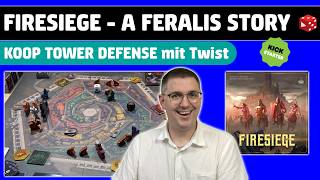
Firesiege: A Feralis Story arrives as a bold and original entry into the cooperative tower defense space. Reviewers consistently praise its novel central mechanic and find themselves warming to a game that initially seems experimental. The consensus cuts across channels: this is a tightly paced, accessible cooperative experience that does something genuinely different within the crowded tower defense genre, even if it does not pursue every element of the traditional tower defense formula.
The game earns genuine excitement from reviewers who emphasize replayability and surprising depth. Players note that every game feels distinct thanks to randomized goal cards and variable setup. At the same time, reviewers acknowledge that Firesiege is a bit messy in its presentation, carrying some rough edges that do not detract from its core appeal but do merit mention. The expansion, Ballot of Fire, emerges as highly recommended and nearly essential in reviewers' eyes. What reviewers love most is not the tower defense wrapping, but the innovative action selection system that sits at the game's heart.
Core Mechanics That Define Firesiege: A Feralis Story
Dual-Sided Action Tiles
At the center of Firesiege lies an action selection system that reviewers describe as genuinely novel. Each player draws three action tiles from their personal bag during their turn. The crucial twist: tiles are double-sided, with a positive white side and a negative black side. Players always see and resolve the side facing them first, then flip the tile and resolve the opposite side. The genius of the system is visibility. Other players see the opposite side of the tile while it stands in a slot on the active player's board, allowing them to offer vague guidance without explicit communication. The Cardboard Herald's Jack explains: players must decide whether to pick a known good action and risk unknown consequences, or select a partially known bad side hoping to gain useful information about what awaits on the flip.
This mechanic serves a dual purpose. It creates rich decision-making by forcing players to weigh known versus unknown outcomes, and it elegantly mitigates alpha player dominance. No single player can fully quarterback the game because perfect information about consequences does not exist. Reviewers from the Hungry Gamer channel emphasize that this tile mechanic is unique within the board game landscape and remains satisfying even in solo play, where players can pay resources to manually flip tiles and examine both sides. The system generates meaningful cooperation through imperfect communication, rewarding table talk without devolving into explicit direction-giving.
Base Defense and Crisis Management
Firesiege positions itself as base defense rather than pure tower defense. Players command hero units and soldiers tasked with protecting the city of Medda from an invading Skreel army. Enemies spawn from nests along three color-coded paths and advance toward the central citadel. The immediate loss condition is clean: if any Skreel reaches the citadel, the game ends in defeat.
To win, players must flip six banners through completing randomized goal cards and defeating special boss enemies called warlords. Actions center on movement, recruitment, and combat. Movement costs green energy, recruitment costs blue energy, and combat strength scales with hero power plus one for each friendly soldier in the area. The Hungry Gamer highlights how the shared resource system matters: all four stat tracks belong to the entire team, forcing players to negotiate priorities every turn. A player considering a powerful attack must weigh whether it costs energy the team needs for movement or recruitment. This interdependence generates organic cooperation distinct from mere coordination.
The Firesiege: A Feralis Story Experience
Tension Through Hidden Information
Firesiege cultivates tension through controlled chaos. The action tile draw is a gamble. Players know the side they can execute this turn, but the opposite side might trigger negative effects. Enemy movement, triggered by symbols on the action tiles' reverse sides, remains partially hidden until cards resolve. The horde track advances, warlord bosses arrive unexpectedly, and the mercenary support meter can swing from help to hindrance depending on where the marker currently sits. Reviewers describe this as exciting precisely because the consequences of actions unfold gradually. You commit to a tile knowing it could trigger something bad, then watch the chaos unfold as you work to adapt.
The Cardboard Herald emphasizes that this tension does not feel punishing because the game grants players options to react. You assess the situation and get reactive, staying on your toes. The balance between fog of war and anticipation defines the cooperative rhythm. You cannot plan three turns ahead with certainty, but you can read the board state and make educated guesses about what to prepare for.
Satisfying Escalation and Escalating Challenge
Firesiege scales difficulty elegantly. Brettspielblog notes that the game seems relatively easy at first, but reviewers consistently lost their early games, discovering they had underestimated the challenge. The twist is that harder is achievable. Flipped banners act as difficulty modifiers. Certain goal cards increase the challenge level as you flip more banners, creating a natural escalation. Some goal cards introduce mini-games and rule variations, keeping the familiar loop of defend, move, recruit, battle constantly fresh. By game's end, the board is tense. Resources feel tight. Every action tile draw matters.
What Makes Firesiege: A Feralis Story Stand Out
An Action Selection System Unlike Any Other
The tile mechanic is not window dressing. It solves a genuine problem in cooperative games: quarterbacking and analysis paralysis. The Hungry Gamer explains that reviewers appreciate the mechanic as a throttle on alpha players because no one knows everything. No one sees both sides of the tiles. Players must communicate obliquely, saying things like "Oh, wait, if you play that one, we're going to lose," without explicit instruction. This forces genuine discussion around the table rather than command-and-control play. The novelty of the mechanic cannot be overstated. Reviewers consistently cite it as doing something different and unique within the board game space, worth experiencing for the mechanism alone.
Centaur Heroes in a Weird, Fresh World
Firesiege dares to build around centaurs. All four player characters are centaurs defending the city of Medda against the Skreel, insectoid creatures invading from outside. Reviewers find the choice bold. The Hungry Gamer admits not knowing what a centaur-centric game would be like, but celebrates it as refreshing and weird in the best way. Heroes come in distinct flavors with unique abilities once upgraded, giving each player a reason to care about their character's progression. The screen-printed meeples look deluxe. The playmat and component quality elevate the presentation. While reviewers note the board can get visually cluttered as pieces accumulate, the overall aesthetic reads as intentional and thematic rather than accidental.
Potential Drawbacks
Rulebook Translation and Polish Issues
Brettspielblog and The Cardboard Herald identify translation quality as a sore point in the first printing. The rulebook carries spelling mistakes and confusing wording in places, with squishy phrasing that makes learning slightly harder than it needs to be. The Cardboard Herald notes that while the publisher is not a native English speaker, the translation could have been tighter. This is presentation rather than substance, but it matters for new players trying to learn from the rules themselves. The upcoming reprinting is expected to address this, bringing relief to future buyers.
Expansion Feels Necessary Rather Than Optional
The Ballot of Fire expansion, releasing simultaneously, lands as near-essential. The Hungry Gamer goes further than most in insisting players absolutely need the expansion to feel satisfied with the core game. The expansion introduces archers with adjacency bonuses, a fire mechanic that adds secondary threat and resource management, and magic bombs that extend the puzzle space. Without the expansion, enemy variety feels limited to small Skreel and larger queen Skreel variants. The expansion opens up new scenarios and objectives. Reviewers appreciate the expansion but wish the core game felt more complete on its own. Alternatively, the fact that an expansion exists is strong signal that the base game resonated enough to warrant expansion development.
If You Enjoy Firesiege: A Feralis Story
Players drawn to Firesiege for its cooperative tension should explore Spirit Island, where players take on asymmetrical roles defending an island against colonizers with deep strategic play and replayability driven by spirit powers and power card variety. Those who enjoy the tower defense framework will find satisfaction in Fate of the Fellowship, which uses a similar threaded path system and escalating threat. For reviewers chasing the novel mechanic aspect, Leviathan Wilds from designer Jay Cormier offers asymmetry and tight decision-making. Gloomhaven offers a more complex dungeon crawl with campaign progression for players who want story alongside tactical puzzle-solving. Starship Troopers, mentioned by Brettspielblog as a fantasy cousin to Firesiege's base defense core, shares the theme of holding ground against a numerically superior enemy force.
What Reviewers Are Saying
This dual-sided action system is really novel, and at first sounded kind of bananas to me, but the more I played it, the more I warmed up to it. The information that you are able to glean just from looking at your side, and the accountability, the reliability of both good or bad information, is really interesting. It makes for a cool decision space, especially in this type of game.
— Jack, The Cardboard Herald
I cannot tell you how cool that tile mechanic is. I really think that's really cool. And initially, I was going to say I think you really want to have multiple players around the table for this. And I do stand by that. I think it might play best at two plus, but even as I've been talking this through, that tile mechanic is so neat. It's also really satisfying to do it solo.
— Hungry Gamer
It adds this fire mechanic where sometimes stuff is going to set on fire. And fire is bad, and you can lose by fire. But you can also start spending your actions to put fire out. And as you collect the fire, you can use that fire to do cool stuff. It is needed, I think. You absolutely need that in the game to kind of keep it fresh and keep it moving.
— Hungry Gamer