
Game Info
Year
2026
Players
1-4
Age
14+
Playtime
80 min
Collection
Ratings
Creator Score
Mechanic profile
Not enough video data yet
Vibe profile
Not enough video data yet
Description
A tactical strategy game of the Norwegian Civil War played on a modular 3D board of mountains and fjords and islands
Featured Videos
Review

Fjordar Kickstarter Preview
Ask a Rules Question
All mentions
Browse transcript mentions, sentiments, pros/cons, mechanics, topics, quotes, and references.
Total mentions: 1
This page: 1
Sentiment:
pos 1 ·
mix 0 ·
neu 0 ·
neg 0
Showing 1–1 of 1
Video cZfy0Uxb5Jg
Board Gaming Ramblings Review at 0:40 sentiment: positive
video_pk 38883 · mention_pk 398592
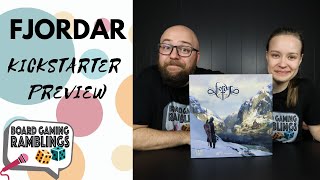
Click to watch at 0:40 · YouTube ↗
Overall sentiment (raw)
positive
Pros
- Short, tense rounds suitable for 2-4 players (about 20 minutes per player)
- Card-driven combat with no dice, enabling planning and control
- Mechanics that balance movement, combat, and territory control
- Clear ways to mitigate luck via card choice and discard options
- Flexible play paths with beacons, churches, and route-building
- Supports both light intro play and deeper strategic play with expansion to full game
- Thematic flavor and historical backdrop integrated through mechanics and layout
- Good depth without being overwhelmingly heavy for intermediate players
Cons
- Some luck remains in card draws and event timing
- Combat can feel punitive when your units are weakened or routed
- High interaction can cause crowding and occasional frustration with routing
- May be a bit heavy for absolute newcomers, though a simpler baseline exists
- Prototype components/art may affect initial perception during previews
Thematic elements
- land control and war, religious influence, maritime routes
- During the Norwegian civil war
- card-driven, strategic conflict with historical flavor
Comparison games
none
Mechanics (from transcript analysis)
- Area control with cubes and supply lines — Control cubes are placed on regions to claim them; connected cubes function as a single move and you create longer supply lines back toward home to maximize movement and scoring opportunities.
- Beacons and endgame scoring — Beacons yield points across rounds; symbol-based scoring adds another vector toward victory, incentivizing varied routes to victory points.
- Card-driven combat — Combat is resolved with combat cards rather than dice; units contribute numeric strength and terrain/adjacency can provide bonuses; battles can force retreats.
- Church building / burning track — Actions can build or burn churches; the church track advances to grant ongoing bonuses, shaping end-game scoring and strategic choices.
- Event / draw-based scoring and card management — At milestones (e.g., reaching five points) event cards are drawn; players can choose to keep or discard cards, influencing the chances of hitting scoring cues later.
- Leader cards with movement and bonuses — Leaders grant directional movement and/or bonuses, introducing varied strategic options and endless replay value.
- Movement card engine — Players play movement cards to determine how far their pieces can move and to access special abilities; cards are placed and built up in front of you; keeping multiple cards may require paying coins to retain them, influencing round tempo.
- Non-dice interaction and route-building — Movement and combat are tied to route-building and positioning rather than dice; players aim to extend and protect supply routes while contesting others.
Video topics + discussion points
No key topics recorded for this video.
Quotes (from this video)
- coins are really good
- it's not a dice roll in combat
- there's a lot of interaction in the game
- mitigates the luck of getting the symbols for scoring at the end of the game
- draw two of them you choose one and you discard it
- this is a strange version of worker placement
References (from this video)
No references stored for this video.
Transcript Navigation
Showing 1–1 of 1