/pic6374171.jpg)
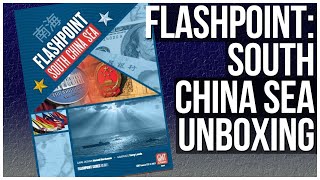
Flashpoint: South China Sea is a two-player strategy game that simulates the complex geopolitical contest currently taking place between the United States and China in a disputed region of the South China Sea. The game is driven by a card deck that captures developments ripped straight from today’s headlines, bolstered by cards with a context-setting reading of recent history, and a set of speculative cards capturing a diverse range of potential future events.
The Chinese player works to influence other countries in the region, establish territorial claims and regional hegemony, and improve its world standing. The U.S. player works to maintain influence with allied countries in the region, secure freedom of navigation, and keep China in check. Success for both players hinges on the support and allegiance of non-player countries in the region. The game stops short of dealing with a potential full-scale military conflict. Rather, it requires the nuanced exercise of political, economic, and military resources, in a form of prima facie diplomacy – on the waters, in the air, and ultimately in the minds of the people – to achieve victory.

- Accessible rulebook for GMT
- Teaches about the historical period
- Focuses on tension and influence
- Part of a potentially larger game system ('Flashpoint')
- Geopolitical influence and control
- South China Sea region (US vs. China conflict)
- Influence-based conflict
- Twilight Struggle
Mechanics (from transcript analysis)
- Area Control — Players aim to gain control over certain areas.
- card-driven gameplay — Implied by the comparison to Twilight Struggle and the mention of cards.
- Influence mechanics — Players gain influence and control over areas, similar to Twilight Struggle.
Video topics + discussion points
Quotes (from this video)
- to me that was a very simple game easy to learn but kind of recreated what really happened during that time
- if y'all ever seen a GMT rule book They're they're not pretty books with glossy pages and big images and very few words per page they're double column they're they're numbered almost like a contract a legal document that's just how they're formatted
- it's basically the conflict between uh uh basically the US and and that region of the world between China and us trying to influence and control that area
- this is coming from somebody who complained I did a 45 minute history lesson on Cuba Libra when I taught it to you
- I knew nothing about how Castro took over CU I I knew he did it how he did it and why I don't know but playing that game three or four times now I have a I'm not a master by any means but I have a much better understanding of what really happened during that time
- I am learning about stuff that happened during the Vietnam war knew nothing about super excited as I play through this game learning about that
- you do learn as you're playing the game how the forces had to build towards that final battle of waterl you learn the players that took place
- yes I have that one I've never play amazing historical game from Marton Wallace yes I had some Muro stuff in it but I actually learned a lot about that from Lincoln
- we got access and allies coming up talking about jumping to the deep end we'll jump straight into that
References (from this video)

- Innovative game system.
- Nuanced and layered gameplay.
- Elegant and smart design.
- Timely and relevant theme.
- Stands on its own, not just a 'Twilight Struggle light'.
- Simple and easy to play, takes about an hour.
- Geopolitical tension between the US and China over the South China Sea
- Modern South China Sea
- Twilight Struggle
- 13 Days
- 13 Minutes
Mechanics (from transcript analysis)
- Area Control — tug and pull on certain aspects of these different regions
- Geopolitical simulation — control of this kind of Economic and and uh and Geographic space
- Multi-Use Cards — has some cool riffs on kind of the multi-use card thing again
Video topics + discussion points
Quotes (from this video)
- this is number five Catherine
- number four is a game from uh the folks at Prospero Hall and this is called rear window
- number three is dead reckoning
- number two is oath sworn
- number one of course this is the game uh that in partnership with restoration games uh we'll be giving away to one lucky commenter
- return to Dark Tower
- one was blood on the clock tower
- the other one is the game I have not reviewed I've played it once it's called the Crescent Moon
References (from this video)
- Really fun kind of card driven game
- Liked the theme and tension
- Good job abstracting real-world tensions
- Fun, playable, and relatively quick game
- Enjoyed how fast it was
- Preferred the two-player game over solo
- US vs. China vying for influence
- Southeast Asia and the Pacific
Mechanics (from transcript analysis)
- Area Control — Vying for influence and control in various regions.
- Card Driven Game (CDG) — Uses cards to gain influence and control.
Video topics + discussion points
Quotes (from this video)
- Don't teach your dog how to sit while using a Sean Conry accent.
- I played so many GMT games over the years, I thought I'd finally rank my top 50.
- It's a heavier game, and that's probably why it's not higher up on this list.
- Although the invasion of Italy remains controversial for a number of reasons.
- I know it's a controversial statement because a lot of people will say this is probably the best that he's come up with.
- Why don't scientists trust atoms? They make up everything.
References (from this video)
- Deals with current events and recent history
- Fun card play
- Decent solo game
- Much preferred as a two-player game
- Tension between the United States and China
- South China Sea
- Twilight Struggle
Mechanics (from transcript analysis)
- area influence — You're trying to compete to to get control these dominate these areas here.
- Card Play — The United States and China are playing cards to gain influence in the different regions.
- Solitaire — It actually is a pretty decent solo game, too.
Video topics + discussion points
Quotes (from this video)
- Does the International House of Pancakes answer to the United Nations or is it the other way around?
- This is the great granddaddy of all diplomatic games.
- This Many people have said this is the meanest game ever made. It's certainly up there.
- I've never played a game that forces players to so consistently make the best of bad choices.
- It's the game that keeps on giving.
References (from this video)
- Neat innovations on the Twilight Struggle idea.
- Smart event card system where events don't automatically trigger for the opponent.
- Good replay value due to the interplay of mid-game scoring opportunities and setting up for the final round.
- Interesting dynamic between US naval presence (disappearing each round) and China's (permanent but expensive).
- Thematic elements are pulled from headlines and relevant geopolitical situations.
- Accessible and solid mechanics.
- Solo mode is fun and simple.
- Playtime is a solid hour, a good medium ground.
- Thematic use of leaders as proxies for negotiations.
- Interplay between economic investments (temporary) and diplomacy (lasting payoff).
- Solo game can be swingy.
- Solo AI doesn't fully simulate the long game scoring aspect of the two-player game.
- Harder difficulty in solo mode has not been tried by the reviewer.
- Area control and gaining standing in diplomatic, economic, and naval spaces in the South China Sea.
- Modern setting of the South China Sea with involvement from China, the US, and other Asian countries.
- Twilight Struggle
- 1960
- Liberty or Death
- Washington's War
- Watergate
- 13 Days
- 13 Minutes
- 300
- 1989
Mechanics (from transcript analysis)
- Area Control — Players try to gain area majority by placing influence cubes (economic and naval) in different countries and naval spaces on the board.
- Card Driven Game — Players have a hand of cards with events and operations points, which can be played for either function, similar to Twilight Struggle.
- event cards — Cards can be played for their event text, but unlike Twilight Struggle, they don't automatically trigger for the opponent, requiring a strategic decision about using the 'mode' to trigger an event or score.
- Political Warfare — A mechanic where players can place markers and attempt to resolve political warfare, which can increase tension and potentially replace opponent cubes.
- scoring cards — Points are scored by activating specific scoring cards, which are played during rounds and can be scored again at the end of the game.
- solo mode — The game includes a solo mode where a player can play against a procedural AI driven by a separate deck.
- Tension Track — A tension track increases as actions are taken, affecting the cost of certain operations and potentially triggering consequences.
Video topics + discussion points
Quotes (from this video)
- This is a really smart way of doing it I think where you play the card it may it's not going to automatically trigger the event for your opponent but it might and so that presents a decision on your opponent's turn like hey I could match that event I've got a mode but I don't really want to do that because an event may not be you know all that great.
- The US is able to do it very cheaply but there's disappear every round whereas China can be very expensive to do it but once they're out there they stay there which kind of makes sense because it's you know this is kind of China's local home Waters here.
- It's nice it's been a while since I played a game like this that got me excited in this kind of way.
- I definitely recommend Flashpoint China Sea South China Sea and so take a look at it.
References (from this video)
- gateway.wargaming accessibility; fast to learn
- short playtime (30-60 minutes) and three play formats (two-player, US solo, China solo)
- educational value with historical event cards and timeline
- compact components; low cost
- strong design touches (play aids, reminders, Spotify playlists concept)
- asymmetry in two-player bid favoring China; learning curve for solo rules
- some players may want more counters or components; minimal
- pacing in solo may be more complex than base game
- Geopolitical competition and diplomacy
- South China Sea geopolitical region with disputed territories
- historical events-driven, card-driven simulation
- Twilight Struggle
- Shores of Tripoli
Mechanics (from transcript analysis)
- area influence via blocks — Place blocks on map regions to track influence and control.
- Card-driven actions — Players use event and operation cards to influence regions, manage tension, and win by scoring.
- historical-event cards — 63 cards representing historical and hypothetical events, with color-coding and modes.
- scoring cards and regions — Scoring cards trigger regional scoring at opportune moments.
- solo bots and campaigns — Three solo campaigns with AI priority rules per side.
- tension track and operation costs — Tension levels affect action costs and card play.
- two-player asymmetric bid — Two-player mode uses bidding to determine which side the player may control, creating asymmetry.
Video topics + discussion points
Quotes (from this video)
- this is a two-player game
- designed as an easy to learn fast playing game
- gateway game
- it's fast playing it's going to be about 60 minutes or less
- three games in one box
- educational value