



Fluttering Souls Deep Dive
What the Community Thinks About Fluttering Souls
Reviewers encounter Fluttering Souls and consistently respond to its combination of melancholic beauty and tactical simplicity. The game receives praise as a clever, accessible two-player experience that belies its depth with an elegant design. Reviewers describe it as captivating and beautifully illustrated, with artwork that honors its Japanese legend basis. The consensus emphasizes that despite straightforward rules, meaningful decisions drive each round; the game rewards players who think ahead about card availability and their opponent's options. For those seeking a quick, engaging two-player game that respects their intelligence without demanding heavy study, reviewers suggest Fluttering Souls stands out.
Core Mechanics That Define Fluttering Souls
Set Collection
The heart of Fluttering Souls is gathering butterflies to complete valuable sets. Each butterfly type scores differently based on collection size: one type might award a large bonus for a complete set of four, a smaller bonus for three, and a modest payout for just two. This variable scoring means players must balance quantity against set completion; claiming a single high-value card early may deny an opponent points while leaving the player's own collection incomplete. The scoring diversity ensures that each round's strategy shifts based on what cards appear in the layout and what an opponent has already claimed.
Card Drafting
Players select butterflies one at a time from an ever-changing pool of face-up cards. When a card is taken, any face-down card blocking it flips face-up and becomes available. This mechanic echoes the card-reveal systems in games like Seven Wonders, where a choice doesn't just advance a player's own score but opens new options for the opponent. Reviewers note that the drafting creates a cascade effect: taking a card repositions the entire layout, forcing a player to think not just about what they want, but what they will make available to their opponent on the next turn. This forward-planning tension is where tactical depth emerges.
The Fluttering Souls Experience
Melancholy Beauty
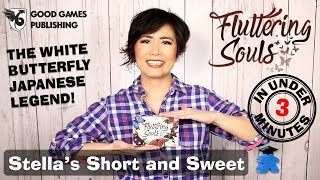
Fluttering Souls carries the weight of its Japanese legend basis: the white butterfly legend tells of loved ones returning from death to visit grieving family members on butterfly wings. Reviewers sense this emotional resonance in the game's artwork and theme. The white butterfly tokens that represent round victories carry symbolic weight beyond mere scoring; they ground the competition in something more reflective than typical point-chasing. Players may find that even as they calculate optimal card selections, the game's aesthetic and narrative create an intimate, bittersweet atmosphere. This tonal depth distinguishes Fluttering Souls from many two-player abstracts that aim purely for tactical fun.
Tactical Simplicity
Reviewers praise the game for being easy to learn yet rewarding to play seriously. The rules themselves pose no barrier: collect butterflies, score them according to type, earn tokens for winning rounds. But within that simplicity lies a constant puzzle. Each turn asks the same core question: what serves the player best, and what do they deny their opponent? A special blocking card can restrict access to desirable butterflies, forcing an opponent into suboptimal choices; this blocking move adds a layer of player-versus-player tension that keeps the game engaging despite its accessible surface. Reviewers report that games play quickly without sacrificing meaningful decision-making.
What Makes Fluttering Souls Stand Out
Elegant Theme Tied to Mechanics
Rather than treating theme as decoration, Fluttering Souls weaves its legend into the core play experience. The white butterfly is not merely flavor; it is the victory token, the goal, and the symbol of the game's emotional heart. Reviewers repeatedly return to this integration as a distinguishing feature. The game asks players to collect beautiful, fragile things in pursuit of an ephemeral prize: contact with the white butterfly, the visitor from beyond. This marriage of theme and mechanic creates coherence that reviewers find compelling and memorable.
Blocking and Opponent Interaction
The inclusion of a blocking card elevates Fluttering Souls from pure set collection into interactive tactics. Reviewers highlight this mechanic as a key strategic element: placing the blocking card forces an opponent into a corner, giving a player control over the opponent's options while optimizing their own collection. This asymmetry of power keeps players engaged and reactive. The card also serves a secondary role as a tie-breaker at round's end, doubling its utility. Reviewers note that skilled players can use the blocking card to fracture an opponent's set-completion plans while advancing their own score, creating a satisfying moment of tactical triumph.
Potential Drawbacks
Strategy Can Feel Predictable
With simple scoring rules and a clear incentive to block high-value cards, experienced players may find the optimal line of play relatively straightforward. The strategy centers on reading the board state and forcing an opponent toward lower-scoring options; once that pattern is clear, the game can feel like a solved puzzle. Reviewers do not voice this as a complaint, but players seeking deeper decision trees or emergent complexity may find Fluttering Souls resolves its strategic questions too quickly.
Exclusive Two-Player Design
Fluttering Souls is built explicitly for two players. This constraint is both a focus (the game is optimized for the head-to-head experience) and a limitation (it excludes group play). Reviewers celebrate the two-player specialization but do not discuss how the game might scale to larger groups. For players with larger gaming circles or those seeking versatility across player counts, this exclusivity may be a consideration.
If You Enjoy Fluttering Souls
Reviewers mention Seven Wonders as a mechanical ancestor, citing the shared card-drafting DNA where hidden cards add uncertainty to a player's choices. If Fluttering Souls appeals to you, Seven Wonders offers a larger-scale drafting experience for more players, though with greater rules complexity. The emotional resonance of Fluttering Souls' theme may also appeal to players who value narrative and aesthetic coherence in their board games.
What Reviewers Are Saying
"It's based on the white butterfly, a legend, novel, Japanese tale about loved ones coming back from the grave and visiting family members on the wings of white butterflies."
— Meeple University
"It's just a really fun, clever game. You can play quickly. You can play it just about anywhere."
— Jamie, Tabletoptiktok
"You're trying to force your opponent into a corner while having the best outcome for yourself."
— Meeple University