


Free Radicals Deep Dive
What the Community Thinks About Free Radicals
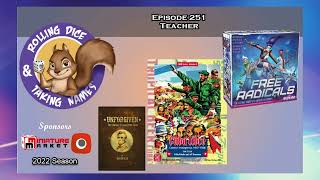
Reviewers who covered Free Radicals agree on its ambition and disagree on who it suits. The most detailed discussion comes from Rolling Dice & Taking Names, where Marty and Tony spent a substantial part of an episode working through the design. Their central point is that the game's ten factions are built from five colors with two factions per color, and that each faction plays so differently that a player must learn their own path largely on their own. The hosts also weighed the game against Terra Mystica and Root, concluding that the factions here differ far more than those in Terra Mystica, and that Root is the closer comparison for true asymmetry.
The John Gets Games channel offered a more candid take. The host received the game as a sponsored review copy and called it a highly asymmetric title with a great deal going on, praising its vibrant, beautiful look. They were clear, however, that it was not a game they would prioritize teaching to friends. The Watch It Played news segment introduced the game as a euro-style design with completely asymmetric factions, and singled out its mancala-style mechanism as the element that caught attention.
Core Mechanics That Define Free Radicals
Ten Asymmetric Factions Built From Five Colors
The defining feature of Free Radicals is its faction structure. Each of the ten factions has its own engine for earning resources and power. Rolling Dice described a courier faction that flies drones across a map in a pickup-and-delivery system, an artisan faction that plays data cards and must match their colors to take actions, and a merchant faction that visits market stalls and manages favor cubes. Other factions described in the episode include a hotelier faction built around fitting tetris-style pieces and a farming faction that plants crops on a grid, where adjacency determines which actions activate. Some factions share a double-sided board, so choosing one side means its partner faction is unavailable. When a table has fewer than five players, a non-player faction fills the empty seats. It receives favor and advances knowledge, but takes no turns.
Awakened Buildings on a Shared Center Board
Interaction runs through a central board of buildings. A player awakens a building by playing a data card in their faction color and paying the required resources. Once awakened, the building gives its controlling player a special ability, and any player who visits it gains the benefit as well, so the owner may be helping a rival. Rolling Dice stressed that this is what keeps the game from being a solitary exercise, and the hosts noted that awakening buildings early is central to a strong position. Favor cubes and a knowledge track add to the economy, and players score victory points from complete sets of cubes at the end of the game. Players must weigh each favor they grant against the benefit it hands the recipient.
The Free Radicals Experience
Turning Resources Into Victory Points
The core feeling of play is a puzzle about conversion. Rolling Dice described the end goal as spending resources to advance the victory point tracker, with the game running a fixed twelve rounds and the winner being whoever has the most points when the last round ends. Early turns can feel slow because players struggle to find where their resources come from, but the hosts reported that the pace picked up once they understood their faction and more buildings opened. One host said that on a second game they would study how to activate the boards earlier, which suggests the economy rewards familiarity.
Balancing Helpfulness Against Rivals
The second defining experience is the tension of interaction. Favor is a currency that players use to influence one another, and helping an opponent can pay off for both sides. The Rolling Dice hosts described wanting to help a neighbor only enough to gain some benefit, while avoiding giving that player an advantage that would decide the game. This push and pull is what gives the scoring its tension, and it is the part of the design the hosts kept returning to when explaining why the game held their interest.
What Makes Free Radicals Stand Out
Factions That Feel Like Different Games
Reviewers praised the replay value that comes from faction variety. Rolling Dice noted that the game is very different each time it is played, especially when players rotate factions and sit with different combinations of rivals. The hosts also observed that the core actions stay constant. Awakening buildings and advancing knowledge work the same way regardless of faction, so the shared rules give players a stable foundation even as their faction changes. Getting Games described the factions as highly asymmetric, and Watch It Played described a euro-style design with completely asymmetric factions.
Interaction Through the Shared Board
The second standout is that the game does not isolate its players. Rolling Dice described a board where activated buildings give benefits to any visitor, so a player who appears to be running a solo engine is still affected by every other faction's choices. Combined with the favor economy, this keeps players watching one another's turns. One host said the game was about more than moving cubes around the board, pointing to the strategic choice of which factions to help and when.
Potential Drawbacks
A Heavy Onboarding Load Across Ten Factions
The most consistent concern is the teaching burden. Rolling Dice explained that the hosts did not expect to learn all ten factions for a group session, so each player studied their own faction from printed material before play. The Getting Games host went further and said they would not prioritize teaching the game at all, even though they are excited to play it, because it is not in their wheelhouse compared with other titles on their list. The hosts' experience suggests a table of new players will need a strong advocate who knows the rules, or printed faction sheets that each player can read ahead of time.
Ambiguous Rules and a Difficult Start
The second concern centers on rules clarity and early-game pacing. Rolling Dice reported a dispute over whether the data card for awakening a building had to match the building itself or only the player's faction color. The rulebook language did not settle it, so the group inferred an answer and printed the relevant pages for everyone to read. Separately, one host felt resource-starved early and found themselves roughly 30 points behind, which they attributed to not yet understanding how to build combinations across the board. Reviewers suggested that the game rewards patience and a second playthrough more than a first one.
If You Enjoy Free Radicals
Players who enjoy the tension of Free Radicals should consider Twilight Struggle, Red Flags Over Paris, and Fort Sumter. The Rolling Dice hosts used these titles as reference points when they described coin games, in which an event deck and action selection drive every decision. Those games share Free Radicals' appeal of making hard choices where taking one benefit can hand an opponent a stronger turn, and where a player must read the board several moves ahead to see what others can do. Like Free Radicals, each of these titles rewards players who invest time in understanding their options before committing to a course of action.
What Reviewers Are Saying
"There are five colors and each color has two factions, so for a total of 10 factions that all play different."
— Rolling Dice & Taking Names
"It's a highly, highly asymmetric game with a whole bunch of stuff going on. It's a very vibrant and beautiful looking game, but I just don't see a situation where I'm going to prioritize teaching this to people and getting it played."
— John Gets Games
"A euro style game with completely asymmetric factions. Total of 10 in the box, it's full of tile laying and exploration, as well as mancala mechanism, which is what piqued my interest."
— Watch It Played