/pic5561163.jpg)
/pic4717882.jpg)
/pic5561163.jpg)


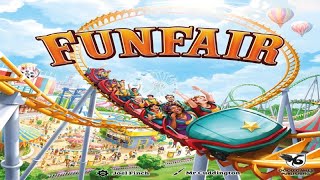

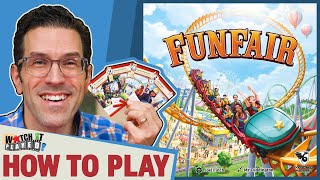





Funfair Deep Dive
What the Community Thinks About Funfair
Funfair occupies a curious niche: a game that earns genuine affection from casual players while inviting measured skepticism from those seeking adversarial depth. The Board Game Garden simply loves it as a light, relaxing build, while 3 Minute Board Games admires its bright theme but questions its gentle, solitary feel. The amusement-park setting resonates immediately, creating what reviewers call an intrinsically fun and whimsical experience. Yet beneath that cheerful exterior lies a game that asks players to build in relative isolation, minimizing the direct confrontation some gamers crave.
Core Mechanics That Define Funfair
Card Drafting and Market Economics
Funfair's primary engine revolves around drafting cards from your hand or a shared market. Each round the market refreshes, and players either pay coins to build a card immediately or spend an action to collect cards for future turns. The choice between building now and stockpiling for later creates constant tension, sharpened by tight starting funds that force careful allocation across building, collecting, and generating loose change. That friction between limited resources and tempting options drives the turn-to-turn decisions.
Engine Building Through Attraction Synergy
The attraction-and-upgrade relationship forms the core engine. Players build a row of attractions, each able to receive themed upgrades like fairy tale, jungle, pirate, or robot, which trigger bonuses and generate income. 3 Minute Board Games highlights how cards interact to create powerful combinations, and how the exponential scoring rewards building vertically within a theme. Blueprint cards add further scoring vectors by demanding specific configurations, transforming what could be linear tableau-building into a system where players optimize along several axes at once.
The Funfair Experience
A Theme That Carries the Game
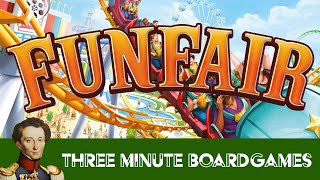
The amusement-park motif is Funfair's greatest asset. 3 Minute Board Games keeps returning to the joy of imagining and assembling a unique park, noting there is something intrinsically fun and whimsical about theme parks and that the bright, welcoming art backs it up. Building a fairy-tale robot ride or a pirate roller coaster personalizes each playthrough and gives narrative coherence to otherwise abstract card plays. For the casual audience the game targets, that thematic immersion carries real weight.
A Solitary, Contemplative Rhythm
Gameplay unfolds at an unhurried pace: city events occur, several rounds of park-building resolve, guests generate income, and the market resets. The Board Game Garden enjoys exactly this relaxed flow, calling it a nice, light, easy game to bring to the table. 3 Minute Board Games sees the same pace differently, noting the experience can feel cold and the player interaction is extremely limited. Because upgrades generate exponential returns, the optimal play is usually to deepen your own park rather than disrupt opponents, reinforcing the game's contemplative, build-your-own rhythm.
What Makes Funfair Stand Out
Approachability Without Condescension
Funfair strikes a difficult balance: simple enough for newcomers to grasp, yet engaging enough to hold attention. There is no hidden information to master, and card effects follow clear logical patterns. The Board Game Garden recommends it precisely for players who enjoy card drafting and tableau building and want a light, easy game about amusement parks. A late-game showcase attraction adds a strategic wrinkle, letting players who save resources build one more powerful ride without overcomplicating the path to the table.
Variable Objectives Drive Replayability
Blueprint and award cards shift from game to game, generating asymmetric goals without requiring player powers or asymmetric setups. 3 Minute Board Games notes that these cards make the targets you chase different each play. One game rewards thrill rides, another sideshows; one award favors coin collection, another staff synergy. The result is modest but real variability, enough to invite repeat plays without demanding an expansion.
Potential Drawbacks
Limited Player Interaction
The game's gentleness is also its most debated trait. Because players draft from a shared market and build in isolation, direct confrontation is rare. 3 Minute Board Games frames Funfair as something of an overreaction to its meaner predecessor, Unfair, suggesting that in pursuing a friendlier experience the designers may have removed too much interaction. Taking a card the market is a mild lever, but the exponential upgrade math means you are usually better off improving your own park than interfering with someone else's. Players who want negotiation, blocking, or take-that moments will find little of it here.
Runaway Leaders and Uneven Appeal
The exponential scoring, while elegant, can produce runaway leaders: a player who stacks several upgrades early locks in outsized end-game returns, and by then an entrenched park is hard to challenge. 3 Minute Board Games acknowledges that the scoring system itself encourages the very isolation some players later lament. Reviewers split on the resulting atmosphere, with some embracing the calm and others finding it sterile, which makes Funfair a better fit for relaxed groups than for competitive ones.
If You Enjoy Funfair
3 Minute Board Games points players directly to two cousins: for a slightly meatier card-drafted engine, try It's a Wonderful World, and for something far more interactive and mean with the same carnival theme, try Unfair. Beyond those, Funfair's tableau-building core connects it to Splendor for compact engine economics and to Sushi Go! for accessible drafting. Each rewards the satisfaction of synergy and clean, friendly design that makes Funfair such an easy game to bring to a casual table.
What Reviewers Are Saying
"There's something intrinsically fun and whimsical about theme parks, and the art and presentation of the game backs that up."
— 3 Minute Board Games
"The best thing about this game is its theme and art style; it's bright, engaging, and welcoming."
— 3 Minute Board Games
"I really, really enjoy Funfair. It is pretty simple, it's a pretty light game, but if you enjoy card drafting as well as tableau building and you want a nice, light, easy-to-table game about amusement parks, then this is a good one to check out."
— The Board Game Garden