
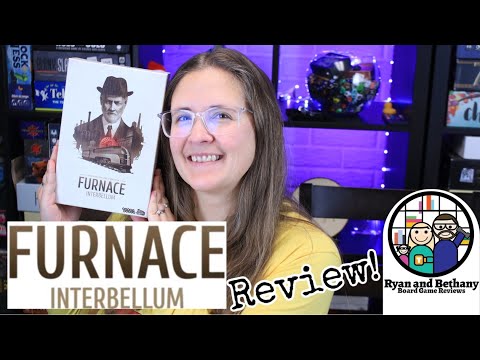


Furnace: Interbellum Deep Dive
What the Community Thinks About Furnace: Interbellum
Furnace: Interbellum is an expansion for the bidding-driven engine builder Furnace, and the reviewers covering it treat it as a worthwhile addition that deepens the base game rather than replacing it. Allies or Enemies placed the expansion on their list of remakes, sequels, and expansions from 2023, and they said they could not imagine returning to Furnace without it. Ryan and Bethany Board Game Reviews were more measured. They described the expansion as Furnace plus additional layers, and they felt the core game stayed streamlined even as the new material added decisions. Chairman of the Board, who had just received a copy from the publisher, expected the expansion to inject new life into the base game.
Core Mechanics That Define Furnace: Interbellum
Auction and Bidding With a Hidden Second Dial
Allies or Enemies identify Furnace as an auction game, and Interbellum adds a second secret dial that changes how bids play out. Because an opponent can use that dial to outspend a player, the reviewers noted that winning a card is never fully certain. Ryan and Bethany explain that the Capital discs are now variable, so players can set them anywhere from zero up to eight, with higher values available at a cost. Those variable discs require an extra bidding token once the manager tokens enter the picture, which gives players another piece to manipulate on the board. The reviewers also stressed that the existing bidding rules still apply, so players cannot simply match each other and must be creative about where they place their bids.
Economic Engine Building Through Capitalists and Managers
The second defining mechanic is the base game's card-driven economic engine, now modified by the Capitalist and Manager systems. Chairman of the Board describes Furnace as a solid little engine builder that is super quick to play, and Ryan and Bethany say the new Capitalist cards interact closely with the new Manager tokens. Manager tokens can attach to cards already on the board, either to repeat an effect or to strengthen a card that is still useful. A card that no longer helps a setup can be removed for compensation, which makes the engine more flexible over the course of a game. Ryan and Bethany also found that the Capitalists were well balanced, with no single one feeling stronger than the others even with the new ideas added.
The Furnace: Interbellum Experience
A Two-Player Opponent That Plays to Score
The two-player experience is where the reviewers diverge most sharply. Allies or Enemies say the expansion makes the two-player game much better, and they note that the bot now varies between versions so it does not play the same way every time. Ryan and Bethany describe a very different opponent. The new two-player AI behaves like a third player who is actively scoring points, pursuing a theme, and collecting the cards a human player wants. Ryan and Bethany warn that this opponent can snowball, with an early points lead that is difficult to recover from. Their conclusion was that this AI made the two-player mode feel heavier and less rewarding than the original fast, simple bot.
Modular Play That Changes Every Session
The modular structure is the other experiential quality that reviewers keep returning to. Allies or Enemies say they will always play with the expansion from now on, and they praise the extra bidding dynamics that make even the base bidding feel fresher. Ryan and Bethany found the expansion added more to consider on every turn, with glossy effects that make the game less simple and less quick than before. They also suggested a useful way to approach the expansion: play the base game on its own, then add the expansion back in and watch how the decisions change. That approach, they felt, revealed the full story of how the expansion shifts strategy.
What Makes Furnace: Interbellum Stand Out
Adjustable Bidding and Expanded Player Support
Interbellum expands the table as well as the bidding. A fifth player component set lets groups push past the base game's limit, and Ryan and Bethany note that this keeps the experience social with a large group. Ryan and Bethany also describe the result as a party game, with every player still engaged in the decisions. The variable Capital discs give players a new lever to pull, and the reviewers believed that expansion was necessary to support the new Manager system and the additional player count.
Built to Be Played Alongside the Base Game
The reviewers highlighted how well the expansion integrates with the base game. Ryan and Bethany admit that early in their experience they were unknowingly playing with the expansion built in, because the material had already been mixed into the box alongside the base game. Allies or Enemies also praised the expansion's effect on the core experience, saying that the new dial and the two-player changes make the game feel fuller. Chairman of the Board was drawn to the modularity of the expansion, describing its extra modules as a way to inject variety into the game.
Potential Drawbacks
A Snappy Two-Player Mode Became Heavier
Ryan and Bethany's main criticism focuses on the two-player mode. They described the original two-player AI as very fast and almost invisible in terms of time, while the new version demands far more attention and planning. Their reaction was direct: they would not choose to play two-player with the expansion, and they found it difficult to justify the effort of countering a rival who was already ahead early on. They felt the expansion works best when played with more people, where the extra player keeps the game fun for everyone.
More Rules to Track and Sort Out
The additional rules also come with a setup and upkeep cost. Ryan and Bethany pointed out that sorting out the cards and components is a chore, and that the expansion adds more effects to consider on each turn, so the game is no longer as simple or as quick as the base version. Chairman of the Board, who had not yet played the expansion, admitted uncertainty about what the dials and modules actually do.
If You Enjoy Furnace: Interbellum
Players who already love Furnace are the clearest audience for this expansion. Ryan and Bethany's review argues that the expansion rewards anyone who wants more depth from the base game's engine, while preserving the streamlined structure that made the original so appealing. Chairman of the Board describes the base game as super quick, which makes it a natural starting point for players who want a lighter engine builder before adding Interbellum's extra layers. For players who enjoy bidding combined with spatial or engine-building decisions, Chairman of the Board discusses Vegas Showdown as a bidding game with a bumping system on shared tracks alongside a building puzzle, a pairing that may appeal to the same players. Allies or Enemies also highlight Great Western Trail: New Zealand as a favorite deck-building Euro, a reminder that engine-driven games with clever card mechanics remain a strong fit for this audience.
What Reviewers Are Saying
"I can't imagine playing without it yeah I think we'll always play with it going forward"
— Allies or Enemies
"if I were to play with the expansion I would not want to play two-player"
— Ryan and Bethany Board Game Reviews
"I think this is going to be a nice addition to furnace to inject some life into the game"
— Chairman of the Board