

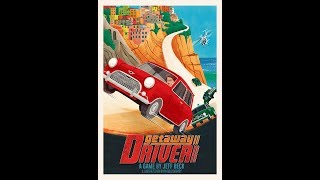


Getaway Driver Deep Dive
What the Community Thinks About Getaway Driver
Getaway Driver, published in 2019 by Uproarious Games, is a two-player asymmetric chase game in which one player drives a getaway car out of town while the other plays the police and builds the city around the driver. The commentary available on it is more descriptive than critical, and the sharpest hook comes from cardboardrhino. In a Kickstarter round-up, cardboardrhino presents the game as a fast, stunt-heavy pursuit title and stresses how little setup it asks for, describing it as easy to learn, fast to set up, and playable in about 30 to 45 minutes.
The most detailed explanation of how the game works comes from a rules walkthrough by BoardGameTeacher, which goes through components, the twelve setup steps, and the three phases of each round. That video is closer to a teaching guide than a review, so its value to readers is in how clearly it lays out the moving parts. The Dice Tower mentions Getaway Driver only in passing during a shelf tour of its library, listing it among the titles on one shelf without offering an assessment. The overall picture is of a game that reviewers and curators recognize quickly, with the praise centered on its theme and pace rather than on deep critical analysis.
Core Mechanics That Define Getaway Driver
Hand Management
The driver's hand is the engine of the escape. The driver starts with five secret driver cards, chosen from the box, and must decide when to play each one because every card is a stunt that can be spent to get past a problem on the road. The walkthrough explains that when a hazard token is placed on a tile, the driver must use a stunt card matching that tile to maneuver around it, and that entering a red light tile also requires spending a stunt card. Every spent card goes to a discard pile, and the driver can only use it again by paying for it with a stash token. That means the driver's hand shrinks over the chase and the timing of each play matters as much as the play itself.
The police side has its own hand decision. Police reinforcement tokens come from revealing city tiles marked with badges, and the police spend them during the purchase step to buy upgrades. Each upgrade card lists its cost in the bottom right corner, and the walkthrough notes that the effect appears next to the cost. Because both sides manage a limited hand of tools, the choice of which card to commit in a given round becomes a central decision for both players.
The Pursuit Meter and Asymmetric Chase
The pursuit meter is the clock that defines the asymmetry. Each round, the driver must advance the meter at least one space when taking the study the road action, which is also how the driver peeks at face-down city tiles without moving onto them. If the meter reaches red, the driver is captured. In the police phase, any police vehicle sharing a tile with the driver counts as pursuing, and if no vehicles are pursuing, the meter moves back one space. The result is a tug of war in which the driver must keep moving forward while the police must keep the chase close enough to hold the meter in place. The rules also make clear that the police win immediately if the driver has no legal move, so the driver can be cornered as well as caught.
The Getaway Driver Experience
Cat-and-Mouse Tension
The tension in Getaway Driver comes from the two players working on the same board with opposing goals. The police expand their search by placing face-down tiles on the sides of the driver's car, which means the driver never knows exactly what road lies ahead until it is revealed or studied. Green light tiles give the police a clear road, yellow light tiles favor the driver, and red light tiles block police movement entirely. The walkthrough's description of the police closing the net captures the feel: each round the police tighten the trap while the driver searches for a gap. Because the city grows outward from the car, every decision on either side reshapes the chase.
Thematic Car-Chase Excitement
Reviewers consistently tie the game to its movie inspirations. Cardboardrhino describes it as a game "full of car crashes crazy stunts and escapes," and the framing of the box, which references The Italian Job and The Fast and the Furious, sets expectations for reckless, high-speed play. Stunt cards, hazard tokens, and police vehicles that crash out of the city when they hit a hazard all reinforce the sense of a pursuit that is dangerous for both sides. The theme is not decorative: the rules convert the cinematic escape into concrete outcomes, such as a crashed police car returning to the supply pile or a driver forced to back up when no stunt card answers a hazard.
What Makes Getaway Driver Stand Out
Distinct Roles for Each Player
Cardboardrhino summarizes the central appeal in one sentence: one player is the daredevil motorist and the other is the police officer who does whatever he can to catch the driver. The two roles are not mirror images. The driver works with a secret hand of stunt cards, stash tokens, and an escape tile, while the police work with a visible reinforcement pool, vehicles, barricades, tire spikes, a helicopter, and the power to build the board. Each side gets a different kind of puzzle, which keeps both players engaged even though only one can win.
A City Built Around the Chase
The city itself is one of the game's most distinctive features. The walkthrough explains that the police draw and place tiles face down, that the table's edges define the limits of the city, and that the board grows only where the police choose to extend it. Because the setup asks the driver to scatter stash tokens across the table, the city is partly defined by the players before the first move. Cardboardrhino's quick-learn pitch sits alongside this design, since the city-building and chase begin almost immediately and the play area itself becomes the game's map.
Potential Drawbacks
A Steep Setup for a "Pick Up and Play" Pitch
Cardboardrhino's Kickstarter round-up praises Getaway Driver as "easy to learn, fast to set up," but the rules walkthrough tells a more demanding story. Setup alone runs twelve steps split between five driver tasks and seven police tasks, including scattering stash tokens, building the police reinforcement pool, and dealing out the upgrade hand. Each round then layers three phases with their own sub-actions, as the police reveal and place tiles, the driver resolves a hazard or stunt card, and the police check for pursuit before buying upgrades. Groups expecting the fast, breezy chase promised by the pitch may need a full round or two before the setup and phase structure start to feel automatic.
A Luck-Dependent Economy for the Police
The police side's upgrades depend on which tiles happen to carry a badge. Reinforcement tokens only arrive when a revealed city tile shows a badge and a number, and that number is the only thing determining how many tokens the police gain that turn. Since the driver and police alike are drawing from the same shuffled stack of city tiles, a police player can find their reinforcement pool starved simply because badge tiles are slow to surface, leaving them short on the stash and upgrade purchases that counter the driver's stunt cards.
If You Enjoy Getaway Driver
Readers who enjoy Getaway Driver are most likely to appreciate other two-player asymmetric games built around hidden movement and pursuit. The core appeal is a tense, one-on-one chase in which one player must escape while the other closes the trap, with information unevenly distributed between the two sides. Good starting points are other compact, tile-driven chase games and two-player titles where one side hides its intentions while the other reveals and reacts. Look for games that combine a limited hand of tools with a visible tracker that moves toward a decisive outcome, since that combination drives the same escape-versus-capture tension.
What Reviewers Are Saying
"Getaway Driver puts you in the driver's seat in a game full of car crashes, crazy stunts and escapes. It is a fast and frantic asymmetric game for two players."
— cardboardrhino
"The police cannot travel through red light tiles, and the driver has to use a stunt card to go into a red light tile."
— BoardGameTeacher
"The rounds consist of three phases: the police expand their search, the driver makes their escape, and the police close the net."
— BoardGameTeacher