




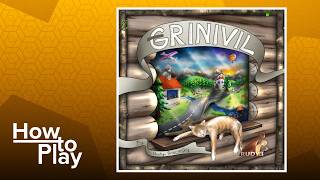
Grinivil Deep Dive
What the Community Thinks About Grinivil
Reviewers describe Grinivil as a city-building economic game in which every player contributes to a shared town and profits when others use the infrastructure they helped create. The enthusiasm centers on interaction. Nick Murphy, BoardGameGeek frames the game as one where players are practically forced to use their actions for their own purposes, so every move affects the people around the table. The Board Gaming Doctor calls the experience an interactive, almost cooperative style of play, in which players can specialize in roads, trees, or residents while still competing for the same points.
Agreement is strongest on the central puzzle. Reviewers consistently praise the variable time action ring and the economic tension of earning and spending coins to move forward. Disagreement appears when they discuss learning the game. The Board Gaming Doctor, who had one play on record, found the first four-player session rough, with the rulebook difficult to follow and several basic rules applied incorrectly, yet came away eager to play again. Nick Murphy's video works as a full setup and rules walkthrough, and the game's learning curve is the main theme that connects the reviews. Benjamin, Brettspielblog had not yet played when recording, and built their view from the rules, other videos, and early comments. Benjamin emphasized the game's strong pre-release buzz, noted that the designer developed, illustrated, and crowdfunded the game largely alone, and expected remaining copies to sell out during Spiel 2026.
Core Mechanics That Define Grinivil
The Time Action Ring
Published by RUDY3 Publishing, Grinivil revolves around a ring of action tiles that is assembled at setup from four fixed corner tiles and a random selection of pink-bordered variable tiles, so the order of actions changes from game to game. On a turn, a player moves a marker to any available action on the ring, including a full loop back to their current position, provided they can afford to perform the action. After acting, the marker advances by the time cost printed on the tile. Red time boxes are mandatory, while grey boxes let a player pay three coins to move one space less, so money constantly shapes timing. The Board Gaming Doctor describes the ring as the element that ties the whole game together, and Nick Murphy explains that passing the final tile triggers taxes, wages for workers still on construction sites or ability tiles, and a refill of four resources in the market. The ring therefore functions as both a menu of actions and a game clock.
Auction Bidding for Resources
Grinivil includes an auction action that Nick Murphy walks through in detail. The player who takes the auction space draws five resources from the bag, and every player bids on them with a minimum bid of 10 coins. The initiator must also bid. The highest bidder takes the resources and one victory point, while an initiator who loses the bid receives half of the highest bid, rounded down, as compensation. The auction costs no time units, which makes it a useful way to obtain materials without shifting the marker. A related secret-bidding action, crowdfunding, lets players offer coins to share in the construction of a single non-residential building, with the first block going to the largest contributor.
The Grinivil Experience
An Almost Cooperative Shared Board
Much of the feel of Grinivil comes from the shared board. Players construct floors of residential, commerce, and public buildings, and when someone builds on a parcel owned by another player, the owner collects a payment. The Board Gaming Doctor describes players specializing in different roles, with one player focused on roads, another on trees, and most others mixing both while chasing residents. Helping another player build costs a little money, but it can unlock a resident who scores heavily. That constant balance between your own gains and the board's overall progress gives the game the cooperative-feeling interaction that reviewers highlight, even though the outcome is competitive.
A Player-Driven Ending That Builds Tension
Grinivil does not end on a fixed round. Once one player has two or fewer building blocks left, sudden death begins, and each player decides whether to keep their marker in place or return it to the start. A player who returns can sell one finished house before the game ends, and players who have finished still collect money as the ring passes their turns. The Board Gaming Doctor described how this encourages players either to race and deny opponents time, or to slow down and build toward combos. The tension increases because residents left in hand at the end cost 10 points each, so the final turns carry real penalties.
What Makes Grinivil Stand Out
A Different Puzzle Every Game
Reviewers consistently point to the variable time action ring as the reason Grinivil stays interesting. The Board Gaming Doctor credits the stack of interchangeable tiles with creating different combinations of actions and proximity, which changes which efficiencies are available in each game. Nick Murphy notes that the rulebook suggests a fixed arrangement for a first game, while the randomized pink tiles otherwise reshape every session. Benjamin, Brettspielblog, singles out the time track mechanic as one of their favorite designs, because it forces players to weigh moving forward against paying to reduce how far they move.
Economic Interaction on a Shared Table
Grinivil's economy stands out because almost every purchase, sale, and building decision connects to other players. Resources are bought from a market where scarcity drives prices, so the fewer resources remaining, the more expensive they become. Land parcels generate income for their owners when others build on them, and residents reward the players who helped construct the buildings they require. The Board Gaming Doctor compares the market dynamics to Brass and Clans of Caledonia, and the shared-infrastructure economy to Food Chain Magnate, where players compete over the same structures.
Potential Drawbacks
A Demanding Rulebook and Unclear Iconography
The most consistent criticism is that learning Grinivil is difficult. The Board Gaming Doctor found the rulebook hard to follow and said that consulting it during play slowed the game, with several basic rules, some of which would have changed the outcome, handled incorrectly. The group misapplied the tax rules and the rules for building on the same site, and the reviewer found the iconography unclear, especially the victory point track. The reviewer suggested a one-sheet player aid covering build requirements and a worded breakdown of each turn. Reviewers still describe the game as rewarding once the rules are understood, which makes the first session the main barrier.
A Player-Driven Ending That Is Hard to Gauge
The Board Gaming Doctor found the player-driven ending a source of frustration, especially in early games when a strategy has not yet taken shape. The reviewer ran out of time to finish the public buildings planned for scoring and found that residents left in hand cost points at the end. Since the endgame trigger depends on how many building blocks remain, new players can misjudge how much time they have. The reviewer acknowledged that experienced players can use the trigger to race or set up combos. The drawback is less about the design itself than about how little warning a first-time player receives before the game closes.
If You Enjoy Grinivil
Players who enjoy Grinivil's shared economy and market pressure will find similar satisfaction in Food Chain Magnate, which the Board Gaming Doctor cites as a close comparison because both rely on shared infrastructure. Players who appreciate how Grinivil's market raises and lowers prices will find a related challenge in Brass and Clans of Caledonia, where supply and demand shift the value of resources as the game flows. Fans of the player-driven ending and the pressure of racing an opponent's clock may enjoy Ark Nova, which the Board Gaming Doctor describes as having a more player-driven endgame. For the storage puzzle, where players decide what to keep and when to expand capacity, The Colonists offers a comparable challenge.
Players who want unforgiving interaction with more flexibility can explore Antiquity, which the Board Gaming Doctor placed among harsher splatter-style games that Grinivil softens. Lands of Galaria, which the same reviewer describes as semi-cooperative building, offers another route for players who enjoy shared progress with competitive edges. Players who like shared investment and stock manipulation can look to City of the Big Shoulders or the 18XX family, where players invest jointly and profit from one another's moves.
What Reviewers Are Saying
"Grinivil is all about manipulating and working that time action ring while building the town of Grinivil together with the other players. It's where all the things you need to do are, and managing your time as you move around it is critical because you got to get that city built. You are practically forced to interact with other players trying to use their actions for your own purposes more than to allow other players to take advantage of yours."
— Nick Murphy, BoardGameGeek
"I like that in this game that there is a centralized focus of getting residents into the city. Everyone needs to do that and should do that to be competitive and a lot of the victory points do come from that. But I also liked that you could specialize a little bit like buying or building a lot of roads or focusing on trees."
— The Board Gaming Doctor
"I personally really like this time track mechanic. It's one of my favorite mechanics, if you disregard all those standard deck-building and worker placement things."
— Benjamin, Brettspielblog