

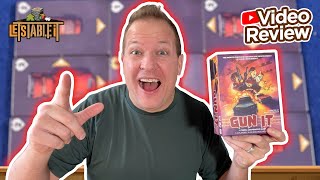


Gun It Deep Dive
What the Community Thinks About Gun It
Reviewers describe Gun It as a short, loud cooperative getaway game where the plan is only half the fun. Let's Table It introduces the game as a tile placement cooperative title about dealing with the mess in front of you, and places it alongside Hostage Negotiator and Final Girl for players who enjoy shared pressure at the table. Hungry Gamer, which covered the game on its Boards and Brews podcast after the publisher sent a copy, reached a similar conclusion from a more skeptical starting point. The co-host known as Don said they enjoyed the game and that it fit the theme well, while the Hungry Gamer host praised its clever structure but warned that a first session can be rough.
The reviewers agree that Gun It is quick to teach and that the tension is its main selling point. They diverge mainly on how much the randomness and player count matter. Hungry Gamer was more willing to accept the coin-flip swings as part of the fun, while the consensus across the videos is that the experience depends heavily on who is sitting in the car and how much the group is willing to coordinate.
Core Mechanics That Define Gun It
Cooperative Game
Gun It is built so that every player shares one outcome. Let's Table It explains that if the crew car is wrecked, everyone loses, and that each scenario ranks the group's score, with the lowest rank or better counting as a win. Players do not compete for points in the usual sense. Instead, the crew coordinates who drives, who holds each weapon, and which direction each shot will travel. Hungry Gamer described the central activity as a discussion about sequence, where one player agrees to act first so that a second player can shoot across the car at a precise moment. The result is a game where communication is the real mechanic, and the group's collective planning matters more than any individual's skill with a pistol or shotgun.
Grid Movement
The board in Gun It is built from tiles rather than a fixed map. Each round, the grid is refilled with tiles around the crew car, and every tile is flipped face up once the planning phase begins. Let's Table It describes how the driver moves one space in a chosen direction and slides every vehicle in that space along with the car, while wrecked vehicles spill damage along the yellow arrows printed on their tiles. Those arrows are the strategic heart of the game for Hungry Gamer, who noted that the directions point in different ways, and that one player's action can reshape the entire board. At the end of a round the grid collapses from the front, right, back, and left, removing any vehicle that sits two spaces away from the crew car. Players also score for orthogonal spaces around their car that remain empty, which rewards careful positioning as well as destruction.
The Gun It Experience
Tension Under a Running Clock
Both channels return repeatedly to the timer. Let's Table It recommends a digital timer with added music to make the table feel more tense, and Hungry Gamer described the sand timer as the right length: long enough for a real conversation, but short enough that the group often reaches the last grains before committing. The co-host admitted that timers are not usually to their taste, yet said the timer fits the theme of a car full of people driving fast with enemies closing in. The result is a steady, anxious energy that makes each planning window feel important.
Chaotic Chain Reactions That Feel Earned
The satisfaction in Gun It comes from watching a plan go off, or from recovering when it goes wrong. Hungry Gamer compared the feel to Spy Hunter, the classic arcade driving shooter, because the player is a small crew moving through traffic and using each weapon to create a chain of crashes. The reviewer called out the stress that turns into moments of joy and glory, noting that the moments of frustration were few enough not to feel punishing. Let's Table It highlighted the pileup scoring, which rewards clever combinations of wrecks, so a single well-placed shot can produce a spectacular result that the whole crew celebrates together.
What Makes Gun It Stand Out
Scenarios and Difficulty Dials
Let's Table It emphasized how much flexibility the game offers. Players choose difficulty levels separately for the crew, the scenario, the setting, and the hostiles, which lets a group mix and match to suit its experience. Scenarios bring their own goals, score charts, and sometimes their own timers, and the moment and setting cards add narrative flavor that gives the game a stronger visual identity. The reviewer also noted that an onramp guide walks new players through a first scenario, after which groups can pick their own. Hungry Gamer felt the scenarios differed enough in story and vibe to justify replaying, even though the core rules stay the same.
A Small Footprint That Fits Anywhere
Hungry Gamer repeatedly returned to how compact the game is. The reviewer explained that the box is small and the play area is a few cards and tiles, which made it easy to play at a two-player table in a cafe. That portability is a practical advantage for a game with a lot going on, and it sets Gun It apart from larger cooperative games that need a full tabletop. The same reviewer contrasted it with a longer game, observing that the lighter footprint suited a relaxed session just as well as a longer evening.
Potential Drawbacks
A Steep First Session and Coin-Flip Swings
Hungry Gamer was candid that the first play was rough. The group needed a few sessions to understand how cause and effect worked in practice, and some early shots went wrong because the crew misjudged the direction or range. Long shots add a further layer of randomness, since a coin flip decides whether a risky shot connects. Hungry Gamer described the coin as a point where the game may or may not cooperate with the plan, and the reviewer felt that the balance was acceptable but would frustrate players who prefer predictable outcomes. For groups that dislike chance, this is the element most likely to sour the experience.
Awkward Player Counts and Solo Play
The player count is another point of friction. Hungry Gamer reported that the two-player game worked well with one person in the front seats and one in the back, but that three players creates an uneven split because four characters must be divided among three people. The reviewer also felt uncertain whether four players would have enough to do, since the group had not yet tested that count. Solo play received a mixed reception: the puzzle was engaging, but the reviewer lost every solo game and felt the absence of a partner to bounce ideas off was a real loss. Groups that play mostly with three people or alone may find the design less satisfying than the reviews suggest.
If You Enjoy Gun It
Players who enjoy Gun It's cooperative structure will find similar satisfaction in Hostage Negotiator, which shares the same sense of a shared outcome under pressure. Let's Table It specifically linked the two, noting that the crew's success depends on collective planning rather than individual wins. Final Girl is another natural pairing for groups who like cooperative tension that escalates through scenarios. Players who enjoy Gun It's directional driving and shooting feel will find similar energy in Spy Hunter, the classic game that Hungry Gamer cited when describing the chain-reaction excitement. Each recommendation reflects a different piece of what makes Gun It appealing: shared stakes, escalating scenarios, and the thrill of a plan that comes together under time pressure.
What Reviewers Are Saying
"It can be a tense game, but it's all about cooperating with all the players to find the best plan and then gaining experience points for how well you execute that plan."
— Let's Table It
"For a game that seems like it's about making you feel stressed out for a brief moment, and then that stress turns into moments of joy and glory. I think it accomplished that more often than it didn't."
— Hungry Gamer
"There's four different seats in the car and you can shoot out from a different side of the car or you can drive or whatever you're going to do. But you have like 2 minutes to kind of pass these things around to figure out the order that you're going to be doing these different actions."
— Hungry Gamer