


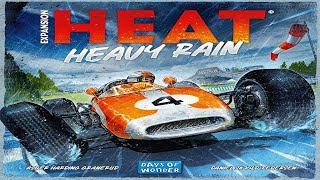



Heat: Heavy Rain Deep Dive
What the Community Thinks About Heat: Heavy Rain
Heat: Heavy Rain arrives as a cautiously appreciated but somewhat underwhelming expansion to the acclaimed base game Heat: Pedal to the Metal. Board game reviewers recognize the expansion adds genuinely enjoyable content in the form of two new race maps and additional cards, yet there is a consistent undercurrent of disappointment about how the expansion prioritizes quantity over scope. Reviewers like Board Games UnLocked, One Stop Co-op Shop, and Board Game Animal acknowledge that Heat's base game remains strong enough to carry lighter expansions, but many feel the designers made strategic choices that underutilized the expansion's thematic potential. The expansion feels less like a significant evolution and more like incremental content meant to capitalize on Heat's popularity while keeping price points accessible.
Core Mechanics That Define Heat: Heavy Rain
Flooded Track Sections
Heat: Heavy Rain introduces flooded spaces, primarily featured on the Japan map, that fundamentally shift how gear management plays during specific race moments. When a driver starts their turn on a flooded section, shifting down now costs one additional heat card per gear shift. Normally, downshifting requires no heat cost unless performed twice in sequence; flooded sections invert that equation by making even single shifts more expensive. Reviewers note the mechanic makes thematic sense, as flooded corners become high-risk zones where heat economy tightens considerably, forcing drivers to either maintain higher speeds and risk crashes or burn through their heat reserves. The strategic tension is real, though reviewers observe the mechanic lands on the corners of the Japan map where downshifting is already tempting, so the interaction feels natural rather than punitive.
The Cooldown Upgrade Card (Purple Drop Ability)
The expansion introduces a new type of upgrade card marked with a distinctive purple symbol that enables a previously unavailable action: players may search their discard pile, retrieve one heat card, and place it back into their engine. This cooldown mechanic diversifies deck-building strategy by rewarding players who manage their heat cards thoughtfully rather than burning through their reserves carelessly. Reviewers praise this addition as genuinely clever, as it creates a risk-reward decision point where holding onto certain cards in the discard might pay off later. The purple symbol becomes its own mini-strategy layer within the upgrade economy, giving players who prioritize this symbol a different path to victory than those focusing on raw power or acceleration.
The Heat: Heavy Rain Experience
Refinement Over Revolution
The expansion feels like a respectful continuation of what reviewers already loved about Heat rather than an ambitious reimagining. Reviewers describe opening the box and finding exactly what they expected: more of a proven formula. There is comfort in that familiarity, especially for players who have worn grooves into the base game through repeated plays. The new maps integrate seamlessly with existing content, and the extra cards slot into existing decks without requiring players to relearn core rules. One reviewer captures this sensation: the expansion succeeds because it never tries to be more than it promises.
The Misleading Promise of the Expansion's Theme
Despite its name and evocative artwork, Heat: Heavy Rain delivers only partial thematic integration. The expansion's headline weather mechanic, flooded sections and their heat-modification rules, appears only on the Japan map, leaving Mexico untouched by the heavy rain concept. Reviewers find this disconnect frustrating. One reviewer notes with genuine confusion that the designers explicitly reference rain mechanics on one map while the expansion's title and marketing emphasize weather as the marquee feature. This sends a mixed signal: either the rain system felt incomplete and was scaled back, or the designers chose not to apply backwards compatibility to existing maps. Board Games UnLocked's reviewer offers the thought that there could have been ways to implement flooded track sections on other maps, even if that required some creative reinterpretation of the rule, yet no such option exists in the rulebook.
What Makes Heat: Heavy Rain Stand Out
Two Genuinely Excellent New Maps
Japan and Mexico are both strong track designs in their own right. Japan sprawls across the map with a two-lap structure, starting drivers with seven heat and three stress, and uses its flooded corners strategically placed where downshifting temptation is highest. Mexico introduces chicanes, a pair of back-to-back corners that trigger advanced AI behaviors when using the weather and road conditions module, making legend opponents more formidable and less predictable. Reviewers consistently praise the cartography and visual identity of both maps, noting that new race venues are the lifeblood of racing games and Heat delivers here without compromise. The maps feel like events worth traveling to, not generic filler.
Strategic Depth Without Overwhelming Complexity
The expansion does not demand a rulebook overhaul. Both the flooded sections and the new purple cooldown symbol integrate into the existing turn structure without friction. Players can add these elements piecemeal or together, and the game remains immediately recognizable to anyone who owns the base game. Reviewers appreciate that Heavy Rain respects the elegant simplicity of Heat's core design while offering new decision points for those who want them. There are no lengthy exceptions, no revised core mechanics, just modular additions that expand the space of meaningful choices.
Potential Drawbacks
Limited Integration of New Mechanics Across Existing Content
Reviewers consistently voice frustration that the flooded-sections mechanic appears only on Japan and the advanced AI rules appear primarily in Mexico, with no way to apply these subsystems to France, Italy, Great Britain, or USA. One reviewer observes that this feels like incomplete work. If flooded sections were a core thematic pillar of Heavy Rain, they argue, players should have the option to adapt the rule to other tracks, even if that required homebrew solutions in the rulebook. The missed backwards compatibility stands out when compared to other racing games that let players customize and remix track rules. Reviewers note the designers released a design diary stating they wanted to keep expansion prices low by releasing smaller boxes frequently, yet this strategic choice comes at the cost of making each expansion feel slightly half-finished.
Misleading Branding and the Legend Card Problem
The expansion's title invokes weather and water as major themes, yet rain mechanics appear on only one map. Reviewers describe feeling misled by the marketing. Additionally, despite introducing a new driver, the seventh racer, in orange, the designers did not print updated legend cards that include the new color. This creates a friction point: if a player wants to run a solo game with all available racers and use the legend system, they must use the orange driver without matching legend cards, or they must house-rule solutions. One reviewer flags this as a cost-saving measure that frustrates collectors and solo players who value complete component sets. The omission implies either future expansions will address this issue or the designers do not plan to fully support the solo experience as the player count expands.
If You Enjoy Heat: Heavy Rain
Heat: Pedal to the Metal remains the essential purchase. The base game contains more strategic depth, more cards, and more maps than most racing board games ever ship. If you exhaust the base game and crave new race venues, Heat: Heavy Rain delivers two high-quality tracks plus a handful of strategic wrinkles. For players who own the base game and play it regularly, the expansion is a logical next step, though reviewers cautiously recommend evaluating whether to need it immediately or wait for a follow-up expansion that might address the integration gaps. Tunnel Vision, Heavy Rain's successor, repeats the same design pattern, suggesting this is the intended expansion philosophy going forward.
What Reviewers Are Saying
"The expansion and what it brings is good. Like, the content is good. I think where I'm disappointed is that there's not a lot of content here. It's not that this expansion is bad by any means. If you can get it, definitely get it. Because there's certain expansions that will come to a game that basically add a whole bunch and it can become cumbersome to throw it in with the game, and that's where this expansion exceeds because it is literally just more content for heat, which is fantastic."
— Board Games UnLocked
"This is an expansion that I would not buy myself if they had not sent me a review copy. I don't think it's really worth it, just to be honest, because you get two new courses, which are pretty cool, but only one of them uses the new flooded mechanic, so it just seems like a bit of a waste, a missed opportunity."
— One Stop Co-op Shop
"Heat is just so good and this one whenever they announced an expansion was one that I pre-ordered as quickly as possible. This is kind of a weird one. I do think this is a good expansion because it is more of heat. It's two new maps. A new racer and kind of new rules specifically for those maps. So this was kind of an expansion that I thought was good but could have been slightly better."
— Board Games UnLocked