








Hellas Deep Dive
What the Community Thinks About Hellas
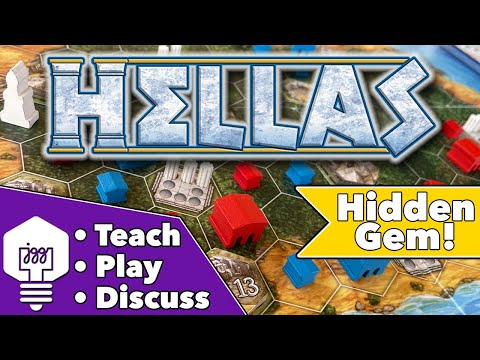
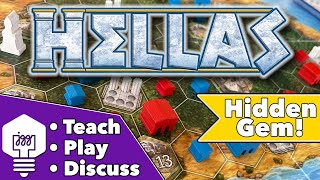
Hellas is a 2016 game designed by Stefan Dorra, and reviewers keep returning to it because its turns overlap. Players place cubes on actions, and everyone else at the table can take that same action on their own turn. Board Game Hangover called it the second hottest board game in its ranking of new releases. Junkets Games has played it repeatedly and says the group has become quite taken with it. This overview covers the 2016 release only.
Core Mechanics That Define Hellas
Action Following
Each turn, a player places a cube on one of the action spaces and resolves that action. Other players can then use the same action on their own turns, usually at a reduced benefit that depends on their position relative to the placement. Board Game Hangover described the core loop as action drafting, where you place your cubes and then see what happens. Because the follow option is built into action selection, the spot you choose is never only about your own gain. It also decides which actions your rivals can reuse.
Area Acquisition
Hellas is often filed under area control, but Junkets Games argues that area acquisition is the better description. Players spend marble to claim ground, and a coastal house costs one marble while an interior house costs two. Temples cost five marble on the coast and seven inland, and the connected buildings around a temple form a city that scores at the end of the game. Quarries add a second layer, since the active player draws numbered tiles and stacks them over lower-numbered quarries, which changes how much marble every adjacent house produces. Scoring rewards planning as well: each player counts the tokens in their largest city, pillars on adjacent temples add to that city's value, statues raise a nearby city, and each ring is worth two points with a three point bonus for the player holding the most rings.
The Hellas Experience
Tension in a Head-to-Head Game
Two-player Hellas is built on constant back-and-forth. Each action you take is also an option for your opponent, so a build that looks cheap may hand them a useful follow-up. Junkets Games compared the rhythm to chess and described the tempo of follow actions as a kind of double move, where each choice sets up the next. The hosts described the session as a game of chicken, with each player trying to shut the other out of key spaces.
Hidden Information at the Table
Marble stock is hidden behind dividers, so each player has to estimate how much the other can afford. Junkets Games explained that the box covers are meant to keep this information private, which makes buying decisions feel like a gamble when a quarry is about to swing the economy. The hosts admitted they could technically count each other's marble, but said that is not how the game is meant to be played. That uncertainty gives a direct, tactical euro an extra layer of guesswork.
What Makes Hellas Stand Out
Action Following Inside a Classic Euro
Junkets Games described Hellas as a classic, old school, dry euro that feels older than it is, but the action selection stands out. The follow actions are integrated into the selection mechanism rather than added on top of it. The hosts singled this design out as a cool example of how action selection can work, noting that each choice of action also determines what the other player can do. For players who enjoy tight, deliberate turns, that integration is the feature that sets the game apart.
A Compact Box That Doubles as the Board
Board Game Hangover highlighted how compact the production is. The game box doubles as the board, the other side of the box is used for scoring, and the lid comes out to reveal the pieces, which are packed neatly inside. The reviewer said the game is much smaller than the original version, which makes it look more modern.
Potential Drawbacks
Debate Over Two-Player Balance
Junkets Games mentioned that some people feel Hellas is not a strong two-player game, and the hosts acknowledged that view even while enjoying their own sessions. The direct back-and-forth may feel too sharp for players who prefer more room to plan ahead. Players who want a looser, more forgiving contest between two people may find the tension more draining than rewarding.
Quarry Swings Can Be Harsh
Quarry tiles can swing income sharply. In the two-player playthrough, a single tile dropped one quarry from three marble to one, which the host called pretty devastating for a player with a large building network there. The hosts described the quarry mechanic as the most important part of the game, and said it is where things get mean. Players who dislike sudden economic reversals may find that a carefully built plan can be undone by one draw.
If You Enjoy Hellas
Hellas suits players who like placing a few pieces that matter to everyone at the table, reading what others will do next, and fighting for ground with tight, deliberate turns. It also appeals to fans of medium-weight euros with hidden resources and steady counterplay, especially in two-player games where the tension stays high. If you prefer to focus on your own engine and rarely think about your opponents, the constant follow options may feel like too much interaction. A full playthrough is a good way to see how quickly the quarry and follow decisions unfold.
What Reviewers Are Saying
"And it's action drafting. So you place your cubes and then see what happens. And there is also the secret info on what things you have still left and so on."
— Board Game Hangover
"Hellas is a wonderful, not really area control, more like area acquisition style game that came out like six or so years ago."
— Junkets Games
"The tempo of this follow is so interesting because like you effectively get double actions, right? Yeah, like I choose something and then you go and then you choose something and then I go and then I choose something, boom boom boom."
— Junkets Games