






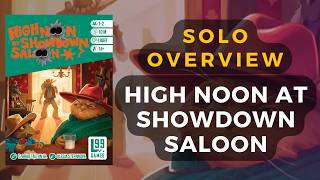
High Noon Deep Dive
What the Community Thinks About High Noon
High Noon draws enthusiastic praise for its audacious theme and snappy playtime, though reviewers are divided on whether the production and rulebook clarity live up to the game's Wild West concept. The Allies or Enemies crew celebrates the thematic blend of ghost cowboys competing in what sounds like a supernatural showdown, while DaniCha appreciates the game's compactness and the satisfying surprise of its endgame scoring. The Dice Tower rates it as serviceable but middling (6 out of 10), noting solid combo ideas but confusion around the game's presentation and skeleton-cattle premise. Overall, High Noon appeals to players who value theme novelty and quick play sessions over deep strategic depth.
Core Mechanics That Define High Noon
Tile Placement
At its heart, High Noon is a tile placement game where players construct a shared saloon environment by laying character tiles with specific connection points. Each tile features bullets (for showdown scoring) and rifle-barrel edges that interlock with adjacent tiles for bonus points throughout the game. Players deliberately position tiles to create scoring chains, managing the placement of character effects like the Ranger (who rotates an adjacent character) or the Waitress (who restricts where the next tile must go). The adjacency puzzle becomes the game's central decision point, with every placement reshaping the board state and opening new scoring opportunities for opponents.
Card-Driven Route Building
High Noon combines its tile system with card play, where players lay cards to determine how tiles flow across the saloon. This card-to-tile pipeline creates an elegant combo layer: your card selection feeds into where and how your tile placement path develops. The system feels akin to route-building games, except the routes are physical tiles emerging on the board rather than abstract connections. This mechanic lets players chain effects through careful sequencing, turning the tile saloon into an emergent puzzle of player intentions colliding with rival builds.
The High Noon Experience
Wild West Duel Tension
The game's signature feature is the dual gunslinger endgame. Two dualists bookend the saloon, and players compete to amass bullets on their side of the board through tile placement and connection scoring. When the round ends, players count bullets on their dualist, and whoever has more wins the showdown. This thematic anchor transforms a tile puzzle into a gunfight fantasy, letting players feel the pressure of a Western showdown while making tactical placement decisions. Reviewers note that the duel mechanic gives the game memorable flavor and raises the stakes of each tile placement.
Surprise Scoring Discovery
One of High Noon's strongest draws is its opacity until endgame. Because bounty tiles impose hidden conditions (an attached character must have no matching connections, or must be part of a chain of four or more), players cannot always predict who will win. DaniCha highlights this as a major strength: the game keeps everyone guessing through final scoring, which creates genuine tension and prevents runaway leaders from dominating the entire session. This surprise element rewards careful placement but punishes overthinking, keeping play light and brisk.
What Makes High Noon Stand Out
Incredibly Fast Play
High Noon resolves in roughly 10 minutes, making it an ideal filler or gateway game. DaniCha praises its speed, noting that you can play a full satisfying game before many heavier games finish their first round. This compactness appeals to convention players, casual groups, and anyone seeking a Wild West theme without the 90-minute commitment. The quick resolution also makes the hidden-scoring surprise all the more impactful: the game ends before anyone has time to calculate exact victory margins.
Thematic Ghost Cowboy Premise
The game's wild-card appeal is its supernatural western setting. Allies or Enemies is immediately drawn to the idea of ghost cowboys competing in a saloon, combining two evocative themes that rarely appear together. While The Dice Tower's reviewers expressed some confusion about whether the skeleton cattle are undead wranglers or something else, the thematic ambition itself is refreshing in a market of historical simulations and abstract games. The duel mechanic and skeleton imagery reinforce the ghostly gunslinger fantasy throughout play.
Potential Drawbacks
Production Quality and Rulebook Clarity
DaniCha surfaces a tangible manufacturing concern: the tiles shed plastic shavings onto the playmat during use, suggesting incomplete finishing or edge-shaving. While they note the tiles create a premium tactile feel, the debris issue could be distracting during play, especially in tight game spaces or with players sensitive to component quality. Additionally, both The Dice Tower and Allies or Enemies hint at rulebook or presentation confusion. The Dice Tower struggled to parse the skeleton-cattle premise, and The Dice Tower's unboxing commentary suggests the theme is not immediately obvious from the box or artwork alone.
Middling Mechanical Depth
The Dice Tower rates High Noon at 6 out of 10, acknowledging some interesting combo ideas but ultimately finding the execution unremarkable. The tile placement puzzle, while satisfying, may not offer sufficient replay variety or strategic branching for players seeking meatier decision spaces. The quick playtime, while a strength for casual play, also means the game's mechanical complexity caps out relatively early in a session. Players accustomed to deeper tile-placement games like Carcassonne or heavier dexterity games may find High Noon superficial by comparison.
If You Enjoy High Noon
Consider games that blend quick tile placement with thematic storytelling. Carcassonne offers similar incremental board building but over a longer timeline and with more options per turn. For players drawn to the asymmetric or duel-based gameplay, games like Dice Throne or Tag Team provide card-driven combat with character variety. If the Wild West theme resonates, seek out other regional games that lean into frontier atmosphere. For convention and casual play, any fast-resolution tile game (Domino or PieceHolder variants) will scratch the same itch, though few match High Noon's supernatural western flavor.
What Reviewers Are Saying
You don't really know who's going to win at the end of the game, which I like. I kind of like that surprise aspect to it.
— DaniCha
High Noon. And this is ghost cowboys. So that's two things I really like. But in High Noon it is a card playing route building game where your cowboys who are also ghosts. What's not to like about that?
— Allies or Enemies, Shawn
It's really just a game where you're putting cards out and then building these little paths of tiles on them. There's some interesting ideas from this combo game.
— The Dice Tower, Tom Vassel