









High Score Deep Dive
What the Community Thinks About High Score
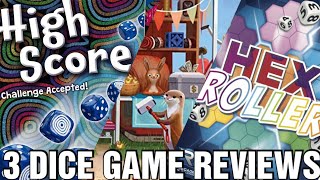
Reviewers tend to agree on what High Score is: a fast, portable Reiner Knizia dice game, published by Cosmos, in which each round's challenge card changes how the dice are scored and how many rerolls players receive. Most commentary treats it as a light push-your-luck filler that punishes greed and rewards nerve. The disagreement centers on how much depth sits underneath that simplicity. The Chairman of the Board channel calls it a pure luck affair that is still fun for what it is, while kovray frames it as a step up from Farkle with more going on than the classic dice game. Board Game Animal, ranking Knizia's catalogue, places it well below the designer's strongest work and describes it as a game that falls to the background. The Dice Tower covers it only briefly, identifying it as a 2021 Knizia title without offering a verdict.
The most energetic enthusiasm comes from groups playing it as a table game rather than an analytical puzzle. In the No Rolls Barred playthrough, the hosts laugh through rules checks, chant "push your luck" at each other, and treat the bust penalties as the main source of drama. The overall picture is of a game that works at the table because it is quick, noisy, and produces strong reactions when a roll goes wrong, even if reviewers who want deep decisions find it thin.
Core Mechanics That Define High Score
Re-Rolling and Locking
Each round begins with a challenge card that sets the rules for that turn, including how many rerolls the player gets and how many dice must be set aside. The No Rolls Barred hosts describe several variants. On one card, the player may keep any number of dice and roll the rest up to three times. On another, every roll requires banking exactly one die before the remaining dice are thrown again. Players can also stop whenever they like, which turns each throw into a decision. Reviewers keep returning to the same evaluation problem: a partial result, such as a pair of fives or a vortex, is only worth keeping if the odds of improving it on the next throw justify the risk of losing what is already banked.
Compound Scoring
Scoring in High Score changes from round to round, and the card for each round tells players how the vortex face counts. Reviewers describe its value shifting between 10, zero, minus 10, a wild that can stand in for any number, and a face worth six. Other cards reward making groups of ten from any dice, scoring three of a kind minus the remaining dice, or counting only odd values. The Chairman of the Board channel summarizes the result as points based on different scoring cards, and the No Rolls Barred table spends much of its time working out the arithmetic before committing to a stop. Points then come from two layers: the round's own formula, and a finishing order on the track where the leader earns three points, second place earns two, and third earns one. Landing on a space already occupied knocks a player back one, so a high total can backfire if it collides with another player's piece.
The High Score Experience
Nerves at the Bust Line
Play feels tense because the cost of a bad roll is real and immediate. In the No Rolls Barred game, a player who pushed too far dropped into negative territory, and the table reacted with a chorus of "push your luck" as the group watched each throw. Reviewers describe the moment of a reroll as a gamble that cannot be taken back, with the scoreboard swinging from a comfortable lead to near last place in a single toss. The Chairman of the Board's description of "pure luck" captures the same feeling from the other side: the outcome often seems to escape the player's hands even when the decision to roll again was theirs.
Table Banter and Rules on the Fly
High Score is also a social game. The No Rolls Barred group argues over whether a roll counts, asks each other whether a rule is new, and jokes about the dice rolling themselves when a player hits a lucky sequence. That rules-discovery energy is part of the experience, and it fits the way the game is pitched as a quick filler. Kovray describes it as something to pull out at any point, and the Chairman of the Board channel calls it a great little filler to end a game night. The overall mood is light and competitive, with laughter often louder than the arithmetic.
What Makes High Score Stand Out
Challenge Cards That Reset the Rules
What reviewers praise most is the way a single deck of cards keeps the game from settling into a routine. Because each card rewrites the vortex value, the reroll allowance, and the scoring formula, a set of dice that was strong one round can be nearly worthless the next. The No Rolls Barred hosts had to re-read their approach every round, looking for the best hand the current card rewards rather than repeating what worked before. That variety is what sets High Score apart in reviewers' minds from plain Farkle, the comparison kovray draws in its own review.
Light Enough for Any Table
The Chairman of the Board channel calls the game as light as it gets, yet still recommends it as a dependable way to close out an evening, with a session that fits into roughly fifteen minutes. Kovray praises the small box as something players can bring out on many kinds of occasions, and says the game is easy to take to the family, recalling how much their own parents enjoyed Farkle. The No Rolls Barred hosts sum up the premise by saying it is simply that simple once the card is understood. Reviewers treat that low barrier as the main reason to own it, even when they do not consider it a deep strategic choice.
Potential Drawbacks
Luck Dominates the Result
The most consistent criticism is that skill has limited influence on the final score. The Chairman of the Board channel describes it as a pure luck affair, and the No Rolls Barred table reacted to several bad rounds by calling the outcomes unfair. Players who value meaningful decisions point out that a well-judged choice can still be undone by one unlucky roll, which some find frustrating rather than thrilling. Those players are more likely to prefer Gang of Dice, which the Chairman of the Board channel considers the more interesting of the two.
A Modest Place in the Designer's Catalogue
Board Game Animal, whose ranking covers Reiner Knizia's work, places High Score well below the designer's stronger titles and describes it as one that falls to the background next to them. The critique is not that the game is poorly made but that it lacks the lasting pull of Knizia's best designs. The No Rolls Barred hosts also needed to clarify rules mid-game, including what happens when two players land on the same space, which suggests the card-driven rules take longer to absorb than the premise implies. Newcomers should expect to check a few points before the flow becomes automatic.
If You Enjoy High Score
Readers who like the basic loop will find Farkle the most direct point of reference, since kovray describes High Score as a step up from it with more systems and interest. For a version with more decisions, the Chairman of the Board channel recommends Gang of Dice, which it considers the more interesting game while noting that High Score is the more approachable option. Those who want another Knizia dice game with clever scoring should look at Decathlon, which Board Game Animal calls a delightful experience built on traditional dice, or Raw the Dice, which that channel praises for capturing the scoring sensation of Raw in a shared dice format.
What Reviewers Are Saying
"You were basically hoping to roll four on every single roll now, which the probability of doing that is low, quite low, compared to me taking this one. Just one, hoping for one more one."
— No Rolls Barred
"A simple dice rolling game trying to get basically points based on different scoring cards. Pure luck fest, but it's fun for what it is, you know, as light as it gets."
— Chairman of the Board
"The way that it was described to me is if you've ever played Farkle, this is like a step up from Farkle, and there's just more to it. I love games that you are in a small box you can bring in various occasions just pull out and try to get the highest score."
— kovray