/pic6267937.jpg)
What if petty arguments were like a card battle game?
Would you be mean or would you be nice?
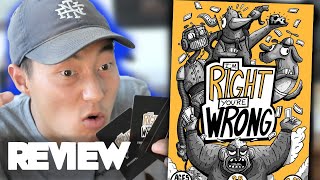
I’m Right You’re Wrong is an imaginary argument. Your hand is filled with comebacks like “SCREW YOU” and “SORRY”. Battle it out until one player is left standing, and FOREVER CORRECT!
Sometimes nice guys DO finish last. So, will you take the high road and use your INSIDE VOICE? Or, will you tell your opponents to EAT DIRT?
Here’s the catch… Most cards suck and there’s only so much kindness to go around.
Pick your battles wisely and don’t shoot yourself in the foot.
How To Play:
Draw a card at the beginning of each turn.
Play one from your hand and follow the rule on the card.
Run out of cards or break a rule, you lose.
Get caught cheating, you lose.
Game ends when one player is left standing.
Creator’s Comments:
The message of this game is: WORDS HAVE POWER. In a world growing increasingly combative, people matter. Relationships matter. Whether Right or Wrong, let kindness lead the way.

- Very easy to learn
- Rulebook gets you into the game quickly and is well structured
- Color-coded components and clear insert
- Strong card diversity across colors creates interesting interactions
- Light, casual, and humorous vibe that fits social play
- Two-player variant adds strategic setup and hand/trap planning
- Deck manipulation and hand management drive pacing and tension
- Fun feedback loop of listening and talking during play
- Rulebook lacks clarity on some edge cases (e.g., when exactly you lose, and quick start questions)
- No robust gameplay example loop in the rules
- Some nitpicky wording that could be improved for clarity (e.g., forgetting to draw a card)
- Box says 5-10 minute play time but larger groups run longer
- Limited ways to build lasting strategic advantage; few big swing plays
- Traps feel underdeveloped; not as nuanced as other party games
- Theme doesn't always come through during play
- Array
- Exploding Kittens
Mechanics (from transcript analysis)
- Deck Management / Card Counting — Discarding and bottom-decking mechanisms create a timer and influence late-game draws; players can count remaining cards.
- Deck Manipulation — Discarding and bottom-decking mechanisms create a timer and influence late-game draws; players can count remaining cards.
- Direct Interaction / Take That — Cards allow you to hurt opponents or force them to draw, creating confrontations and politics at the table.
- Direction Change / Turn Order — There are cards that reverse play direction to spice up play.
- Hand Management — Players manage a hand of cards to decide how to influence the game, with losing conditions tied to running out of cards.
- Negotiation — Players negotiate around red, green, and yellow cards to influence outcomes and gameplay flow.
- negotiation / social interaction — Players negotiate around red, green, and yellow cards to influence outcomes and gameplay flow.
- Take That — Cards allow you to hurt opponents or force them to draw, creating confrontations and politics at the table.
- Trap cards — Yellow trap cards are placed face down and activated later to disrupt opponents.
Video topics + discussion points
Quotes (from this video)
- I'm right you're wrong
- this is a card game for two to five
- it's stupid easy to learn
- you can count how many cards are left in the deck and then use that knowledge to force people to draw the cards that you put there
- screw your friends and try not to screw yourself too hard
- fake ceased fire that i'm gonna disarm your traps
- the reversing play direction to spice it up
- not 5 to 10 minutes as it says on the box at least for bigger groups
- this is clearly meant to be absurd