/pic4597146.jpg)
Game Info
Year
2018
Collection
Ratings
Creator Score
Expansions & Family
/pic3029488.jpg)
Mechanic profile
Not enough video data yet
Vibe profile
Not enough video data yet
Description
The competition of the builders continues in Imhotep: The Duel!
In this game, players take on the roles of Nefertiti and Akhenaten, one of Egypt's most famous royal couples. Game pieces must be cleverly placed so that players can unload the most valuable tiles from the six boats. While this is happening, each player builds their own four monuments in order to gain as many fame points as possible.
Imhotep Family
(2 games)
Part of the Imhotep family — see Imhotep for the combined view.
/pic4597146.jpg)
Featured Videos
Rules Teach

Imhotep The Duel Board Game - Gen Con 2019
Ask a Rules Question
All mentions
Browse transcript mentions, sentiments, pros/cons, mechanics, topics, quotes, and references.
Total mentions: 8
This page: 8
Sentiment:
pos 6 ·
mix 0 ·
neu 1 ·
neg 0
Showing 1–8 of 8
Video 8K97Ru99DO0
Getting Games Discussion at 25:14 sentiment: positive
video_pk 91920 · mention_pk 348309

Click to watch at 25:14 · YouTube ↗
Overall sentiment (raw)
positive
Pros
none
Cons
none
Thematic elements
- two-player variant of Imhotep
- Egyptian-themed boats
- competitive, push-your-luck
Comparison games
none
Mechanics (from transcript analysis)
- boat loading and movement — load workers onto boats and push them along
Video topics + discussion points
No key topics recorded for this video.
Quotes (from this video)
- I'm not making a review videos anymore
- I've been so excited to be playing games over this last month
- BoardGameGeek is an amazing resource for me as a content creator
References (from this video)
No references stored for this video.
Video MfwpWYDTcbo
Meeple University Discussion at 2:42 sentiment: positive
video_pk 91565 · mention_pk 245736
Click to watch at 2:42 · YouTube ↗
Overall sentiment (raw)
positive
Pros
- simple entry
- new sight boards add twists without changing core
- duel variant coming out at Gen Con
- thematic flavor and quick pacing
Cons
Thematic elements
- architecture and monument building
- ancient Egypt
Comparison games
none
Mechanics (from transcript analysis)
- action_selection — One of three very simple actions to perform each turn.
- Pick-Up and Deliver — Acquire stones and deliver them on boats to various sites.
- placement_and_delivery — Acquire stones and deliver them on boats to various sites.
- Set Collection — Strategic gathering and placement to optimize site work.
- set_collection_and_placement — Strategic gathering and placement to optimize site work.
Video topics + discussion points
No key topics recorded for this video.
Quotes (from this video)
- it's very immersive the storyline is strong
- the puzzles are super hard
- the level of difficulties is almost experts four and a half
- it's four and a half the highest one we've done so far
- Imhotep the duel is coming out of Gen Con
- you are an ancient Egyptian architect trying to build the ancient monuments of Egypt
- I love the chariot race and I love the scaffolding
- tribes is great it's a sip building game
- it's very streamlined it's almost family friendly
- for hidden building game it does a really good job of making it feel intuitive and quick and fun
References (from this video)
No references stored for this video.
Video 2b1UeEBh1AM
Getting Games Discussion at 11:36 sentiment: positive
video_pk 91483 · mention_pk 245488

Click to watch at 11:36 · YouTube ↗
Overall sentiment (raw)
positive
Pros
none
Cons
none
Thematic elements
Comparison games
- Imhotep
Mechanics (from transcript analysis)
Mechanics unknown.
Video topics + discussion points
No key topics recorded for this video.
Quotes (from this video)
- this is puffin she's a six-month-old Minnie burna doodle and she is just the best
- it's just been wonderful having her around
References (from this video)
No references stored for this video.
Video SHjsFsq8fhc
Getting Games Discussion at 21:28 sentiment: neutral
video_pk 90293 · mention_pk 241081

Click to watch at 21:28 · YouTube ↗
Overall sentiment (raw)
neutral
Pros
none
Cons
none
Thematic elements
Comparison games
none
Mechanics (from transcript analysis)
Mechanics unknown.
Video topics + discussion points
No key topics recorded for this video.
Quotes (from this video)
- the algorithm for youtube is a black box
- you miss all the shots you don't take
- this is my full-time job
References (from this video)
No references stored for this video.
Video 8nfYyNizuzw
kovray Top 10 List at 15:16 sentiment: positive
video_pk 89512 · mention_pk 237897

Click to watch at 15:16 · YouTube ↗
Overall sentiment (raw)
positive
Pros
- placement variability (3x3 grid vs ships)
- tension and interaction with opponent logistics
- simple core idea with strategic depth
Cons
none
Thematic elements
Comparison games
none
Mechanics (from transcript analysis)
Mechanics unknown.
Video topics + discussion points
No key topics recorded for this video.
Quotes (from this video)
- the art knit is absolutely phenomenal
- it's a very exciting game
- the edge of the seat factor really elevates this game
- it's a tug and pull in an internal tug and pull
- production, the theme, the art, the rules are easy to teach
References (from this video)
No references stored for this video.
Video 6OfMU1rhZ9c
Getting Games Discussion at 0:39 sentiment: positive
video_pk 63478 · mention_pk 156887
Click to watch at 0:39 · YouTube ↗
Overall sentiment (raw)
positive
Pros
- Tense two-player experience with attention to opponents’ moves
- Compact playtime (about 30 minutes) and good filler between heavier games
- Beautiful artwork and good production quality
- Opportunity to replay with variant tile versions
Cons
none
Thematic elements
Comparison games
- Imhotep
Mechanics (from transcript analysis)
- Contiguous scoring and pyramids — You aim to create contiguous groups of scoring tokens and build pyramids, which contribute to your point total in multiple ways.
- End of round variety and variant rules — Minigames can be flipped to more complicated or interactive versions via variant tiles.
- Mini-Games — Tokens taken from launched boats are used to engage in several minigames (e.g., obelisk, numbered tokens for clustering points, etc.).
- Token-driven minigames — Tokens taken from launched boats are used to engage in several minigames (e.g., obelisk, numbered tokens for clustering points, etc.).
- Two-player grid-based worker placement with boat launching — On your turn you either place a worker onto a grid or launch a boat; boats in the middle of the table have tokens; launching a boat uses the row/column aligned with the boat to determine which tokens are taken.
- Worker Placement — On your turn you either place a worker onto a grid or launch a boat; boats in the middle of the table have tokens; launching a boat uses the row/column aligned with the boat to determine which tokens are taken.
Video topics + discussion points
No key topics recorded for this video.
Quotes (from this video)
- this game does a really good job of packing a good amount of punch in like a 30 minute or so game
- the artwork in this game is just stunning
- it's a party style game let's just keep it going
References (from this video)
No references stored for this video.
Video jSnP3H_-PMw
Drive Thru Games Top List at 24:20
video_pk 27724 · mention_pk 80958

Click to watch at 24:20 · YouTube ↗
Pros
none
Cons
none
Thematic elements
- Ancient Egypt
Comparison games
none
Mechanics (from transcript analysis)
- Two-player duel — compact, quick, strategic decisions in a two-player format.
Video topics + discussion points
No key topics recorded for this video.
Quotes (from this video)
- I'm really into this now yeah so it's Catan but you know I had my top 50 games of all time list a long time ago a few months ago and I always kind of forget about cities and nights because I really loved that game.
- Catan star farers now this is the sort of a remake of star fares of Catan which is basically to be glib about at Catan in space but this carries with it a lot of the mechanics…
- it's basically that sort of more complex longer winded Catan that I really like but in space and I'm like super all into this now yeah so it's Catan but you know
- Combat Arena... it's set in the 40k universe and it's gonna deal a little bit more with the range combat
- Return to Dark Tower... I remember sitting in it and you know hitting the buttons and the stuff would talk and he'd move around the right moves
- Zombicide Green Horde I really enjoyed it I think it's a really good co-op idea
References (from this video)
No references stored for this video.
Video a_rxpBoVpJ8
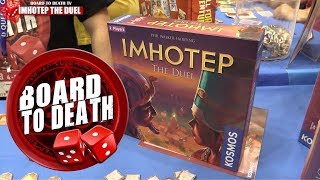
Board to Death TV - Board Game Reviews Rules Teach at 0:24 sentiment: positive
video_pk 2642 · mention_pk 7796
Click to watch at 0:24 · YouTube ↗
Overall sentiment (raw)
positive
Pros
- Maintains core mechanics of the base game in a compact two-player form
- Clear, immediate player interaction via unloading/loading boats
- Strong thematic alignment with ancient Egypt through monuments and river trade
- Accessible to new players while preserving depth for experienced players
- High-quality components and intuitive scoring structure
Cons
- Only a two-player variant; broader play experiences exist in the base game with more players
- No major drawbacks discussed; potential for pacing variance depending on tile drafting
Thematic elements
- Resource management and spatial planning around transporting stones via boats
- Ancient Egypt, Nile river, temples and pyramids
- procedural, mechanic-driven with minimal narrative storytelling
Comparison games
- Imhotep (base game)
Mechanics (from transcript analysis)
- Boat unloading / loading — On your turn you either unload boats to claim tokens or place a meatball on the bridge to advance loading capacity, creating tension and sequencing.
- endgame trigger — When the second-to-last boat is unloaded, the round ends and players tally points.
- Market action tokens (blue) — Blue tokens grant single-use actions at the start of a turn; after use they are discarded and not reshuffled.
- Scoring interaction with opponent — Players compare obelisks heights and placement of scoring tokens to outpace the opponent, creating direct competition.
- tile drafting and placement — Reveal and place temple/pyramid tokens on board sites; tokens fill the board and determine scoring possibilities.
- Token-based scoring tracks — Circles on obelisks, pyramid tokens, and tomb tokens drive endgame scoring; more tokens yield higher points.
- Two-player balancing — All mechanics are adapted to a two-player duel format with fixed starting resources and board layout.
Video topics + discussion points
No key topics recorded for this video.
Quotes (from this video)
- Imhotep the dual is a two-player version of the base game
- we absolutely loved Imhotep
- it's cool that you see the mechanics that from the base came in here
References (from this video)
No references stored for this video.
Transcript Navigation
Showing 1–8 of 8