/pic3438634.jpg)
In the teachings of the Catholic Church, an indulgence may be granted to relieve sins. In some cases, this might be by doing good works or engaging in meaningful prayer, but in the darkest of times, indulgences were sold to anyone willing to make a significant "contribution". As the rising families of the Italian Renaissance conspired and plotted to seize control, the indulgence offered a clear conscience for many a questionable deed committed in the name of power.
Indulgence is a trick-taking game for 3-4 players. On their turn, players choose an edict that gives the rule for the hand. The other players then decide if they want to violate the edict by doing the opposite of what it commands. So "Don’t take any Medicis" suddenly becomes "I must take all the Medicis". Committing a sin can be challenging, but a player attempting it gets the benefit of the indulgence, a token that turns one of their cards into a winning hand. Can you trick your opponents into committing sins without the indulgence? Can you avoid sinning yourself? Whoever can pull that off will end up with a pile of gems and the title of victor.
Indulgence is a restoration of Dragonmaster, originally published by Milton Bradley in 1981 and designed by Jerry D'Arcey. It was itself a reimagining of D'Arcey's prior game, Coup d'Etat, and its classic progenitor Barbu. Dragonmaster enjoyed lavish production, with oversized cards, art by the incomparable Bob Pepper, and some nifty interlocking gems for keeping score. In addition to the retheming, the restoration evens out the game play. The original game suffered from a runaway leader problem in which an early power play with the dragon card all but assured one player's elimination from contention and gave the other a big leg up. The indulgence token replaces the dragon card to make it more accessible, less powerful, and easier to understand. It also increases the number of contracts from 5 to 20, and ups the deck to 36 cards.

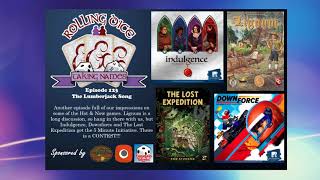
- Simple trick-taking mechanics
- Engaging 'edict' twist that changes gameplay each round
- Fun dual play dynamic between following rules and 'shooting the moon'
- Beautiful artwork
- Replayability due to variable edicts
- Can be tricky to balance playing with the ruler vs. against them
- The 'sinner' mechanic might be difficult for some to grasp initially
- trick-taking with edicts
- Hearts
- Spades
Mechanics (from transcript analysis)
- bidding — The ruler effectively 'bids' on players failing to follow the edict by setting the terms.
- Push Your Luck — Players decide whether to follow the ruler's edict or become a 'sinner' for a potentially larger reward.
- Set Collection — Collecting specific suits or card values based on the chosen edict.
- Trick-Taking — Standard trick-taking rules with following suit and the highest card winning.
- Variable player powers — The 'ruler' role grants a unique power to set a rule for the round.
Video topics + discussion points
Quotes (from this video)
- I promise I won't leave you again
- you know I got to take her out some more spend a little less time editing and playing games and do some more stuff with her
- we're doing it at the front of the show
- do not mess with a fandom if you're going to say something about a particular fandom you had better get it right
- we're up front we're transparent here we screwed up and I guarantee we will do it again
- brilliant slogan brilliant
- This game is easy this game is easy to pick up somebody can teach it to you really quick
- The brutality is the fun
- It is a really cool game
- I think it's a brilliant move
- we will help us decide once and for all or until we do this again do we refer to this as gladiators in an arena or dice in a bowl
References (from this video)

Mechanics (from transcript analysis)
Video topics + discussion points
Quotes (from this video)
- Magic Maze for sure.
- Indulgence. Easy. Indulgence is a great trick taking game.
- Oh, Castle of Mad King Ludwig
- Number two, Magic Maze
- Cuz it still is just one of the greatest social deduction games of all time in my personal opinion.
- This is like one of my favorite trivia games of all time, especially if we're talking about just take it to a bar with some friends and play it while you're sitting around eating, chitchatting, drinking. Great game.