








Infiltraitors Deep Dive
What the Community Thinks About Infiltraitors
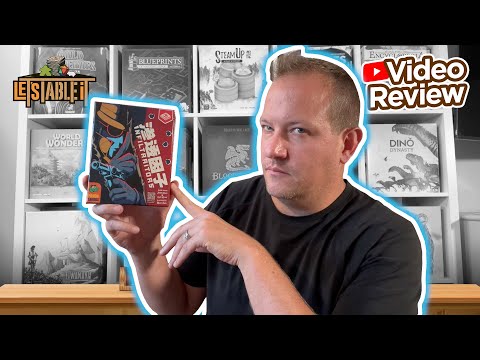
Infiltraitors, published by Pandasaurus Games with Broadway Games on the release, is a cooperative deduction card game for two to five players. The reviewers who covered it tend to agree on the core appeal but split on how much patience the game demands. Brody of Let's Table It frames it as a team effort in which agents work together to uncover and eliminate every Trader hidden in the deck, and recommends it to anyone who wants deduction games on their own table. Tom Vasel of The Dice Tower admits the game is hard to describe in a nutshell but says Vasel found it very enjoyable. Beyond Solitaire highlights how plain the game looks on paper compared with how engaging it turns out to be in play. Tabletop Toki is one of the most favorable voices, praising the base game and recommending it as a substitute for the Lord of the Rings trick-taking game. The split shows up elsewhere. One host of Rolling Dice and Taking Names says that host loves logic and deduction games and expects fans of that style to dig it, while the co-host says deduction games like this take far too long and are not appealing.
Core Mechanics That Define Infiltraitors
Clue Placement and Matching
Each turn a player takes one of five actions, and the most important one for solving a suspect is giving a clue. The player holding a suspect card in front of them secretly knows what it is, so teammates must hint at it by playing cards from their hands beside it. A clue placed vertically confirms a shared trait, while a clue placed horizontally rules one out. Matching works on the same suit, the same number, or a number that is a multiple or factor of the suspect's number. Brody uses the rulebook example of a six green suspect: every green card matches, a red three matches because three is a factor of six, a blue twelve matches because it is a multiple of six, and a blue four does not match. Because each card shows its multiples and factors, the matching logic stays readable even when the table gets crowded. Brody also notes that horizontal clues are often the ones that slowly cross off numbers and colors, so a single vertical hint is only the start of the deduction.
The Deck as a Timer and the Elimination Guess
The headquarters deck doubles as a clock. The buy time action discards the top card face down and draws up to three cards, but every discard shrinks the pool of information. When the deck runs out, the game ends. The elimination action is the team's only way to score. A player spends a bullet token, points the gun at a suspect, and names both the suit and the number. A correct guess removes that Trader from play and lets the guessing player retrieve a card from the discard pile, which can be a face down card. A wrong guess wastes a bullet, and the suspect's owner keeps the card hidden. The bullets are the real limit on guessing, since the team loses if it cannot perform one of the five actions or if it holds fewer bullets than there are suspects left to find.
The Infiltraitors Experience
Tension Under a Ticking Deck
Most of the reviewers describe a steady pressure rather than a frantic one. The deck counts down each time a player buys time or discards, so every discard feels like a small gamble. Because the team cannot see face down cards, the group often has to reason from partial information, and that uncertainty is where the tension comes from. The Rolling Dice and Taking Names host who enjoys the genre says this is the kind of game that rewards close attention to every clue, while the skeptical co-host feels the same pressure stretches the session out too long.
The Click of a Clue Landing
The payoff comes when a sequence of clues finally narrows a suspect to a single card. Beyond Solitaire describes the surprise of a game that looks too simple to be engaging until it is actually played. Brody describes a similar payoff with the way vertical and horizontal clues combine: two vertical cards of different colors can point toward one of two narrow possibilities, and each new placement erases more options from the table. For players who like working out a puzzle with friends, that moment of clarity is the reason to keep playing.
What Makes Infiltraitors Stand Out
A Linear Campaign of Twenty Missions
Infiltraitors ships with three training missions followed by twenty missions that increase in difficulty. Brody notes that the game adds rules and components along the way, such as finger pointers and number tiles, so each mission feels a little fresher than the last. UndeadViking Videos points out that the progression is linear rather than randomized, which gives the campaign a shared arc for the same group of players. That structure is the main reason reviewers compare the game to The Crew, since both reward a team that stays together through a sequence of harder challenges.
Core Mechanics That Hold Up Without Gimmicks
Tabletop Toki singles out the base mechanics as the strongest part of the design. The reviewer compares the game favorably with the Lord of the Rings trick-taking game, which relies on a scenario book that adds small mechanics along the way. Infiltraitors, by contrast, feels satisfying from the first mission, so the reviewer never found reason to wait for the game to click. The introductory scenario already delivers a complete experience, and the reviewer describes everything beyond it as more value for the money. Brody also praises the way the clue boards let every player track possibilities, which keeps the core loop easy to explain to newcomers.
Potential Drawbacks
Length and the Deduction Barrier
The most consistent criticism is that deduction games are not for everyone. The Rolling Dice and Taking Names co-host says this style of game takes too long, and that complaint is likely to resonate with players who prefer quicker games. Brody's own description also makes clear that a team may need many cards before it reaches the right answer, and sometimes a clue simply does not add much new information. Players who want fast turns or a light table presence may find the pace of deduction tiring over a full session.
Not Quite the Crew, Yet
UndeadViking Videos wants to love Infiltraitors and has played it repeatedly without losing, but the reviewer says it is not as good as The Crew. The reviewer is still testing whether the game has the staying power to carry twenty missions, and the sense is that the verdict depends on how the campaign holds up over a long run. Because the game draws so heavily on the same team trick-taking feel that makes The Crew memorable, some players may find the comparison raises expectations that the deduction format does not always meet.
If You Enjoy Infiltraitors
Players who enjoy the shared, linear progression of The Crew will find the closest match here. Reviewers keep returning to that comparison because both games ask a team to stay together through a run of escalating missions, communicate with limited information, and succeed through careful reasoning from partial information. Players who love the trick-taking structure of the Lord of the Rings trick-taking game are another natural audience, since Tabletop Toki presents Infiltraitors as a worthy alternative for that table. Anyone who enjoys deduction puzzles with a timer and a campaign arc should find enough here to justify an evening of learning the clue rules.
What Reviewers Are Saying
"so simple that you know you don't expect it to be engaging as it truly is but then you play it and you're like oh my God"
— Beyond Solitaire
"I want to really love it but I've yet to lose a game of it"
— UndeadViking Videos
"If you are a fan of the Crew then you will really want to explore this game"
— Let's Table It