



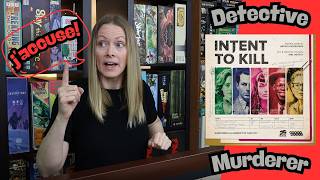



Intent to Kill Deep Dive
What the Community Thinks About Intent to Kill
Intent to Kill stands out as a tense, asymmetric deduction game that generates genuine back-and-forth intrigue between two opponents. Reviewers consistently praise it as a "very intriguing" experience that centers on noir detective work and calculated deception. The game's central appeal is its asymmetric structure: one player takes on the role of a ruthless murderer with hidden motives and restrictions, while the other plays a detective trying to uncover both the killer's identity and the specific rule governing their crimes. Grant Lyon notes it is "really a two-player game" despite its 2-4 player rating, and recommends teams only for experienced players. The Dice Tower's Tom Vasel calls it "a very interesting two-player deduction game," praising its noir artwork and the intriguing cat-and-mouse dynamic it creates. Tabletop Tolson emphasizes that the game has a "lovely feel when you capture of course the murderer" and highlights the equal satisfaction of succeeding as either side. Overall, reviewers recognize Intent to Kill as a cerebral game of hidden information and strategic misdirection rather than a light party game.
Core Mechanics That Define Intent to Kill
Asymmetric Roles and Hidden Motives
Intent to Kill's foundation is its completely asymmetric power structure. The murderer operates under a hidden motive, a rule that restricts which victims they can select. Motives range from "victims must be from different social groups" to "you cannot murder in the four central blocks of the city." The detective does not know the specific motive but receives the same list of possible motives the murderer chose from. Every victim murder is a clue, and the detective must deduce which motive fits the pattern of victims. Grant Lyon explains that the murderer "will be trying to not be too obvious what you are doing," intentionally selecting victims that could satisfy multiple motives to obscure their true rule. Tabletop Tolson describes the murderer's challenge: "I'm not going to give them a single motive. I'm going to try my best to make them all seem like they are legitimate and accessible." This creates constant tension as the murderer must balance killing according to their motive while leaving the detective uncertain about which rule they are actually following. The detective wins by identifying both the murderer and their exact motive; the murderer wins by going undetected or by the detective failing to correctly identify their motivation.
Deduction Through Questioning and Surveillance
The detective's investigation relies entirely on gathering information through civilians. Detectives can question unintimidated civilians to ask categorical questions about the murderer: gender, age group, build, or height. However, three categories of people can lie: the murderer themselves, the murderer's "person of interest" accomplice, and members of the murderer's chosen loyal social group. Everyone else must tell the truth. The detective gains another advantage through building actions: police stations allow surveillance token placement on suspects, diner visits permit questioning, hospitals can comfort intimidated witnesses (making them available for questioning again), and fire stations reveal social group affiliations. Tabletop Tolson notes that "there is no full pure logic in this. There's still just a little bit of maybe they're this group, maybe they're that group." The murderer actively works against this investigation by intimidating two civilians each round, preventing the detective from questioning them. This creates an escalating puzzle as the detective must piece together increasingly constrained information while the murderer tries to lead them astray and block their progress.
The Intent to Kill Experience
Noir Tension and Deception
Intent to Kill delivers a noir detective aesthetic with genuine psychological tension. Tom Vasel specifically praises "the noir artwork," which sets the mood for a detective investigation in a morally gray urban setting. The central emotional draw is the back-and-forth mind game: the murderer must commit crimes while appearing innocent, and the detective must sift through lies and misdirection. Reviewers consistently emphasize the game's intriguing nature. Tabletop Tolson celebrates the emotional satisfaction on both sides: capturing the murderer delivers a "lovely feel," while "if you can get away with it as the murderer, that's also a really really good feeling" after thwarting the detective's logic with carefully-constructed deception. The game thrives on bluffing and reading opponents rather than random chance.
Cat-and-Mouse Intellectual Combat
The core experience is described as a "cat-and-mouse" dynamic with real stakes. Grant Lyon observes that this is "a cat-and-mouse type of game but with uh some murderous consequences. You know, this is not a cat-and-mouse game about stealing cheese. It's about murder." The murderer and detective are locked in a contest of wits where every action signals intent: where the murderer commits murder reveals location strategy; where the detective moves reveals investigation focus. One reviewer notes "there's a lot of mind games going on, but it is a really great deduction game" where both players are constantly second-guessing each other's intentions and strategies. The intellectual rigor and the personal duel between two opponents is what defines the experience.
What Makes Intent to Kill Stand Out
Scalable Complexity Through Logic and Intuition Modes
Intent to Kill is designed to grow with your experience. Tabletop Tolson praises the fact that "the fact that this game grows with the plays that you have and then gives you another kind of play with different cards and components and then even offers you further scenarios at the end of the rule book is really really cool." The game recommends starting with Logic mode, which uses core deduction and information gathering. Once players master the base game, Intuition mode adds additional cards and complexity layers that increase strategic depth. This design respects newcomers while rewarding experienced players with tactical enhancements. The game does not require players to own multiple copies or expansions; the additional content is built into the box from the start.
Strategic Asymmetry and Player Agency
Unlike many hidden-role games, both the murderer and detective have genuine decision-making agency and strategic options. The detective chooses where to move, which civilians to question, and which building actions to prioritize. The murderer chooses where to kill (within their motive), whom to intimidate, and how to construct a misleading pattern. Tabletop Tolson emphasizes the murderer's constant calculation: "I'm going to intimidate two people anywhere I want. And then I'm going to murder someone. And I'm going to follow all my rules and try to throw the detectives off the scent." Neither role is passive or overpowered; both require active, moment-to-moment decision-making.
Potential Drawbacks
Box Size vs. Contents Imbalance
Tabletop Tolson raises one specific critique: the game comes in a box that "might be a little bit too big" for its contents. The reviewer suggests "it could have been two boards put together and pretty much half the size of the box" and speculates the game could have fit in a much smaller presentation without losing functionality. While the large cards and board require adequate spacing, the box does feel oversized for what's actually inside.
Best at Two Players, Challenging with More
Multiple reviewers note that while the box advertises 2-4 players, the game is fundamentally optimized for exactly two players. Grant Lyon states that "everything I've seen online is I think it's a two-player game. This is really a two-player game, and yes, you could play it in four players like on teams or something like that, but it's really meant to be a two-player game." Playing with teams (two detectives vs. one murderer, or two murderers vs. one detective) introduces communication dynamics and number imbalances that dilute the core duel. The game's elegance comes from its direct one-versus-one investigation.
If You Enjoy Intent to Kill
Fans of Intent to Kill should explore other deduction and hidden-role games like Clue, which shares the detective investigation DNA but in a simpler, more classic form. They may also appreciate games that combine social deduction with strategic asymmetry, where one player has hidden information and the others must deduce it through careful play and observation. Intent to Kill's emphasis on tactical misdirection appeals to players who enjoy bluffing card games and hidden-movement games where the hunt itself is the core tension.
What Reviewers Are Saying
"It's really really fun. And of course, if you can get away with it as the murderer, that's also a really really good feeling, too, to have thwarted their plans and really kind of thrown a wrench in their logic and the assumptions they were making about who they could trust and who they couldn't trust."
— Tabletop Tolson
"So, there's a lot of mind games going on, but it is a really great deduction game. And adding in then the extra abilities and the extra things in the more like advanced mode takes it up a level."
— Watch Review
"This is a cat-and-mouse type of game but with some murderous consequences. This is not a cat-and-mouse game about stealing cheese. It's about murder."
— Grant Lyon