/pic8235845.jpg)
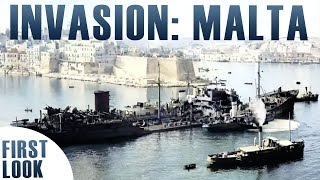
Invasion: Malta uses many familiar game mechanics found in similar scale wargames. Featured here are chit draws for activation of formations and individual unit efficiency ratings. The Axis player uses amphibious landings and airdrops to bring his units into the battle while the Allied player defends with artillery bombardment from behind heavy fortifications. As you might expect, the game includes the highest quality OoB for both sides for each scenarios; we really dug into various national archives for this game. All scenarios stop after only a few days of campaigning as it is during this time that the battle would be decided.
Our hobby has perhaps a unique ability to explore the great questions of events in history. Here, what if during WWII the Axis actually invaded Malta. Who would win? The answer turns on many additional questions and circumstances. This two-player game explores several of these in three scenarios plus the bonus game covering the historical invasion of Leros.
Fall 1940: The Italians had big talk and many objectives during the war but not enough realistic plans. Perhaps the best time for their invasion would be in the fall, and perhaps timed along with the German invasion of Britain; or, if the Germans do not invade, then perhaps in place of the actual Italian invasion of Greece. Operational plans for Malta were poor but British defenses are weak. Perhaps the Italians could catch the British not reacting in time.
Spring 1941: In April 1941 the Axis had a choice, either occupy Crete or attack Malta. On April 21st Gen. Student, chief of the paratroopers, overcame opposition from the Wehrmacht Operations Staff, and others, in Berlin and persuaded Hitler to attack Crete. But, what if Hitler accepted the alternative recommendation to attack Malta? The Germans and Italians would now have to prepare for a combined operation, air, land, and sea, and do this quickly. The forces arrayed against Malta would have been huge, but the British were far better prepared than a year before and well fortified. The bloody issue would have been in doubt from the start.
Summer 1942: After a over year of preparation and study and agreement on the need to invade, the combined German and Italian staffs had put together an extensive and complex plan for invasion. Its success depended on many factors and lessons had been learned from the battle for Crete the year before had been put into effect. All was as ready as it could be, yet they did not invade. The British were stronger in numbers and weapons but their efficiency was down due to the long siege. Was it just Hitler’s nervousness about such an unusual Axis operation, or was it the allure of bigger victories elsewhere?
November 1943, Leros: The possibility of invading Malta had passed but the British had put themselves out on a small island in the Aegean, Leros. Incredibly, a large part of the British garrison consisted of the former Malta garrison, now well rested. In effect, it was a miniature Malta. This time the Germans did not hesitate, they invaded by sea and air. This tough little infantry fight shows just what grit was involved and how the experience of fighting on Malta would have been. The British lost, but the battle was close. All the flavor of the Malta battle is here but at only one-third of the size.
TIME SCALE: 8 hours per turn
MAP SCALE: 600 yards per hex
UNIT SCALE: Battalions and companies

- Comprehensive WWII theater with deep systems
- High complexity; long play time
- Invasion and defense on Mediterranean island
- World War II land/sea/air landings in Malta
- Operational-scale WWII wargame
Mechanics (from transcript analysis)
- landings/combined arms — Complex operational gameplay with many aspects (air, sea, land) included
Video topics + discussion points
Quotes (from this video)
- The news is somewhat dire but let's not give up yet
- It feels good to be back
- This was the best players in the world I think
- One of the fun things about conference was the place and games we played
- The biggest shift is the balance of life and work; it forced a reorganization
References (from this video)
- Very high level of detail and fidelity to island invasion dynamics
- Rule explanations are clear and well-structured
- Two distinct but related games (Malta and Leros) in a single box with shared system
- Comprehensive setup aids (aids cards, setup guides) that streamline deployment
- Replayability driven by multiple Malta scenarios and Leros scenario, plus landing-zone variation
- Rich map detail with granular hex-scale and realistic terrain
- High complexity with a 38-page core rulebook and 40-page playbook; steep learning curve
- Long play times per scenario (8+ hours) may deter casual players
- Counter sheets and components are numerous; setup can be time-consuming
- Axis invasion of Malta; WWII island warfare with a grand tactical scope
- World War II island invasion of Malta; hypothetical axis invasion scenarios from 1940-1942
- grand tactical simulation with high fidelity to historical deployment and island-specific constraints
- A Glorious Chance
Mechanics (from transcript analysis)
- Activation system — formation chit pull activation to determine orders and sequence of play
- Airborne operations and gliders — paradrops, gliders, and drift mechanics for landing with variable outcomes
- Amphibious invasions and naval elements — naval convoys, amphibious landings, and landing zone planning
- Artillery and air support — coordinated bombardment and interdiction that shape land combat
- Command points and headquarters — HQs and command points govern activation and coordination of forces
- Day/Night restrictions — temporal constraints on actions and arrival of air/sea operations
- Efficiency rating — unit quality is rated and used to resolve actions via die rolls
- Formation system — German formations vs Allied formations shaped by geography and rules
- Motorized rules — special rules for motorized movement reflecting Malta terrain constraints
- Stacking — per hex stacking limit is 9 value points; excess stacking yields penalties; used to model congestion
- Stacking and Balancing — per hex stacking limit is 9 value points; excess stacking yields penalties; used to model congestion
- Supply — models supply lines and weather effects that influence unit effectiveness and movement
- weather — weather impacts operations, supply, and mobility across the island
Video topics + discussion points
Quotes (from this video)
- This is a two-player solitaire-friendly game that has three scenarios covering the invasion of Malta.
- This game is loaded with rules and there are no optional rules, so the 38 pages contain the core rules you'll need to play.
- I think I'm at about a 6 and a half out of 10 for complexity, and I might go a little bit higher.
- The writing of the rules and the explanations are very clear; every time I've had a question the answer has been presented there.
- There is a lot of depth and a lot of systems modeled to give a grand tactical recreation of this hypothetical Battle of Malta.
- This is a game you're going to want to slow down, take your time, and really enjoy as you play forward.
- Two complete games in one box that share the same rules and map system.