/pic732997.jpg)
Julius Caesar is a two-player game, depicting the later Roman civil wars (49-45 BC). The forces of Caesar are pitted against those of Pompey.
From the publisher:
Julius Caesar brings the drama of the Roman Civil War to life. Players take control of the legions of Caesar or Pompey and fight to rule Rome as Emperor.
From the Designer:
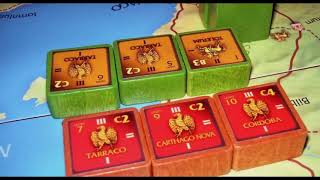
Julius Caesar is a card driven block game. You use cards to Move, levy or play an Event. 13 victory point Towns or Cities are depicted on the 17"x 33" (43 x 84 cm) game board of the Mediterranean. Take command of Caesar's Veteran Legions or Pompey sprouting Young Legions around the Mediterranean. You decide how best to defend or conquer the Republic. With endless possibilities at your disposal this game will keep your adrenaline pumping. The only question I have for you, the game player, is, are you ready to prove that you deserve to be Emperor of Rome? Come prove it on the game board!

Julius Caesar Review
- Subtleties and strategies are not immediately apparent, leading to depth.
- Streamlined and not overwhelming with information compared to other wargames.
- Engaging naval movement and traffic lane dynamics.
- Layered strategy involving card play and anticipating opponent's moves.
- Balanced luck factor with dice rolls that can influence outcomes but don't dominate.
- Even keel and not overly stressful rules.
- Exciting moments and replayability as the game takes on different shapes.
- Can be difficult for players new to wargames to grasp initially.
- A poorly chosen move or attack can lead to defeat.
- Dice rolls may not always be in your favor.
- Caesar versus Pompeii
- Roman Civil War
Mechanics (from transcript analysis)
- Area Control — Controlling areas, even with one unit, is key for levying new units and reinforcements. Victory points are earned through control on the board.
- Block wargame — Uses blocks representing units with strength and combat values. Strength determines dice rolled and is reduced when taking damage. Blocks can be rotated.
- Card Play — Players use command cards with movement and levy values, and event cards that can trump command cards. Highest movement cost gets initiative. Event cards can cancel each other out.
- Combat — Combat involves rolling dice based on unit strength. Defender rolls first. Hits reduce unit strength. Combat lasts four rounds, with attacker forced to retreat in round four. Reserves can join in round two.
- Levy — Levying can increase the strength of units on the board or place new units on the board in controlled towns. New units start with strength one.
- Movement — Units move in groups. Can move two spaces or one space and attack. Movement across dotted lines is limited to two units per turn, while thick lines allow four units.
- Naval Movement — Boats can be summoned in major ports. Boat movement is similar to land movement (two spaces per movement point). Boats can be used to transport land units ('skipping stone'), costing one movement per unit.
Video topics + discussion points
Quotes (from this video)
- it's hard to say if somebody will or will not like a game but you know i pretty much recommend this game to everybody
- i would really make time to play this with somebody and and and just kind of experience that
- good music isn't making noise the whole time good music is leaving pockets of silence
References (from this video)

- Good gateway into wargaming
- Really good, really deep and strategic
- Uncertainty about its Hall of Fame deservingness
- Warfare
- Ancient Rome
- Hammer of the Scots
- Ski Gahara
- Commanding Color Games
Mechanics (from transcript analysis)
- Block wargame — A representative game of the block wargame style.
Video topics + discussion points
Quotes (from this video)
- I think from my perspective based on what I've seen of the games that they inducted the original 25 uh I just wanted to speculate on what the next 25 would be
- there's some interesting gaps in the 25 list that's out there now
- Shadows over Camelot out really started that whole thing
- it influences things that you wouldn't necessarily think that it did influence that kind of thing
- it really took the world over for several years
- it's like too big I mean the shadows of Brimstone which isn't on this list and I would never suggest to be in the Hall of Fame is like its own thing
- it is such um a force or a presence in the board gaming world that it just has to be in there
- it's almost like the quintessential board game in in a way
- it is really the predecessor of all of these board games that have been a big part of the board game geek hobby
- maybe eventually this is my opinion here I think they should stick to the games for a few years and then you know later on they can start thinking about like putting ryer kitsi in or stefen Feld or Christian Peterson or Corey kesa Cole Worley Richard Borg
References (from this video)

- Interesting combat system
- Historical theme
- Military conflict
- Roman Civil War
- Historical
Mechanics (from transcript analysis)
- Block Warfare — Fog of war combat system
Video topics + discussion points
Quotes (from this video)
- just being on the top 100 is an honor
- my criteria of course on this list is always fun