/pic7098640.jpg)
Kamisado is a game of pure skill and strategy with no dice, cards or other chance element — it's just you against your opponent!
The aim in each round is to be the first to get an octagonal "dragon tower" to the opposite side of the board; towers move in straight lines, either forwards or diagonally forwards. The twist is that you must move the tower of the color matching the space on which the opponent moved on her previous turn. As the game progresses, you'll find that the routes you want to use are blocked by enemy towers — and sometimes your own! If you can't move, your opponent moves again immediately, moving the tower matching the color of the space occupied by the stymied tower.
As the game unfolds, your towers will be promoted to "Sumos" and have the ability to push your opponent's pieces backwards, earning you extra turns. The situations continue to become more complex and challenging, until one player accumulates the required winning total and can be declared a "Kamisado Grand Master" — until the next game!


- Beautiful artwork
- Clever and unique mechanics
- The board is always moving so you really have to plan ahead
- The board is always moving
- balancing favor with people against connection to nature
- rural Japan during the Edo period
Mechanics (from transcript analysis)
- Area Control — Using a combination of asymmetrical Powers, area control, set collection and pattern building and light card drafting.
- asymmetrical powers — Using a combination of asymmetrical Powers, area control, set collection and pattern building and light card drafting.
- Card Drafting — Using a combination of asymmetrical Powers, area control, set collection and pattern building and light card drafting.
- Pattern Building — Using a combination of asymmetrical Powers, area control, set collection and pattern building and light card drafting.
- Set Collection — Using a combination of asymmetrical Powers, area control, set collection and pattern building and light card drafting.
Video topics + discussion points
Quotes (from this video)
- People's Choice top 10.
- This is now my all-time favorite game.
- This is the perfect Adventure series for short attention spans.
- This is the game I own that I most want to play but won't until five other Campaign games are at least good but not yet finished.
- This month's top touted game is Scarface 1920.
- I like more pretend Bloodshed than actual Bloodshed myself.
- This game was the perfect thematic gangster board game we needed.
References (from this video)
- very fun, very tactical, very quick
- teaches quickly; portable variants exist
- abstract may be niche for some players
- color-matching, strategic blocking
- abstract dragon-tower race on an 8x8 grid
- highly abstract tactical play
Mechanics (from transcript analysis)
- color-based movement — pieces move forward to color-mmatched completion
- line-of-sight / dragon teeth scoring — tooth pieces modify movement and scoring drastically
Video topics + discussion points
Quotes (from this video)
- two could be as bad as one it's the loneliest number since the number one
- two is the loneliest number
- Flamme Rouge is like a Lance Armstrong simulator without the Assassin cheating in Warhammer underworlds
- Remember to like share and subscribe
- I'll be Rob AKA just the Rogue
References (from this video)
- tense and pure abstract gameplay
- short playtime and high skill expression
- no luck or hidden information; everything is transparent
- minimal theme may limit appeal for some players
- board setup can feel bulky for casual players
- color-matching competition; no strong narrative
- abstract two-player board with colored towers
- abstract
- five-in-a-row style abstractions
- other Chris Byrne two-player abstracts
Mechanics (from transcript analysis)
- abstract strategy / movement — move a colored tower forward (diagonally or straight); no backwards movement
- color-determined turn order — the color of the landing square dictates which color tower the opponent must move next
- perfect information — no hidden information; all moves are visible and planned ahead
- race to the far edge — the goal is to get one of your towers to the opponent's back rank
Video topics + discussion points
Quotes (from this video)
- oh my god this is one of the most tense abstract games I've ever played
- it's that fast
- I will teach you the game in 30 seconds and chances are we'll finish in the next nine and a half minutes
- this is really solid
- Keyflower is just stuck with me
References (from this video)
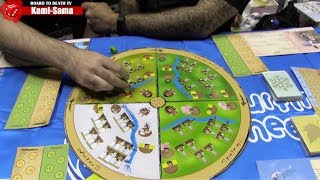
- Highly asymmetric, with many distinct characters and playstyles.
- Seasonal rotation adds dynamic strategic depth and variability.
- Theme is reinforced by the nature vs. balance mechanics (Nature and Favour tracks).
- End-game drafting and villager mechanics create meaningful decisions.
- Tiebreaker rule adds flavor and strategic nuance.
- Prototype shown; components and balance may change in production (e.g., initial components described as provisional).
- Asymmetrical design can be heavier for new players and may require more setup and learning compared to symmetrical games.
- Harmony between nature and humanity; deities shepherd village development.
- A village in Japan across four seasons where kami (spirits) guide growth by placing shrines.
- asymmetrical, character-driven with season-based mechanics and end-game scoring emphasis.
Mechanics (from transcript analysis)
- Action point allocation — Players spend action points to place shrines in houses, influencing scoring and board state.
- Area control / placement — Control of houses and spaces across the board determines scoring opportunities and draft order.
- asymmetrical player powers — Each kamisama has a unique set of abilities and victory paths, driving distinct playstyles.
- Seasonal rotation — The board rotates through Spring, Summer, Autumn, and Winter, changing available actions and effects each turn.
- Thrives / end-game goals — Each kamisama has a Thrive goal that contributes to scoring and strategic planning.
- Tiebreaker — Last-place position can act as a tiebreaker, adding a strategic kicker to end-of-season results.
- Track Advancement — Advancement on Nature and Favour tracks; scoring uses the lower value between the two to encourage balance.
- Villager drafting — After determining who controls the most houses, players draft villagers to gain ongoing benefits.
Video topics + discussion points
Quotes (from this video)
- this is obviously a really early prototype
- it's entirely asymmetrical we have you know a dozen or more of these characters they all approach the game in a very different way
- we're really really excited about this one
References (from this video)

- tight, elegant play
- quick rounds with deep decisions
- less accessible to absolute newcomers
- the visuals may feel plain to some players
- strategic rook-like movement with a unique push mechanic
- Japanese themed abstract duel
Mechanics (from transcript analysis)
- abstract_strategy — move pieces forward to land on opponent's color, influencing next move
- color-driven_move — landing on a color compels the opponent to move a specific piece next
Video topics + discussion points
Quotes (from this video)
- Nar is a Viking themed whole thing, but the whole timing, the sequencing when you get to fire off those banners, when you're actually making that, it's one of those games that is a small footprint, but I think it builds really well.
- With the expansion, I think it's fantastic. And they integrated some of that stuff in the new version, Sakura Slam.
- I love Clask so much.