/pic7389053.png)
In Kartini - From Darkness to Light, you manage schools for girls where girls from different islands of Indonesia come to be students. As they graduate, the students become politicians, fighters, patrons or teachers, further advancing education for women and supporting the fight for the nation’s freedom. Strategically manage your duits (money) and books to help as many girls graduate from your school while paying attention to your school’s reputation. After three rounds, the player with the highest points wins the game.
Kartini - From Darkness to Light celebrates the triumphs of girls’ education. The game takes place in Indonesia in the late 1800 to the early 1900, during the country’s struggle for independence from Dutch colonialism. This was the era where Indonesian young women were stepping up to the plate, leading battles and participating in politics for a free Indonesia.
Realizing that the key to the nation’s eventual liberation lied in education, some of them built schools and advocated for more and more girls to be educated to then participate in the nation’s fight for freedom. Indonesian women’s yearning for education and to take an active role in the public life were encapsulated in a famous series of letters written by Kartini, a Javanese aristocrat, to her Dutch friends. These letters were later published as a book titled ‘From Darkness to Light’ from which the name of this game derived. Kartini’s letters are often credited as one of the cornerstones of Indonesian women emancipation movement and they served as profound inspirations for Indonesia’s fight for independence.
—description from the publisher
Additionally, there is also a 'Curriculum Guide' available:
Kartini: From Darkness to Light: Curriculum Guide
The curriculum guide to Kartini: From Darkness to Light offers educators a framework from which to build a game-based unit or even a game-based course on such themes as "Nationalism," "the History of Indonesian Nationalism," "Women in Nationalism," and "Theories of Nationalism."
The guide provides targeted historical reasoning skills aligned to course themes as well as assessment exercises appropriate to the university classroom. Although the guide has been tailored for historical analysis, it is nevertheless useful to history-adjacent educators interested in integrating game-based pedagogy in their own classroom practice.
It will provide guidance on the use of Kartini the board games and suggestions for assignments connected to the game.
—description from the publisher

- Interesting theme and historical context
- Good integration of theme and mechanics
- Engine building aspect is enjoyable
- Meaningful choices and strategic depth
- The flavor text adds to the experience
- Battle outcome balance is still under development
- Advancing education for women and fighting for national freedom
- Indonesia's struggle for independence in the late 1800s and early 1900s
Mechanics (from transcript analysis)
- Area influence/control — Placing students in the battleground contributes to battles, and successful battles can unlock new islands.
- Deck Building — Recruiting teachers and students involves drawing from decks.
- Engine Building — Educated students can become teachers, who in turn teach future students, creating an educational engine.
- Resource Management — Players manage money (duit), books, and reputation to recruit teachers and students, and to satisfy educational requirements.
- Set Collection — Players aim to educate a diverse group of women into a diverse set of occupations for in-game scoring.
- Variable Player Powers/Abilities — Special abilities are gained from politicians and certain teachers, and heroes have unique requirements and abilities.
- Worker Placement — Graduated students are placed into different roles (battleground, patron, politician, teacher) which unlock rewards, abilities, or further game progression.
Video topics + discussion points
Quotes (from this video)
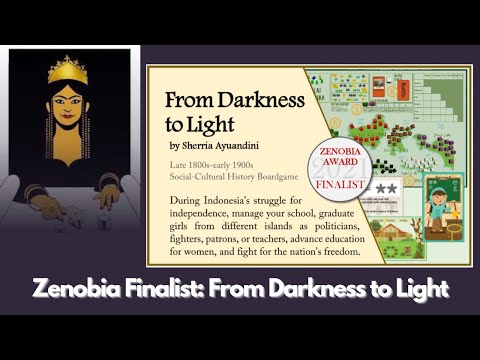
- the zenobia award is a design award put together by various folks across the board game industry and is targeted towards marginalized designers and also topics for games
- all these games that i'm going to be showing you on these videos are from different historical contexts and different time periods
- from darkness to light by designer sharia ayandini
- the overall objective is to try to educate a as diverse a group of women as possible in a as diverse sort of set of occupations as possible
- it's a very very interesting game i definitely hope folks will take a look at it again
References (from this video)
- Engaging theme of advancing education and independence.
- Multiple player modes (solo, co-op, competitive).
- Strategic depth with various actions and progression tracks.
- Varied occupations (Fighter, Patron, Politician, Teacher) with distinct benefits.
- Can lose victory points if reputation drops too low.
- Some actions have immediate consequences on reputation.
- Managing girls' schools to advance their education and independence
- Indonesia in the late 1800s and early 1900s
Mechanics (from transcript analysis)
- Area Majority — Mechanics related to gaining the most patrons in each cluster for victory points, and placing schools in regions.
- Card Drafting — Players choose one Cartini letter to keep and one to discard at the start of the game, and draft hero cards.
- player interaction — Players can pay each other to take pupils from their schools, and turn order is determined by passing actions.
- Resource Management — Managing doits, endowment, books, and pupils to perform actions like hiring teachers, recruiting pupils, and graduating students.
- Set Collection — Graduating students requires specific books and conditions, and scoring is based on different colored frames on graduated students.
- Track Advancement — Advancing on the 'Darkness to Light' track based on graduations, which can affect events, books, reputation, and doits.
- Worker Placement — Placing teachers, fighters, patrons, and politicians into specific areas or on the progression board to gain benefits.
Video topics + discussion points
Quotes (from this video)
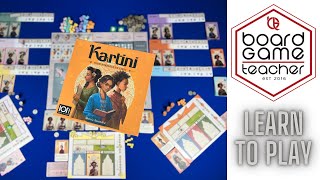
- This is a 1-6 player solo Co-op or competitive game where you manage girls schools in Indonesia to advance their education and Independence in the late 1800s and early 1900s
- Keep in mind that if you have a pupil from an island where you do not have a school you can still register a student
- The player with the most victory points is the winner of Cartini from Darkness to light
References (from this video)
- Rich, meaningful Indonesian historical theme and narrative.
- Multiple graduation paths (teacher, fighter, patron, politician) plus hero students with unique abilities.
- Dynamic turn order and reward system that rewards planning and timing.
- Clear asymmetry in student types and region-based recruitment with strategic depth.
- Cooperative milestones option (some variants) adds group play complexity.
- Component quality is still prototype and may change before final release.
- Rule complexity can be high; learning curve may be steep for new players.
- Endgame and scoring can feel book-keeping heavy, with multiple interdependent tracks.
- Managing multiple tracks and interactions across islands may impose downtime.
- education, empowerment, and nation-building through women's education
- Indonesia during late 1800s to early 1900s, during the nation's struggle for independence
- historical education with a focus on social progress and politics
Mechanics (from transcript analysis)
- Area Control — Graduates and schools are placed on connected regions of the main map, with island-specific dynamics affecting recruitment and scoring.
- Area control / placement on islands — Graduates and schools are placed on connected regions of the main map, with island-specific dynamics affecting recruitment and scoring.
- Card Drafting — Registering students and heroes draws from rows of cards; hero cards require colored meeples and grant ongoing effects.
- Card drafting and set collection — Registering students and heroes draws from rows of cards; hero cards require colored meeples and grant ongoing effects.
- Progress tracking and endgame triggers — Reputation and endowment tracks, milestone scoring, and the From Darkness to Light track influence endgame timing and scoring.
- Resource Management — Books are purchased from a library space, used to graduate pupils, and can be traded for other book types or with other players.
- Resource management (books) and Balai Pustaka — Books are purchased from a library space, used to graduate pupils, and can be traded for other book types or with other players.
- Track Advancement — Reputation and endowment tracks, milestone scoring, and the From Darkness to Light track influence endgame timing and scoring.
- Turn order selection / passing — Players may pass to secure better rewards and determine the next round's turn order through reward tracks and donation tokens.
- Worker Placement — On each turn, players perform actions such as hiring teachers, recruiting pupils, registering students, and gathering books.
- Worker placement / action selection — On each turn, players perform actions such as hiring teachers, recruiting pupils, registering students, and gathering books.
Video topics + discussion points
Quotes (from this video)
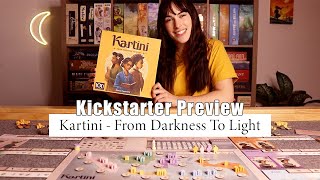
- Cartini from Darkness to Light explores a powerful Indonesian historical theme.
- The education of young Indonesian women enabled them to take important roles in battles, politics, and nation-building.
- From Darkness to Light track represents external forces that push against players and accelerates game pacing.