


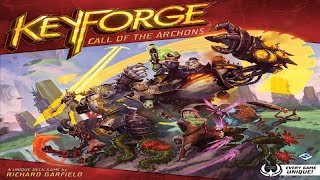
From the imagination of legendary game designer Richard Garfield comes a game unlike anything the world has ever seen—a game where every deck is as unique as the person who wields it and no two battles will ever be the same. This is KeyForge, where deckbuilding and boosters are a thing of the past, where you can carve a path of discovery with every deck, where you can throw yourself into the game with the force of a wild wormhole and embrace the thrill of a tactical battle where wits will win the day!
Along with this new breed of game comes a new world: the Crucible, an artificial world built from the pieces of countless planets across the stars. Here, anything is possible. This world was built for the Archons, god-like beings who, for all their power, know little about their own origins. The Archons clash in constant struggles, leading motley companies of various factions as they seek to find and unlock the planet’s hidden Vaults to gain ultimate knowledge and power.
This starter set contains two starter decks, two unique Archon Decks, and all the keys and tokens two players need to play!
KeyForge: Call of the Archons is the world's first Unique Deck Game. Every single Archon Deck that you'll use to play is truly unique and one-of-a kind, with its own Archon and its own mixture of cards in the deck. If you pick up an Archon Deck, you know that you're the only person in existence with access to this exact deck and its distinct combination of cards. In fact, in just the first set of KeyForge: Call of the Archons, there are more than 104 quadrillion possible decks!
Every Archon Deck contains a full play experience with a deck that cannot be altered, meaning it's ready to play right out of the box. Not only does this remove the need for deckbuilding or boosters, it also creates a new form of gameplay with innovative mechanics that challenges you to use every card in your deck to find the strongest and most cunning combinations. It is not the cards themselves that are powerful, but rather the interactions between them—interactions that can only be found in your deck. Your ability to make tough tactical decisions will determine your success as you and your opponent trade blows in clashes that can shift in an instant!
KeyForge: Call of the Archons is played over a series of turns in which you, as the Archon leading your company, use the creatures, technology, artifacts, and skills of a chosen House to reap precious Æmber, hold off your enemy's forces, and forge enough keys to unlock the Crucible's Vaults. You begin your turn by declaring one of the three Houses within your deck, and for the remainder of the turn you may play and use cards only from that House. For example, if you take on the role of the Archon Radiant Argus the Supreme, you will find cards from Logos, Sanctum, and Untamed in your deck, but if you declare "Sanctum" at the start of your turn, you may use actions, artifacts, creatures, and upgrades only from Sanctum. Your allies from Logos and Untamed must wait.
Next, you must strive to gain the advantage with a series of tactical decisions, leveraging both the cards in your hand and those in play to race ahead of your opponent. If you wish to weaken your rival’s forces, you may send out your allies to fight enemies on the opposing side, matching strength against strength. Otherwise, you may choose to use your followers to reap, adding more Æmber to your pool.
Notably, no card in KeyForge has a cost — choosing a House at the start of a turn allows you to play and use any number of cards from that House for free, leading turns to fly by with a wave of activity! Yet balance is key. If you simply reap more Æmber at every opportunity, your rival may quickly grow their team of minions and destroy yours, outpacing your collection and leaving your field barren. But if you focus on the thrill of the fight alone and neglect the collection of Æmber, you won't move any closer to your goal! If you succeed in finding a harmony within your team and have six Æmber at the start of your turn, you'll forge a key and move one step closer to victory. The first to forge three keys wins!
—description from the publisher
Part of the KeyForge family — see KeyForge: Age of Ascension for the combined view.


KeyForge - WITH ASL - How To Play

- Low barrier to entry.
- Can be a light-hearted, casual experience.
- No deckbuilding creativity.
- Lack of player interaction and counterplay.
- Gameplay is repetitive and simplistic.
- No synergy between factions within a deck.
- Inconsistent deck quality.
- The 'auto-win' feel if one player gets a good deck.
- Archon Battles for the Key
- Fantasy/Sci-Fi Multiverse
- Abstract
- Magic: The Gathering
- Netrunner
- Warhammer Champions
Mechanics (from transcript analysis)
- action selection — Players choose to activate one of the three factions in their deck per turn.
- Combat — Players use creatures and artifacts to attack their opponent and their creatures.
- Hand Management — Players manage their hand of cards to play for effects and creatures.
- Unique Deck — Each deck is a unique combination of cards, designed to be played without modification.
Video topics + discussion points
Quotes (from this video)
- I hated everything about it.
- The game was basically handed to you now.
- I don't know, the game was also just extremely swingy.
- There is nothing about that game that's not random.
- I don't like pandemic.
- It's just more and more irritating as they kept throwing stupid themes on it constantly.
- I like the cure is the only Pandemic game I like, the dice version.
References (from this video)

- Came out in 2018 and got you right into the action
- You don't have to learn every single keyword
- You don't have to learn how to deck construct
- You don't have to learn the meta
- You don't have to spend $600 to make a top deck
- Every deck is unique
- Quick playing combo focus play is rewarding to learn
- Deeply challenging to master
- Twelve dollars
- No meta, no need to net deck
- Each deck is unique
- Deck is built to do a specific thing
- You can just buy a deck
- You learn your deck as soon as you buy it
- Trying to find combos within your deck
- Mastering your own deck is a unique take
- You can still go out and spend the money
- It's just for me, I really like trying to think of a cool deck and try and make the deck work
- If someone has a deck that is better than mine, it's not just because they luckily got a pack that makes the deck really good versus me
- Twelve dollars you get a deck
- It might not be shitty, it just may be bad against who you're playing against
- Personally didn't care for it as much
- Magic is superior
- Magic has 25 years of play-testing and refinement
- Most people who spend the money will have the better deck
- If you get a shitty deck, you're out $12
- card dueling
- Magic the Gathering
Mechanics (from transcript analysis)
- Combo-focused play — The play is combo-focused and rewarding.
- Deck construction — Each deck comes as a complete and unique set, and players learn to master their own deck.
Video topics + discussion points
Quotes (from this video)
- Western legends by colossal games who's it for cowboys ready for a sandbox of outlaws marshals and gunfights yeah okay
- The breadth of activities is impressive and victories possible on either side of the law
- stuffed fables is adorable
- The pages of the adventure book serve as the actual board with each page a new story to explore
- it's like a wholesome game
- route which pretty much shot leader games up to the top
- Here's a foreword whimsical woodland creatures ready for a brutal fight yes that's kind of smooth that is true
- I love the artwork I I think it's fantastic it's like hand-drawn cards which is phenomenal
- Root is a phenomenal game
References (from this video)
- Ease of access for new players
- Saves time by not requiring deck construction
- Fast and free-flowing turns
- Vibrant and fantastic artwork
- Players always have a hand of six cards
- Lack of integration between houses in a deck
- Decks can feel repetitive and not unique enough
- Little direct interaction in some matchups
- Frustration with not getting desired deck combinations
- The game can become a slog with certain deck matchups
Mechanics (from transcript analysis)
- Chains — Chains are a modifier that affects hand size or the number of cards drawn at the end of a turn. Playing heavy cards can increase chains, potentially leading to a smaller hand size.
- Creature Destruction — A common interaction involves destroying opponent's creatures to prevent them from attacking, capturing ember, or to hinder cards that rely on creatures being on the board.
- Deck construction — The game features pre-constructed, unique decks, removing the need for players to build their own decks, which is highlighted as a positive for ease of access and time-saving.
- Ember — Ember is a resource used to unlock keys, with six ember required to unlock a key. Players cannot 'sandbag' or hold ember indefinitely, as it can be affected by opponent's cards.
- House Selection — On a player's turn, they select one of the three houses in their deck, and can only play cards, activate abilities, or discard cards from that selected house.
Video topics + discussion points
Quotes (from this video)
- my biggest complaint my personal bass biggest complaint with this game as is and I believe that they are going to release other sets similar to how magic releases their different sets I think they're going to do that here but as is based off of the four decks that I have played a lot of this game is you doing stuff on your turn and you waiting for your opponent to do stuff there is very little interaction
- the biggest problem and that I've seen so far is that there is no integration between these houses they are literally just three separate houses put into one deck
- my favorite things about ki Forge is the ease of access that this game has over magic magic is you have to learn all these cards and you have to learn how the deck build and you have to learn how to ex-old well and it just it just kind of never ends
- the artwork is fantastic in this game very vibrant very colorful you know they did a great job on the artwork
- the other thing I do really like is how your turn works very smooth very free-flowing there's no okay well untap upkeep draw okay first main phase combat second main phase and main phases there's none of that
- on the scale of one to ten obviously five being average ten being perfect and one being a straight-up gutter i'ma give it a seven I think it's a solid seven I do think it's an above-average game
References (from this video)

- announced at Gen Con
- very cool business model
- unique decks
- eliminates the need for chasing cards
- take the deck out of the box and start playing
- made a serious impression
- pre-order already number two before release
Mechanics (from transcript analysis)
- Deck Building — Unique decks where no two are alike, eliminating the need for chasing cards.
Video topics + discussion points
Quotes (from this video)
- personally I love the Arkham Horror card game I've played a lot of strategy games and I've played a lot of narrative games this is one game that really merges those two well together so I'm glad to see that this game is still as popular as what it is
- I think it's one of those games you really need to experience
- I highly recommend it if you haven't checked it out because right now it may be my favorite game of 2018
- every deck that you buy is unique nobody else has it this makes each deck feel different and unique from anybody else that you're going to play against it also helps eliminate that need for chasing cards and deck building as you just take the deck out of the box and start playing right there
- I'm just amazed at how fast this game is taken off people are excited about it they've put in their pre-order for it now they're just waiting to see if they like it
References (from this video)
- Each deck is unique, ensuring a novel experience with every game.
- The game has a unique premise of forging keys to unlock knowledge.
- The mechanics of playing cards, reaping Amber, and fighting creatures are clearly explained.
- Quest for knowledge and unlocking secrets within The Crucible by forging keys.
- The Crucible, a planet of power, mystery, and vaults of wisdom
Mechanics (from transcript analysis)
- Action cards — These cards are played, their ability resolved, and then they are placed into the discard pile.
- Area Control — Creatures are played into a 'battle line' on flanks, and when a creature leaves play, the line shifts inward.
- Combat — Creatures can fight, dealing damage to each other simultaneously equal to their power. Damage is tracked with tokens.
- Deck construction — Players use their own unique deck of cards, which is bought as a pack and is a full, totally playable, but completely unique deck. There will be no other deck printed that has this exact combination of cards.
- Hand Management — Players draw cards and must manage their hand to play or use cards from the active house.
- Resource Management — Amber tokens are collected and used to forge keys.
- Set Collection — The goal is to gather Amber necessary to forge three keys and unlock the Vault of knowledge.
- Unique Card Games — Each deck is unique, with no customization or deck building prior to playing. The deck comes as is.
- upgrades — These cards can be attached to creatures, providing ongoing effects. They stay in play until the creature they are attached to is destroyed.
Video topics + discussion points
Quotes (from this video)
- to play key Forge you'll buy a pack like this and it will contain a full totally playable but completely unique deck there will be no other deck printed that has this exact combination of cards ever.
- The game is played over a series of turns beginning with the starting player and then going back and forth until eventually someone is won.
- The first player now draws a starting hand of seven cards from their deck and their opponent takes six.
- The goal is to gather the Amber necessary to forge three keys and unlock the Vault of knowledge to win you the game.
- A player cannot play and or use the same card or copies of that card more than six times during a single turn and this is known as the rule of six.