
/pic5309968.jpg)




































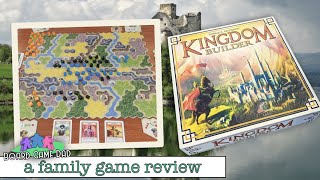



Kingdom Builder Deep Dive
What the Community Thinks About Kingdom Builder
Kingdom Builder has inspired passionate and divided opinions since its 2011 release. While some reviewers celebrate it as an underappreciated masterpiece, others find it frustrating. What unites these perspectives is recognition that the game captures something special, even if players disagree on whether that special quality is enough to make it a must-play. The game rewarded gameplay with a Spiel des Jahres win, cementing its place in the hobby's history, yet many players have cooled on it over time or found it never quite resonated.
Core Mechanics That Define Kingdom Builder
Tile Placement with Adjacency Constraints
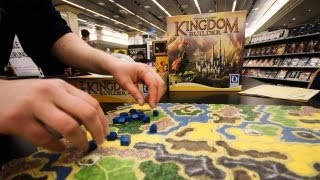
The core of Kingdom Builder is elegantly simple on its surface: draw a terrain card and place three settlements on hexes matching that terrain type. The strategic depth emerges from one constraint: whenever possible, new settlements must be placed adjacent to existing ones. This rule transforms the game from a simple tile placement exercise into a puzzle of spatial planning and board control. Reviewers praise how this single restriction creates meaningful decisions. Players must commit to building in certain regions early, closing off options but also securing territory. The tension comes from balancing expansion with the luck of card draws, forcing players to adapt when they cannot place settlements where they hoped.
Variable Powers and Location Abilities
Kingdom Builder rotates in different special powers through location tiles scattered across the map. These powers let players break rules, move settlements, or gain bonus actions. Each game uses a different subset of these abilities, dramatically changing what strategies work. Reviewers highlight how these powers create asymmetry and tactical depth. The uncertainty about which powers are available adds a planning puzzle to each game's setup. Some powers create satisfying engine-building moments, where players chain abilities together. However, reviewers also note that certain power combinations or their absence can make some games feel less engaging, a randomness issue that persists even among players who deeply enjoy the design.
The Kingdom Builder Experience
Satisfying Puzzle with Punishing Luck
Kingdom Builder walks a tension between elegant puzzle-solving and the frustration of luck-driven card draws. Reviewers describe sitting at the table knowing exactly where they want to build, only to flip a card for the wrong terrain, forcing them to adapt. This creates the "addictive" quality many reviewers mention: the desire to play again because maybe next time the cards will cooperate. When plans do come together, placing settlements in satisfying chains feels rewarding. When they do not, the game feels punishing. Some reviewers appreciate this tension as part of what makes the game compelling; others see it as a drawback that limits how often they want to return to it.
Accessible Gateway with Hidden Depth
Reviewers note that Kingdom Builder teaches quickly and plays in a reasonable timeframe, making it accessible to newer players. Yet beneath its simple rules lies surprising tactical complexity. New players focus on placing settlements wherever possible, while experienced players manipulate the board to block opponents and anticipate future scoring conditions. This layering lets the game work at multiple skill levels, though some reviewers point out that the abstract nature of scoring conditions can confuse younger players unfamiliar with variable victory points and spatial patterns.
What Makes Kingdom Builder Stand Out
Modular Board and Infinite Replayability
Kingdom Builder includes several double-sided board sections that can be mixed and matched, creating a different board every game. Combined with variable scoring objectives and rotating powers, each play of Kingdom Builder is mechanically distinct from the last. Reviewers emphasize this replayability as a major selling point. Players can return to the game expecting fresh strategic challenges because the terrain layout, available powers, and victory conditions will never be the same twice. This modularity also means expansions can introduce new board tiles and powers without exhausting the design space, keeping the game feeling fresh even after dozens of plays.
Interactive Blocking and Engagement
Kingdom Builder rewards players for getting in each other's way. Blocking key terrain from opponents, cutting off their expansion routes, and racing to secure valuable locations create natural conflict and player interaction. Reviewers appreciate how the game stays interactive throughout, as every player's turn influences what the next player can do. There is no downtime for analysis; the modular board and terrain constraints keep pacing brisk and engagement high, even with maximum player counts.
Potential Drawbacks
Randomness Can Override Strategy
The most consistent criticism across reviews concerns luck. Reviewers note that Kingdom Builder can punish poor card luck harshly. Sitting third in turn order, both players ahead of you might block the terrain you need before you draw it, then you flip the card you were counting on and it does not appear. Skilled players can mitigate this by keeping multiple expansion options open, but sometimes the board and card order conspire against any strategy. Reviewers who prioritize agency and player control find this frustrating. Those who enjoy the push-your-luck dynamic of games like Catan accept it as part of the design. The game's random setup and card draws ensure nobody feels completely trapped, but some reviewers would prefer tighter control.
Abstract Theme and Repetition After Many Plays
Kingdom Builder has no narrative or thematic hook. Settlements are abstract pieces on an abstract board, and scoring conditions are mechanical puzzle targets without flavor. Reviewers note this abstraction can feel dry compared to thematic games. Additionally, reviewers who have played Kingdom Builder 50 or 100+ times report a cooling effect. The game remains mechanically solid, but the initial addictiveness fades. Some powers fall out of favor, certain board configurations feel familiar, and the replayability advantage diminishes when players have seen hundreds of power combinations. The game does not become worse; it simply becomes less exciting after the honeymoon phase.
If You Enjoy Kingdom Builder
Players drawn to Kingdom Builder often gravitate toward other tile-placement games with variable setup like Carcassonne and Through the Desert. They appreciate games where spatial constraints and adjacency rules create strategic puzzles. Those who love the modular replayability may also enjoy Dominion, Donald X. Vaccarino's deck-building masterpiece, which inspired Kingdom Builder's variable components. Fans of abstract games with clean rulesets and high interactivity find kingdom-building satisfaction in other titles that reward player engagement and board manipulation. Kingdom Builder pairs well with expansion products, so players seeking deeper dives can explore the full catalog of additional powers and board sections published over the years.
What Reviewers Are Saying
"The game is addictive, and while I can't say I know the formula for making addictive games, I can tell you what the characteristics are that really work for this: one, it's really easy to teach to, set up, and start playing with anybody. Two, it's really modular, and the gameplay, the abilities, the board are going to be different every single time, which really lends itself well to oh man, let's play again."
— Board Game Dad
"As soon as you start realizing what the implications of adjacent if possible are, the strategic possibilities open up so broadly for you. Add on to that that you have these variable scoring conditions which have only become more interesting as more expansions have come out for the game. Kingdom Builder has this vibrance and allure to it that makes it just such an inviting game to play."
— The Cardboard Herald
"Kingdom Builder is an unsung hero of the tabletop gaming world. The variability in the scoring, the maps, and what tiles come out means that the first few games you start to learn how the game is played and plan accordingly. It's one of those games I think will not only always stay in my collection but I can't imagine it ever really dropping out of my top 20."
— All You Can Board